Shiga News – by Philbert Ono Rotating Header Image

Yasu

Golden Week festivals in Shiga

Kusatsu shukuba

April 29: Kusatsu Shukuba Matsuri celebrates Kusatsu's history as a stage town on the Nakasendo and Tokaido Roads. Numerous events and activities are held such as flea markets, street & stage performances, and Japanese dances. The main highlight is the Kusatsu Jidai Gyoretsu procession of people dressed in historical costumes from 11:30 am to 2:30 pm. Near JR Kusatsu Station.

Golden Week is Japan’s spring vacation from late April to early May with a string of national holidays. April 29 is Showa Day (set to April 30 this year since the 29th is Sun.), May 3 is Constitution Day, May 4 Greenery Day, and May 5 Children’s Day. This year’s calendar in 2012 can make it a nine-day holiday for the working folk if they only take off on two working days (May 1 and 2).

In Shiga, it is prime time for matsuri festivals. There are so many matsuri during this time that it took me at least 4 or 5 years to see most of them because many are held at the same time. You really have to decide which one to see. The festivals will be extra special this year because many GW festivals were canceled or postponed last year due to the 3/11 triple disasters.

Here are some of the GW matsuri I recommend seeing. A wide variety for sure. Click on the image to see more photos and information of the respective festival. Maps of the shrine locations, etc., are provided by the Map links.

kaizu rikishi

April 29: Kaizu Rikishi Matsuri Festival in Makino, Takashima.

April 29: Kaizu Rikishi Matsuri features men dressed as sumo wrestlers (rikishi) carrying two mikoshi portable shrines around their respective lakeside neighborhoods near JR Makino Station. They wear kesho mawashi ceremonial aprons. They jostle the mikoshi during the day from 1 pm to 3 pm, and then from 5 pm. At around 8 pm, they proceed to Kaizuten Jinja Shrine for the festival climax with lit torches. Be aware that the festival goes on until after 10 pm which may be past your last train home. Also, if you’re walking back to Makino Station from the shrine, be careful as part of the highway has no sidewalk. Bring a flashlight so the cars (and big trucks) can see you on the road at night. Otherwise, it’s very hazardous. See my video here. Map here.

hino matsuri

Hino Matsuri at Umamioka Watamuki Shrine. Click image to see more info and photos.

May 3: Hino Matsuri in Hino is the largest festival in eastern Shiga Prefecture and one of Shiga’s grandest float festivals. Sixteen ornate floats and three portable shrines are paraded through the streets and gather at Umamioka Watamuki Shrine amid festival music of flutes and taiko drums. It’s all day long from morning till late afternoon when the floats leave the shrine. The three portable shrines are taken across town to the Otabisho and back. Buses run from Hino Station to Umamioka Watamuki Shrine. If you have time, I also highly recommend taking the bus from Hino Station to Shakunage Gorge (しゃくなげ渓) for a relaxing nature stroll in a gorge adorned with shakunage (rhododendron), Hino’s official flower. See my video here. Map here.

Kenketo matsuri

May 3: Kenketo Odori at Takigi Jinja Shrine (龍樹神社).

May 3: Kenketo Odori at Takigi Jinja Shrine (龍樹神社) in Tsuchiyama, Koka is a dance performed by eight boys aged 7 to 12. The dance was originally started to ward off calamities. The boys wear tall peacock feathers on their heads. The delightful dance is a National Intangible Folk Cultural Property. From Kibukawa Station (JR Kusatsu Line and Ohmi Railways), catch the Aikuru Bus and get off at Higashi Maeno. The shrine is a short walk toward the river. Also see my video at YouTube. Map here.

Kenketo ryuo

May 3: Kenketo Festival at Suginoki Shrine in Yamanoue, Ryuo town, Shiga. Click image to see more info and photos.

May 3: The Kenketo Festival is held at few Shinto shrines in Ryuo and neighboring Higashi-Omi. It is mainly a naginata (pole sword) dance and procession by boys dressed in costume. They travel to these different shrines and perform, but the main venue is Suginoki Shrine in Yamanoue, Ryuo town, Shiga. Also see my YouTube Video here. Map here.

Shichikawa matsuri

May 4: Shichikawa Matsuri in Takashima. Click image to see more info and photos.

May 4: The Shichikawa Matsuri at Oarahiko Shrine in Takashima features a procession of yakko-furi laborers carrying archery targets (photo), yabusame horse runs, and a portable shrine procession. This is the largest festival in the Kosei area (western Shiga) and the only one featuring horses in Kosei. Attracts a good crowd. The shrine is near Shin-Asahi Station (JR Kosei Line), but renting a bicycle at the station is recommended. See my video here. Map here.

Omizuo matsuri

May 4: Omizo Matsuri in Takashima. Click image to see more info and photos.

May 4: Omizo Matsuri has five ornate floats pulled around the neighborhood of JR Omi-Takashima Station (JR Kosei Line). The festival eve on May 3 has the floats festooned with paper lanterns as they are pulled around in the evening. On May 4, they pull the floats around during the day and gather at Hiyoshi Jinja Shrine. When entering the shrine, they dramatically run while pulling the float. Also see my video at YouTube. Map here.

 Iba-no-saka-kudashi Matsuri

May 4: Iba-no-saka-kudashi Matsuri in Higashi-Omi near Notogawa Station.

May 4: Iba-no-saka-kudashi Matsuri held by Sanposan Shrine in Higashi-Omi, Shiga Prefecture is an unusual festival with three portable shrines hauled down a steep mountain (Kinugasa-yama) for about 500 meters. It doesn’t sound that far, but it’s all steep, rocky terrain. The mikoshi bearers can easily get injured. This is also one of the hardest festivals to view. You have to climb up this steep, rocky mountain and perch on a ledge. One earthquake and you can fall. The locals have an easy time climbing up the mountain though, even with kids. See my video here. Map here.

Shinoda hanabi

May 4: Shinoda Hanabi in Omi-Hachiman. Intangible Folk Cultural Property.

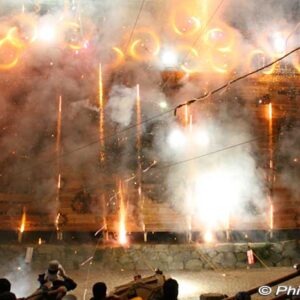
May 4: Shinoda Hanabi is a super spectacular and artistic fireworks display at Shinoda Shrine in Omi-Hachiman. Torch fireworks, Niagara Falls, and panel-type fireworks provide an explosive, close-up experience. For people who cannot wait till summer to see fireworks. Beware of a forest of camera tripods and photographers in front. Get there early if you want to take good shots. Not recommended if you don’t like sudden and loud explosions. Intangible Folk Cultural Property. Walk from Omi-Hachiman Station. Map here.

misaki

May 4: Misaki Shrine Fire Festival in Aisho, near JR Inae Station.

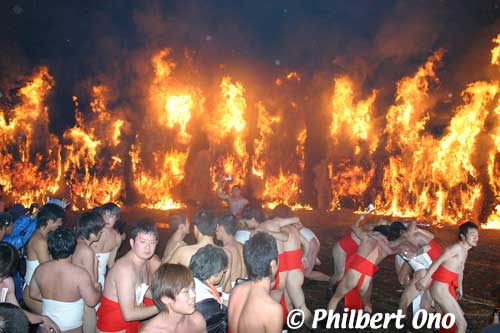
May 4: The Misaki Shrine Fire Festival in Aisho climaxes with a towering clump of bamboo set afire to create a fire column well over 10 meters high. It starts at 7:30 pm when people carry 2-meter long torches from their homes to the shrine. A taiko drum is also carried and beaten. Very dramatic (no marshmallows). The shrine is a 20-min. walk from JR Inae Station. See my video here. Map here.

Hyozu matsuri

May 5: Hyozu Matsuri in Yasu.

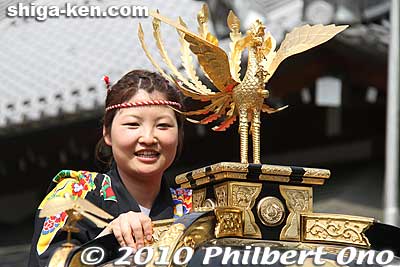
May 5: Hyozu Matsuri is Shiga’s preeminent mikoshi (portable shrine) festival with 35 mikoshi paraded around Hyozu Taisha Shrine in Yasu. Two of them are carried only by spunky young women called “Ayame,” meaning iris flowers. Very colorful and lively festival as they frequently stop, yell, and hold up the mikoshi high in the air. Beware that it can be dusty on the gravel paths. Other mikoshi are carried by children and men. See my video here. Map here.

Sushikiri matsuri

May 5: Sushi-kiri Matsuri at Shimoniikawa Shrine in Moriyama.

May 5: The Sushi-kiri Matsuri sushi-cutting festival at Shimoniikawa Shrine in Moriyama has two young lads very stylistically and meticulously cutting funa-zushi fermented fish (crucian carp native to Lake Biwa) as an offering. All throughout, they are verbally heckled by some men. Not visually spectacular, but unusual and intriguing. The best part is at the end when they give free morsels of funa-zushi to spectators. Shiga’s best-known delicacy from Lake Biwa. Also see my YouTube video here. Map here.

naginata moriyama

May 5: Naginata Odori Matsuri at Azu Jinja Shrine in Moriyama.

May 5: Naginata Odori Matsuri at Azu Jinja Shrine in Moriyama consists of colorful dances and music by children, taiko drumming, a naginata dance and acrobatics by boys using a pole sword. They conduct a roundtrip procession from Azu Shrine to Azu Wakamiya Shrine. A great variety of eye candy for Children’s Day. Also see my YouTube video here. Map here.

Namura sekku

May 5: Sekku Matsuri Festival bull's eye at Namura Shrine in Ryuo. Click image to see more info and photos.

May 5: Sekku Matsuri Festival at Namura Shrine in Ryuo is for horse lovers. After children carry around a portable shrine, yabusame horseback archery is held in front of the shrine gate. Several horses make their runs, but only one of them shoots arrows at the targets. A good excuse to visit this shrine noted for its elegant-looking, thatched-roof main gate and Nishi Honden hall which is a National Treasure. The shrine’s architecture is from the Kamakura Period. See my video here. Map here.

Golden Week 2010 in Shiga

We saw fine weather during Golden Week in Shiga from late April to early May 2010. I went to see a slew of festivals in Shiga during this time. I traveled to Maibara, Ryuo, Tsuchiyama (Koka), Takashima, Yasu, and Kora. I’m trying to see all the major Golden Week festivals in Shiga. The problem is, many of them are held on the same day and at the same time. It will still take me a few more years to see them all, but after this GW, I can say that I’ve see more than half of them.

Here’s what I saw during Golden Week 2010 in Shiga Prefecture (in chronological order):

Photos: Sakata Shinmeigu Yakko-buri Procession 坂田神明宮の蹴り奴振り

Photos: Yuge Fire Festival 弓削の火祭り

Photos: Kenketo Matsuri Festival and Odori Dance ケンケト祭・踊り

Photos: Omizo Matsuri Festival 2010 大溝祭

Photos: Shichikawa Matsuri Festival 2010 七川祭

Photos: Hyozu Matsuri Festival 兵主祭

Photos: Takatora Summit in Kora 2010 高虎サミットin甲良

Attn: JR Tokaido and Kosei Line users

On March 13, 2010, Japan Railways implemented revised train schedules. Note that there are now fewer train runs on the JR Tokaido and Kosei Lines in Shiga and Kyoto. JR has eliminated train runs which saw low ridership. If you use these two lines, you should refer to the revised train schedules and trash the old one.

On the Tokaido Line, the last train from Kyoto Station to Yasu Station now leaves at 12:34 am instead of 12:58 am. In the mornings and evenings of Sundays and national holidays, there is one less train run going from Yasu to Maibara and from Maibara to Yasu. (So four fewer train runs on Sundays and holidays.)

As for the Kosei Line between Kyoto and Katata Stations, the four train runs per hour between 10 am and 2 pm on weekdays will be reduced to only three train runs per hour in both directions. Between Kyoto and Omi-Maiko Stations, there will be one less train run in both directions in the evenings during both weekdays, Sundays, and holidays.

The Kusatsu Line and Hokuriku Line are not affected by cuts in train runs (although the train schedule may be different from before).

Spo-rec Shiga 2008

Jamie and Megan Thompson sang “Lake Biwa Rowing Song” (Biwako Shuko no Uta) at Spo-Rec Shiga on Oct. 18, 2008 at Kibogaoka Park in Yasu, Shiga Prefecture. The performance was part of the side entertainment on the opening day of the sports festival. The MC was Chiho Ono, radio personality at e-radio (FM Shiga) which organized this stage entertainment.

Afterward, I went to see the Sports Recreation event at Kibogaoka Park in Yasu. They had the opening ceremony. Many people were there from all 47 prefectures and South Korea too. 

It’s a great event and Kibogaoka Park is a perfect place. Many food booths, health/sports booths, stage entertainment, and Caffee. There are new sports which you can try out too. Lots of things for the kids. I highly recommend visiting Kibogaoka Park during Oct. 19-21.

Photos: http://photoguide.jp/pix/displayimage.php?album=718

Event notice: Sports Recreation Shiga 2008

The Sports Recreation event will be held in Shiga during Oct. 18-21, 2008. On the first day Oct. 18 at Kibogaoka Park in Yasu, there will be some entertainment on a side stage called スポレク「夢」ステージ near the Nishi-guchi west gate during 9:30 am to 11:15 am. 

During this entertainment time, we will appear and sing “Lake Biwa Rowing Song”(Biwako Shuko no Uta in English) on this outdoor Yume stage at around 10:20 am. Jamie and Megan Thompson will sing the song. If you have time, please come down to see us. 

On the same day, the Spo-rec opening ceremony will start on the center stage at 12:30 pm. From JR Yasu Station, there will be free shuttle buses going to the park every 10-15 min. Note that if the weather is bad, the show will be canceled. Light rain will be no problem though. 

http://www.pref.shiga.jp/edu/sporec/koso.html 

スポレクの開会式の日、10月18日(土)に希望が丘文化公園内に「夢」ステージで色々な団体が9:30-11:20 amに出演します。 私たちは、10:20ごろに出演して「琵琶湖周航の歌」英語版を披露いたします。歌うのはジェイミーとメゲン・トンプソンの双子姉妹。 

「夢」ステージは、希望が丘文化公園の西口の近くにあります(池の前)。そして中央ステージで開会式が12:30ごろ始まります。野洲駅から無料バスあります。 

会場: 滋賀県立希望が丘文化公園内 スポレク滋賀2008会場内 県民ステージ) 
主催: エフエム滋賀 
Tel: 077−527−0814

Rice-planting festivals in Yasu and Taga

I went to see two rice-planting festivals in Shiga, for the first time.

The first one was in Yasu on May 25, 2008. It’s held on the fourth Sunday in May in a sacred rice paddy near Mikami Shrine. Women and men in colorful costumes plant rice seedlings accompanied by singing, taiko drumming, and dancing. Started at 10 am with a Shinto ceremony, then the rice planting was held from 10:30 am to 11 am. The rice paddy is called Yuki Saiden (悠紀斎田記念田) which was the used to produce the rice used for the Showa Emperor Hirohito’s accession to the throne in 1928. It was a scenic area with Mt. Mikami in the background. Near Yamade-mae bus stop near the foot of Mt. Mikami. More photos here.


 Yasu rice-planting festival

The second rice-planting festival was at Taga Taisha Shrine on June 1, 2008. It was more elaborate than at Yasu, with stage performances of taiko drumming and sacred dances. But they required a 500 yen donation to watch the rice-planting. It started at 1:15 pm and ended at 3 pm. The rice paddies were left unfinished though. More photos here .

 Taga Taisha rice-planting

Climbing Mt. Mikami (Omi-Fuji)

Mt. Mikami is nicknamed Omi-Fuji because it has a conical shape like Fuji-san. I recently climbed this mountain. Only 432 meters high. 

It was a pretty easy climb. There are two hiking trails, Omote and Ura. The Ura trail is less steep but takes longer to reach the top. The Omote trail is steeper and goes almost straight up the mountain. I went on the Ura path. 

It took me 90 min. to reach the top. I took my time taking pictures, etc. The mountain has a thick forest. The view from the top is nice, but you can see in only one direction. 

I went down the mountain on the opposite side and reached Karyoku Koen 花緑公園 and Kibogaoka Park. 

From Yasu Station, it’s a short bus ride to the entrance to the hiking trail (get off at 山出前). Not so many buses run from the station though. 

Here are my pictures of my hike: 
http://photoguide.jp/pix/thumbnails.php?album=652