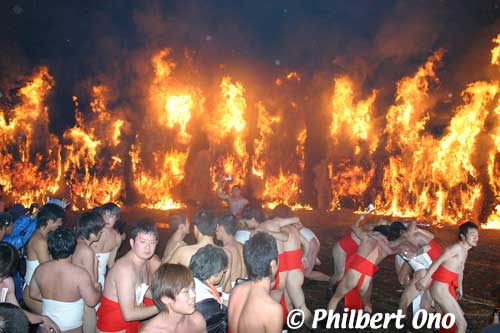
On May 1, 2011, I went to see the Aburahi Matsuri (油日祭り・奴振り) in Koka, Shiga, near Aburahi Station on the JR Kusatsu Line. The festival is held every year, but the yakko-furi procession is held only once every five years. And it was held this year. They walked along a 9-km route in Aburahi. The performance at Aburahi Shrine was the highlight. Here’s the video I took:
Koka
More spring festivals in Shiga
During this rainy season, I’m staying at home to sort through the thousands of photos I took in Shiga during spring. Here are a few more festivals in Shiga which I photographed during spring.
Sanno Matsuri held by Hiyoshi Taisha in Otsu (Part 1 and 2):
Sanno Matsuri photos: Sanno-sai Festival 山王祭
Minakuchi Hikiyama Matsuri is a festival of floats paraded during April 19-20:
Minakuchi Hikiyama Matsuri photos here.
Kenketo Matsuri in Ryuo (Photos here):
Naginata Odori in Moriyama (Photos here):
Taga Matsuri (Photos here):
I have more spring festivals to show and a full update will be posted soon on my home page (shiga-ken.com).
Tsuchiyama Saio Princess Procession
On March 29, 2009, I saw the Saio Princess Procession in Tsuchiyama (あいの土山斎王群行). It was very nice. The Saio princess was an unmarried, young Imperial princess, often the Emperor’s daughter, who was appointed (by divination) to be the High Priestess of Ise Grand Shrines in Mie Prefecture from the 7th to 14th centuries. Whenever there was a new emperor, there would be a new Saio princess appointed. She would travel in a procession from Kyoto to Ise, taking 5 nights and 6 days. She lodged in a special temporary palace (disassembled after she lodged in it) called the Tongu, and one Tongu was in Tsuchiyama. So this festival reenacts this procession. It’s also a continuation of Kyoto’s famous Aoi Matsuri.
I shot both video and stills:
Koka article in Japan Times
The March 8, 2009 edition of The Japan Times had a travel article about the city of Koka. It featured Shigaraki, Miho Museum, and ninja. Unfortunately, it did not mention the shukuba towns of Tsuchiyama and Minakuchi.
http://search.japantimes.co.jp/cgi-bin/fv20090308a1.html
But I’m happy to see another Shiga-related article in the JT in less than a month since the last one about Azuchi:
http://search.japantimes.co.jp/cgi-bin/fv20090215a1.html
Shiga is slowly getting more media attention.
Koka Ninja House (Yashiki)

I finally visited the Koka Ninja House 甲賀流忍術屋敷. I highly recommend taking your foreign friends here. Most foreigners are very interested in ninja. The Koga (Koka) ninja and Iga ninja are the two most famous ninja, but most foreigners do not know that Koga is in Shiga. We have to tell them it’s in Shiga.
The Koka Ninja House is unique because it is still in its original location. Other ninja houses in Japan (like in Iga-Ueno) were moved to the present location. Unfortunately, there’s no bus stop near the Ninja House. You have to go by car or taxi from Konan Station. Actor Harrison Ford visited this ninja house in 2000.
Photos here:
http://photoguide.jp/pix/thumbnails.php?album=687
I also visited Tsuchiyama-juku. I have now visited all of the shukuba post towns in Shiga along the old Tokaido and Nakasendo Roads. Tsuchiyama still has the original Honjin.
Photos here:
http://photoguide.jp/pix/thumbnails.php?album=689
I also saw the new JR Koka Station. I think it is one of Shiga’s best train stations (along with Nagahama and Notogawa Stations). It has huge murals of ninja.
http://photoguide.jp/pix/thumbnails.php?album=688
Koka has so many things, it will take me some time to see everything.
Koka’s English Web site
Koka finally has an English Web site:
http://www.city.koka.shiga.jp/english/index.html
It’s not bad. However, one common error is “Koka City.” It should just be “Koka.” If you say “Koka City,” it means “City” is part of the city’s name. The city’s name is “Koka,” not “Koka City” (=甲賀シティ市).
For example, in the US, we have “Kansas City” and “New York City.” In both cases, “City” is part of the city’s name.
In Japan, we don’t have any city names where “City” is part of the name. We can say “city of Koka.” And for Japanese cities whose name is the same as the prefecture, we can say for example, Niigata city, Saitama city, etc., to avoid confusionwith the prefecture’s name. In such cases, “city” should not be capitalized.
Emperor and Empress visit Shiga
Met with Koka International Society
![]()
Today I went to Koka and participated in the Koka International Society’s (KIS) Kokusai Koryu Salon gathering 甲賀市国際交流協 国際交流サロン. It was a special occasion because nine people from Koka’s sister cities in Michigan came. It was a chance for them to meet and talk with local Japanese folks. They arrived in Shiga on July 26 and really enjoyed their stay, especially since they stayed with host families in Koka.
I also gave all the Michigan visitors a free copy of my Lake Biwa Rowing Song CD and introduced the song in English. It was my first time to give the CD to people from Michigan. So finally, 琵琶湖周航の歌 英語版、海を渡る!
I enjoyed meeting the friendly staff of KIS. Their office is very near Minakuchi-Jonan Station on Ohmi Railways. Koka is the farthest place from where I am (Maibara near Ibuki) so I don’t go there very often. When I do go again, it’s nice to know people to visit.
http://www.kis5.org/
Tsuchiyama, Koka and Shinagawa, Tokyo
Last weekend, I went to visit Shinagawa-juku 品川宿 in Shinagawa-ku, Tokyo for the first time. Shinagawa was the first post town 宿場 on the Tokaido Road. Shinagawa-juku is near Shinagawa Station.
In Shiga, there are many shukuba-machi like Kusatsu , Minakuchi , and Samegai because we have the Nakasendo and Tokaido passing through. I’ve visited most of them and most of them have some shukuba-like traditional buildings such as the impressive Honjin guesthouse in Kusatsu.
So when I visited Shinagawa-juku, I was disappointed to see that there was nothing traditional. Everything was very modern and it looks like any ordinary street in Japan. But the people in Shinagawa-juku are very proud about the history of Shinagawa-juku and they have a tourist information office near the entrance of the Tokaido Road. They also have a walking map for Shinagawa-juku and signs in Japanese (sometimes English too) explaining about various historical spots in Shinagawa-juku.
There are also several pine trees along the old Tokaido Road in Shinagawa-juku. They were all donated to Shinagawa-juku from other shukuba-machi on the Tokaido Road. And one of the pine trees came from Tsuchiyama in Koka! The other pine trees came from Oiso, Hamamatsu, and Mishima. Tsuchiyama is the 49th post town on the Tokaido (there are 53 post towns in total).
The Tsuchiyama pine tree is at the site of Shinagawa-juku’s Honjin (see photo) which is now an empty space. (Looks very lonely.) I’ve never visited Tsuchiyama. Hope to go there soon.
See photos of Shinagawa-juku here.
Vocabulary:
Tokaido 東海道 – Major route which connected Edo (Tokyo) and Kyoto during the Edo Period. Before train lines, people traveled on foot or horse. It took days to reach the destination so the travelers required lodging along the way. The Tokaido had 53 towns or stages called shukuba which provided lodging, food, and entertainment.
Shukuba 宿場 – Post town or stage town. Since Shiga is next to Kyoto with both the Nakasendo and Tokaido Roads passing through, there are many shukuba-machi towns. Nakasendo in Shiga includesKashiwabara , Samegai, Toriimoto , Musa , Moriyama , Kusatsu, and Otsu. And Tokaido has Tsuchiyama, Minakuchi, Ishibe ,Kusatsu, and Otsu. The Hokkoku Kaido which goes to the Hokuriku region also has Kinomoto as a post town.
Honjin 本陣 – The main guesthouse in a shukuba for VIPs like daimyo lords, Emperors, etc. Luxurious accomodations on a large plot. There is also the Waki-Honjin which is a second Honjin. In Shiga, the Kusatsu Honjin is the finest example.