Archive for Omi-Hachiman

Shiga’s Top 10 festivals in April-May

Nagahama Hikiyama Matsuri

Nagahama Hikiyama Matsuri, April 15

April is a great month. Soon after the onslaught of cherry blossoms, we have an onslaught of festivals (matsuri). This is the time to go out and celebrate the coming of spring, pray for good harvests, and see the traditional splendor of Shiga. The highest number of matsuri are held during these two months, especially during the string of national holidays in late April and early May called Golden Week. During the Golden Week holidays, Shiga has multiple festivals on the same day.

To make it easier to decide which ones to see, I’ve picked Shiga Prefecture’s Top 10 Festivals for April-May. I ranked them based on scale (number of participants, length of festival, etc.), grandioseness, cultural importance/significance, cultural perpetuation and practice for younger generations, uniqueness, and enjoyment by spectators.

1. Nagahama Hikiyama Matsuri, Nagahama Hachiman Shrine, Nagahama, April 15
Deciding Shiga’s No. 1 spring festival was a toss-up between the Nagahama Hikiyama Matsuri and Sanno-sai (No. 2 below). But I gave the edge to the Hikiyama Matsuri because it centers on passing on a traditional art to kids. Young boys undergo months-long rigorous training in voice and acting to put on a kabuki play during the festival. The festival has four ornate floats (hikiyama) with a small stage for authentic kabuki plays performed by grade school boys. Even if you cannot understand what they are saying, just looking at their makeup, costumes, and acting will delight. The kabuki performances start at the shrine at 10 am. Then the floats are pulled to other spots in central Nagahama where the boys perform again. By the evening, all the floats gather at the Otabisho across town for more revelry until 9:30 pm when it ends. Although it gets crowded in front of the float, you can usually see the kabuki actors because they are elevated on the float. My video | Google Map

Sanno-sai Festival, Hiyoshi Taisha

2. Sanno-sai Festival, Hiyoshi Taisha Shrine, Otsu, April 12-15
Held by Hiyoshi Taisha Shrine in western Otsu at the foot of Mt. Hiei. This is perhaps Shiga Prefecture’s largest festival in terms of participants and the number of events. Held over a few days, you can see diverse events and rituals like an evening torch procession, thunderous rocking of portable shrines, and even a boat procession on the lake. One thing I like is the joint cooperation of Shinto and Buddhist priests in the ceremonies. You can see and hear both Shinto priests and Tendai Buddhist priests from Enryakuji temple praying or chanting at the same ceremony during the festival. So it’s not entirely a Shinto festival. Hiyoshi Taisha Shrine was historically affiliated with Enryakuji temple until the state required that Shinto and Buddhism be separate organizations. It’s up to you to decide which day and what time to see the festival. Click on the link above to see my photos of the festival (taken on April 13-15) to decide what you want to see. I saw and photographed all the major festival events except on the first day when they brought down the portable shrine from a low mountain. If it’s one festival that wore me out after three days, it’s this one. My video | Google Map

3. Niu Chawan Matsuri, Niu Shrine, Yogo (Nagahama), once every several years on May 4
Another of my all-time favorite festivals. They have three wooden floats topped with lofty “balancing act” chawan bowl decorations. They also hold beautiful sacred dances by boys dressed as girls. A procession of colorful flower umbrella dancers also provides a colorful accent to the festival. It’s held deep in a mountain valley of Yogo in northern Nagahama so the whole area is lush and peaceful. The only problem is that the festival is held only once every 5-6 years. The last time it was held was in 2009. According to rumors, the festival will be held in May 2014, next year. My video | Google Map

Hino Matsuri floats at Umamioka Watamuki Shrine.

4. Hino Matsuri, Hino, May 3
Shiga has a good number of float festivals, but the grandest one in spring is the Hino Matsuri. It’s grand because they have as many as 16 ornate floats with large wooden wheels that they pull through the main streets of Hino town. Each float belongs to a specific neighborhood in Hino and they are decorated with elaborate tapestries, paper lanterns, and a homemade paper sculpture on the roof that changes every year. They also have side attractions like a portable shrine procession and ceremonies featuring a sacred dance. From the morning, the floats are pulled along the streets to gather at Umamioka Watamuki Shrine, the center of the action. They play festival music and show off their floats. If you have time, you should also visit Shakunage Gorge, famous for rhododendron growing in a scenic gorge. There are lovely nature walking paths. Buses run from Hino Station. My video | Google Map

Higashi-Omi Giant Kite Festival held on the last Sun. in May.

5. Higashi-Omi Giant Kite Festival (formerly Yokaichi Giant Kite Festival) (Odako Matsuri), Higashi-Omi, May 26 (last Sun. in May)
The giant kite, made of washi paper and a bamboo frame, measures about 13 meters by 12 meters (size of 100 tatami mats) and weighs 700 kg. It is a work of art with a distinct shape, cutouts, and paint job featuring a traditional design of a large kanji character and twin animals. The design is selected from entries from the public and a new giant kite with a new design is made every three years. The public is also invited to help build the new kite every three years during the summer. On the festival day, the kite is flown on a riverbank a few times. It usually doesn’t stay aloft for very long unless there are strong winds. It can even crash so they clear the whole area whenever they fly the kite. You can also sign up to pull the kite. I did it once and they run at full speed. Kind of scary because if you trip and fall, you might get trampled. From 2013, the festival site will be at the Fureai Undo Park in Notogawa. Free shuttle buses will run from Notogawa Station. After (or before) the festival, be sure to check out the Odako Kaikan Giant Kite museum. Shuttle buses run to the museum. My video | Google Map

Kenketo Matsuri in Tsuchiyama, Koka.

6. Kenketo Matsuri, Koka (Tsuchiyama), May 3
Held at Takigi Jinja Shrine (龍樹神社), Kenketo Odori is a dance performed by eight boys aged 7 to 12. First there’s a procession to the shrine, and the boys start dancing at the shrine at around 2 pm. The dance was originally started to ward off calamities. The boys wear tall peacock feathers on their heads. The dance is a National Intangible Folk Cultural Property. The festival has an interesting twist when the crowd rushes to the man (sometimes knocking him down) holding a flower basket to take all the flowers. To get to the shrine, get off Kibukawa Station (JR Kusatsu Line and Ohmi Railways) and catch the Aikuru Bus. Get off at Higashi Maeno. The shrine is a short walk toward the river. My video | Google Map

Shichikawa Matsuri, Takashima

Shichikawa Matsuri’s yakko-furi procession.

7. Shichikawa Matsuri, Takashima, May 4
The largest festival in western Shiga is held at Oarahiko Shrine. It features a yakko-furi (samurai laborers) procession, yabusame horse runs, and portable shrine procession. The shrine is nearest to Shin-Asahi Station (JR Kosei Line). If it’s too far to walk, you can rent a bicycle at the train station. My video | Google Map

Ayame girls at Hyozu Matsuri.

8. Hyozu Matsuri, Hyozu Taisha Shrine, Yasu, May 5
I call this Shiga’s best portable shrine festival. Over 35 portable srhines (mikoshi) are carried around Hyozu Taisha Shrine in a very lively and gregarious style. Two of the mikoshi are carried by all women called “Ayame,” meaning iris flowers. They wear colorful happi coats to carry the mikoshi. The only thing is that the gravel path can kick up dust. Best to watch the festival from upwind. A few foreigners also participate. It starts in the morning and ends in mid-afternoon.  My video | Google Map

9. Hachiman Matsuri, Himure Hachimangu Shrine, Omi-Hachiman, April 14
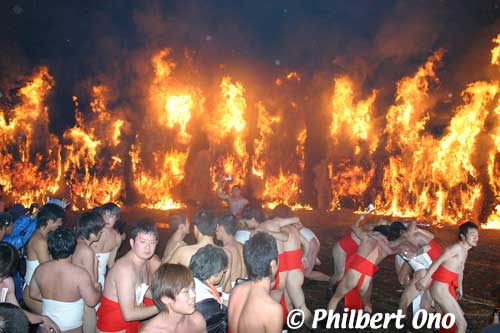
Shiga’s biggest fire festival featuring several tall straw torches (as high as 10 meters) that are lit from 8 pm. If you have time during the day, you should come and look at the torches which are great works of art. The festival is prayer for an abundant harvest. They light the torches one by one. This festival is usually billed together with the Sagicho Matsuri another fire festival held in March. Sagicho Matsuri is still my favorite festival in Omi-Hachiman. My video | Google Map

10. Taga Matsuri, Taga Taisha Shrine, Taga, April 22
If you like horses and traditional costumes, see this festival. They have a long procession featuring Shinto priests, children in costume, women warriors, and more people on 40 horses. A total of 500 people are in the procession. There is a morning procession leaving Taga Taisha at 10:30 am for Totonomiya Shrine deep in Taga’s countryside, and an afternoon (main) procession leaving Taga Taisha at 2 pm for the Otabisho, a short distance away from Taga Taisha. My video | Google Map

For other spring festivals in Shiga, see my previous posts: April 2012 | May 2011 | May 2010 | 2009 Chawan Matsuri

Shiga’s Top 5 cherry blossom spots

Hikone Castle, Shiga’s No. 1 cherry blossom spot.

Cherry blossoms are blooming earlier than usual this year. We’ve been having warm days during the first half of March. According to the cherry blossom forecast, the flowers should be in full bloom in Shiga during the second week of April. Note that they bloom later in northern Shiga (Takashima and Nagahama) than in southern Shiga (Otsu). This year I’ve decided to rank Shiga’s top cherry blossom spots. Here are my Top 5 favorite sakura spots in Shiga (click on the links or image to see more photos):

1. Hikone Castle – Coming at No. 1 is Hikone Castle. Although Hikone Castle is not one of the 100 Famous Cherry Blossom Spots of Japan (according to the Japan Cherry Blossom Association, I think it’s Shiga’s prettiest and most photogenic. It has an awful lot of cherry blossom trees almost everywhere amid the dramatic backdrop of the castle, white walls, and moats. I found so many varied views and great camera angles for shooting cherry blossoms here. You can see cherries on the big stone walls, along the moats, and next to the main castle tower. Culturally and historically, cherry blossoms best match a castle (especially one that is a National Treasure, another reason why I rank it No. 1), a symbol of the samurai whose life was as fleeting as the sakura. Hikone Castle is easily accessible from Hikone Station. Google map.

Kaizu-Osaki is nice but watch out for the cars.

2. Kaizu-Osaki, Takashima - Kaizu-Osaki has cherry trees lining the northern shore of Lake Biwa for a few kilometers. The blue lake water and Chikubushima island provide a very Shiga-esque backdrop for the cherries. It’s one of Japan’s 100 Famous Cherry Blossom Spots, and I would rank it as Shiga’s No. 1 sakura spot if it weren’t for the hazardous viewing conditions. Kaizu-Osaki has a narrow and hazardous lakeshore road (with no sidewalk) right next to the shoreline trees. During the peak period, there are just too many cars passing by, squeezing out pedestrians and polluting the air. There is a short pedestrian path and small park at the beginning if you go from Makino Station, but it doesn’t go to the main part of the trees. Since there is no sidewalk and you are walking on the road, you always have to be on guard for cars. Not recommended for families with young kids, especially on weekends. Also, the tunnels are dark and very narrow (no sidewalks). Bring a flashlight so the cars can see you walking or riding your bicycle inside the tunnel. If you have a car, note that there is very little parking. Shuttle buses run infrequently from train stations (most people walk from Makino Station). I recommend renting a bicycle at Makino Station (at the tourist info office) and cycling to Kaizu-Osaki. If you have the time and energy, bicycling from Makino Station to Nagahara Station (or vice versa) along the lake would be very scenic. You can return the bicycle at either station. And oh, beware of wild monkeys. Best not to carry a plastic bag, etc., that the monkeys may think contains food. Google Map

View from top of Nagahama Castle.

3. Nagahama Castle and Hokoen Park
Another photogenic backdrop with a huge cluster of cherry blossoms. Be sure to go up to the castle tower’s lookout deck (admission charged to enter the castle museum) to see the cherry blossoms surrounding the castle. Breathtaking. One of Japan’s 100 Famous Cherry Blossom Spots (there’s a monument saying so) and a major spot for hanami flower-viewing picnics. They have areas for picnicking as well as areas to just stroll under the cherries. Nagahama Castle is in the lakeside Hokoen Park near Nagahama Station. Google Map

Miidera’s Kondo main hall (National Treasure) and sakura.

4. Miidera temple and Biwako Canal, Otsu
There’s a great synergy between Biwako (Lake Biwa) Canal and Miidera temple during cherry blossom season. Biwako Canal supplies water from Lake Biwa to Kyoto. From Miidera Station (Keihan Line), you can’t miss it. It’s lined with many cherry trees, but it’s fenced off so it’s see but don’t touch. You’d think that they should allow rowboating in the canal when the flowers are in bloom. But if you look closely, you will notice a pretty fast current which would be dangerous for rowers. In the old days about a century ago after the canal was built, they had boats going all the way through canal to Kyoto. After walking along the canal, turn right and walk to the sprawling Miidera temple. They have cherry trees here and there providing a great accent to the old temple buildings (including a few National Treasures). There’s also a great lookout point on a hill giving great views of Otsu (concrete jungle) and the lake. They also light up the trees at night as they do at Biwako Canal. Beautiful and serene. Google Map

Hachiman-bori canal.

5. Hachiman-bori, Omi-Hachiman – Hachiman-bori canal has a long canopy of sakura trees along this scenic moat. The moat and white-walled traditional buildings make it photogenic, fit for shooting a samurai movie. It’s not so crowded either so you can enjoy a laid-back atmosphere while walking on a nice sidewalk or path along the moat. There are also moat boat rides starting near the Kawara Tile Museum. After seeing the flowers, you have the option to see numerous other nearby sights such as Hachiman-yama (via ropeway), Himure Hachimangu Shrine, Kawara Roof Tile Museum, Hakuunkan, Omi-shonin merchant homes on Shinmachi-dori, and buildings by William Merrell Vories. There is much more than just cherry blossoms which is my reason to include Hachiman-bori among the Top Five. Google Map

So, the places above are where I would show a first-time visitor wanting to see cherry blossoms in Shiga. I selected them based on Shiga’s unique beauty or scenery, easy accessibility, and sightseeing value.

To see the current blooming condition, see the Weather News Sakura page for Shiga. Starting with brown that indicates buds, the markers show warmer colors until red (full bloom) indicating how far the flowers have bloomed right now.

This is off-topic, but if you really love cherry blossoms, I highly recommend visiting the Tohoku region (Fukushima, Yamagata, Miyagi, Iwate, etc.). The cherry trees there are huge and look very distinguished, like giant bonsai. The tree trunks are really thick and they make the skinny cherry trees in Tokyo, Shiga, Kyoto, etc., look like baby trees.

Enjoy the spring.

Essential Vocabulary

  • sakura さくら or 桜 - Cherry blossom and Japan’s national symbol and flower. By far, it is the most celebrated flower in Japan.
  • tsubomi つぼみ – Flower buds.
  • shichibu-zaki 七分咲き – Cherry blossoms in 70% bloom which is right before they reach full bloom. News reports consider 80% bloom to be full bloom (mankai).
  • sakura zensen 桜前線 – Cherry blossom front as they bloom across Japan from Okinawa to Hokkaido.
  • kaika 開花 – Flowers started blooming. This is about a week before the tree reaches full bloom.
  • mankai 満開 – Full bloom. You will hear this on the news often.
  • hayasaki 早咲き – Early-blooming flowers. A few varieties of cherry blossoms bloom earlier than usual.
  • hanami or ohanami 花見 – Flower-viewing picnic (often with alcohol) under the cherry blossoms at a park. The most common way to celebrate spring under the flowers and commonly seen in the news. Hanami picnics are usually not allowed in shrines and temples.
  • sakura matsuri さくらまつり or 桜祭り- Cherry blossom festival. Not a religious festival, but can take the form of various events and stage entertainment.
  • Somei Yoshino 染井吉野 - The most common and coveted species of cherry blossoms whose light pink (almost white) flowers bloom in fluffy bunches on the tree.
  • yo-zakura 夜桜 – Cherry blossoms lit up at night. Some temples and parks light up the flowers at night.
  • shidare-zakura しだれ桜 or 枝垂桜 - Weeping cherry blossoms with long, hanging branches of flowers.
  • Sakura Meisho さくら名所 – Famous cherry blossom spot. It is most often a castle, public park, garden, shrine/temple, or riverside.
  • Sakura, Sakura さくら さくら- Famous folk song about cherry blossoms.
  • chiru, chitta 散る、散った – Flowers fell off the tree. Happens a few days after full bloom when the petals fall like pink snow.
  • sakura fubuki さくら吹雪 – Swirling cherry blossom petals. Occurs when the wind blows off the flower petals, creating a pink snow.

Hina-matsuri doll festivals in Shiga 2013

Hina dolls in Gokasho. Click image to see more photos.

Hina-matsuri dolls (雛祭りの雛人形) are being displayed at various locations in Shiga to celebrate Girl’s Day on March 3.

On the weekend of Feb. 23-24, 2013, Gokasho in Higashi-Omi is having a unique event of live hina dolls called Ningen Hina-matsuri (にんげん雛まつり). Yes, they are real girls, ten of them, dressed as Hina dolls. They will appear twice on both the 23rd and 24th at 10:00 am to 11:30 am and at 1:30 pm to 3 pm at the Omi-shonin merchant home of Tonomura Shigeru (外村繁邸).

Gokasho, Higashi-Omi: Normal hina ningyo dolls are also displayed in the Omi-shonin merchant homes and museums. They are on display until March 20 (9 am to 4:30 pm) in the former residences of Tonomura Uhee (外村 宇兵衛), Tonomura Shigeru (外村 繁), Nakae Jungoro (中江 準五郎), and Fujii Hikoshiro (藤井 彦四郎邸). The homes are large, stately Japanese-style mansions. Must-see for architecture buffs. Buy a single 600 yen ticket and you can enter all the homes. Closest train station is Ohmi Railways Gokasho Station. Google Map

Omi-Hachiman: Former Ban family residence (旧伴家住宅) until March 17, 2013 (closed Mon.). Omi merchant home which also served as a girls school and public library until 1997. Spacious room with a large display of Hina dolls. The former Nishikawa Residence (Kyu-Nishikawa-ke Jutaku 旧西川家住) also has doll display. This is a large Omi merchant home designated as an Important Cultural Property. The Kawara Roof Tile Museum and some shops in central Omi-Hachiman will also have hina doll displays. Google Map

Hino: Omi Hino Merchant House (近江日野商人館) until March 10, 2013. The former home of Hino merchant Yamanaka Hyouemon was donated to the town in 1981. Now a museum exhibiting the history and artifacts of the Hino merchants. Admission 300 yen. Another place is Hino Machikado Kan-okan (日野まちかど感応館) which is a former home along Hino’s main road. It is also a tourist information office. Free admission. Some shops and homes in central Hino will also have hina doll displays. Google Map

Enjoy Girl’s Day!

Japanese hina-matsuri map: http://www.omi-syonin.com/htm03/index.html#page=1

Omi gods and buddhas religious art exhibition in Tokyo

Went to Mitsui Memorial Museum in Nihonbashi, Tokyo to see an exhibition of religious art from Shiga Prefecture. It was excellent. Buddha statues, mandalas, bells, scrolls, etc., from many of the major Buddhist temples and Shinto shrines in Shiga were displayed, including two National Treasures and many Important Cultural Properties. Many of these things we normally cannot see even when we visit the temple/shrine. The exhibition ends on Nov. 25, 2012. Admission is 1,200 yen for adults. English captions are provided.

Some images of the pieces exhibited: http://www.mitsui-museum.jp/exhibition/index.html

English info: http://www.mitsui-museum.jp/english/english.html

London Olympic medalists from Shiga Prefecture

Big congratulations to Shiga-native and Shiga-based Olympians who won medals at the London 2012 Olympics. They include Olympians who made history as being Japan’s first Olympic medalist in their sport.

That was Otsu-native KAKIIWA Reika (垣岩 令佳), who won the silver medal along with her partner FUJII Mizuki for Badminton Women’s Doubles. This is Japan’s very first Olympic medal in badminton. Kakiiwa and Fujii made it to the final game after beating Denmark in the quarterfinal and Canada in the semi-final. The final game was against the favored China held on Aug. 5, 2012 after midnight, Japan time. I stayed up late to watch the game live. And what an exciting, fingernail-biting game it was. They rallied back and forth and kept gaining, losing, and regaining points almost forever until the sometimes panicky Chinese duo finally came out on top. Kakiiwa and Fujii fought tooth and nail for each point. The Chinese duo broke down and cried after winning their very hard-earned gold medal, while Kakiiwa and Fujii showed contented underdog faces of doing their utmost. I never knew badminton could be this exciting.

On Aug. 17, 2012, Kakiiwa Reika called on Shiga Governor Kada Yukiko in Otsu to show off her silver medal. She thanked everyone for their support and said it was because everyone’s support that she won the medal. In return, the governor presented her with the Eiyosho Prefectural Citizen’s Sports Award (県民スポーツ賞の「栄誉賞」) on behalf of the Shiga Prefectural Board of Education. The award includes a ceramic trophy in the shape of a sweetfish (ayu) made of Shigaraki-ware. Kakiiwa also visited Otsu Mayor Koshi Naomi at Otsu City Hall and was presented with the Otsu Special Sports Award (大津市体育特別賞).

Shiga’s second medalist is another Otsu native, OTA Yuki (太田 雄貴) who won a silver medal in Foil Team Fencing. This is his second silver Olympic medal as he won silver at Beijing. It was hard for me to understand fencing, but he saved his team and brought them the silver. He will also be awarded the Eiyosho Prefectural Citizen’s Sports Award from the Shiga Prefectural Board of Education for the second time (the first time was for the Beijing medal).

Women’s volleyball generated a lot of excitement in Japan as they finally won an Olympic medal for the first time since 1984 (Los Angeles). Japan was once a volleyball powerhouse and volleyball became an Olympic sport at the Tokyo Olympics in 1964. The Japanese women’s volleyball team gloriously won the Olympic gold medal that first year and went on to win a medal (including another gold in Montreal 1976) in the next four Olympics (excluding Moscow which was boycotted) up to 1984. A long-awaited break in this 28-year dry spell and a reminder of Japan’s past volleyball glory have brought much happiness to Japan.

The Japanese women’s volleyball team beat China in the quarterfinals, but lost all three games to Brazil in the semifinals. Then they faced Korea, who had lost to the US, for the bronze. Although there were some worrisome moments, Japan handily beat Korea in all three games. Four members of the Japanese women’s volleyball team are based in Otsu since they belong to the Toray Arrows. ARAKI Erika (荒木絵里香), KIMURA Saori (木村沙織), SAKODA Saori (迫田さおり), and NAKAMICHI Hitomi (中道瞳) all played pivotal roles in their Olympic quest. On Aug. 14, 2012, these four members returned to Toray in Otsu where they showed their bronze medals to a crowd of some 250 corporate colleagues and employees.

Whenever there are winners, there are non-winners (don’t wanna call anyone losers at the Olympics). Here’s how the other Shiga Olympians did:
INUI Yukiko, Duet synchronized swimming: She and her partner KOBAYASHI Chisa placed 5th. This is the first time Japan has not won a medal in Duet synchronized swimming (Olympic sport since 1984).
ABIKO Tomomi, Women’s pole vault: Placed 19th overall and vaulted as high as 4 m 25 cm. Failed to advance to the final round of the top 12 pole vaulters. She will aim for Rio in four years.
YAMAMOTO Ryo, Men’s marathon: Placed 40th at 2:18:34 or about 10 min. behind the winner. He placed higher than compatriot Arata Fujiwara who came in 46th. And NAKAMOTO Kentaro did better than anybody expected by placing 6th. Men’s marathon results here.

Otsukaresama and a big thank you to all these Olympians this summer.

Video at top: Today on Aug. 20, 2012 at 11 am, an unbelievable 500,000 people flooded Tokyo’s Ginza area to see Japan’s Olympic medalists in a ticker-tape parade. This is the first time Japan has ever held an Olympic parade. Japan reaped a record haul of 38 Olympic medals from over 70 medalists. Mainichi Shimbun also has this photo of Kakiiwa (right) and partner Fujii (left) at the parade.