Shiga News – by Philbert Ono Rotating Header Image

Takashima

Golden Week festivals in Shiga

Kusatsu shukuba

April 29: Kusatsu Shukuba Matsuri celebrates Kusatsu's history as a stage town on the Nakasendo and Tokaido Roads. Numerous events and activities are held such as flea markets, street & stage performances, and Japanese dances. The main highlight is the Kusatsu Jidai Gyoretsu procession of people dressed in historical costumes from 11:30 am to 2:30 pm. Near JR Kusatsu Station.

Golden Week is Japan’s spring vacation from late April to early May with a string of national holidays. April 29 is Showa Day (set to April 30 this year since the 29th is Sun.), May 3 is Constitution Day, May 4 Greenery Day, and May 5 Children’s Day. This year’s calendar in 2012 can make it a nine-day holiday for the working folk if they only take off on two working days (May 1 and 2).

In Shiga, it is prime time for matsuri festivals. There are so many matsuri during this time that it took me at least 4 or 5 years to see most of them because many are held at the same time. You really have to decide which one to see. The festivals will be extra special this year because many GW festivals were canceled or postponed last year due to the 3/11 triple disasters.

Here are some of the GW matsuri I recommend seeing. A wide variety for sure. Click on the image to see more photos and information of the respective festival. Maps of the shrine locations, etc., are provided by the Map links.

kaizu rikishi

April 29: Kaizu Rikishi Matsuri Festival in Makino, Takashima.

April 29: Kaizu Rikishi Matsuri features men dressed as sumo wrestlers (rikishi) carrying two mikoshi portable shrines around their respective lakeside neighborhoods near JR Makino Station. They wear kesho mawashi ceremonial aprons. They jostle the mikoshi during the day from 1 pm to 3 pm, and then from 5 pm. At around 8 pm, they proceed to Kaizuten Jinja Shrine for the festival climax with lit torches. Be aware that the festival goes on until after 10 pm which may be past your last train home. Also, if you’re walking back to Makino Station from the shrine, be careful as part of the highway has no sidewalk. Bring a flashlight so the cars (and big trucks) can see you on the road at night. Otherwise, it’s very hazardous. See my video here. Map here.

hino matsuri

Hino Matsuri at Umamioka Watamuki Shrine. Click image to see more info and photos.

May 3: Hino Matsuri in Hino is the largest festival in eastern Shiga Prefecture and one of Shiga’s grandest float festivals. Sixteen ornate floats and three portable shrines are paraded through the streets and gather at Umamioka Watamuki Shrine amid festival music of flutes and taiko drums. It’s all day long from morning till late afternoon when the floats leave the shrine. The three portable shrines are taken across town to the Otabisho and back. Buses run from Hino Station to Umamioka Watamuki Shrine. If you have time, I also highly recommend taking the bus from Hino Station to Shakunage Gorge (しゃくなげ渓) for a relaxing nature stroll in a gorge adorned with shakunage (rhododendron), Hino’s official flower. See my video here. Map here.

Kenketo matsuri

May 3: Kenketo Odori at Takigi Jinja Shrine (龍樹神社).

May 3: Kenketo Odori at Takigi Jinja Shrine (龍樹神社) in Tsuchiyama, Koka is a dance performed by eight boys aged 7 to 12. The dance was originally started to ward off calamities. The boys wear tall peacock feathers on their heads. The delightful dance is a National Intangible Folk Cultural Property. From Kibukawa Station (JR Kusatsu Line and Ohmi Railways), catch the Aikuru Bus and get off at Higashi Maeno. The shrine is a short walk toward the river. Also see my video at YouTube. Map here.

Kenketo ryuo

May 3: Kenketo Festival at Suginoki Shrine in Yamanoue, Ryuo town, Shiga. Click image to see more info and photos.

May 3: The Kenketo Festival is held at few Shinto shrines in Ryuo and neighboring Higashi-Omi. It is mainly a naginata (pole sword) dance and procession by boys dressed in costume. They travel to these different shrines and perform, but the main venue is Suginoki Shrine in Yamanoue, Ryuo town, Shiga. Also see my YouTube Video here. Map here.

Shichikawa matsuri

May 4: Shichikawa Matsuri in Takashima. Click image to see more info and photos.

May 4: The Shichikawa Matsuri at Oarahiko Shrine in Takashima features a procession of yakko-furi laborers carrying archery targets (photo), yabusame horse runs, and a portable shrine procession. This is the largest festival in the Kosei area (western Shiga) and the only one featuring horses in Kosei. Attracts a good crowd. The shrine is near Shin-Asahi Station (JR Kosei Line), but renting a bicycle at the station is recommended. See my video here. Map here.

Omizuo matsuri

May 4: Omizo Matsuri in Takashima. Click image to see more info and photos.

May 4: Omizo Matsuri has five ornate floats pulled around the neighborhood of JR Omi-Takashima Station (JR Kosei Line). The festival eve on May 3 has the floats festooned with paper lanterns as they are pulled around in the evening. On May 4, they pull the floats around during the day and gather at Hiyoshi Jinja Shrine. When entering the shrine, they dramatically run while pulling the float. Also see my video at YouTube. Map here.

 Iba-no-saka-kudashi Matsuri

May 4: Iba-no-saka-kudashi Matsuri in Higashi-Omi near Notogawa Station.

May 4: Iba-no-saka-kudashi Matsuri held by Sanposan Shrine in Higashi-Omi, Shiga Prefecture is an unusual festival with three portable shrines hauled down a steep mountain (Kinugasa-yama) for about 500 meters. It doesn’t sound that far, but it’s all steep, rocky terrain. The mikoshi bearers can easily get injured. This is also one of the hardest festivals to view. You have to climb up this steep, rocky mountain and perch on a ledge. One earthquake and you can fall. The locals have an easy time climbing up the mountain though, even with kids. See my video here. Map here.

Shinoda hanabi

May 4: Shinoda Hanabi in Omi-Hachiman. Intangible Folk Cultural Property.

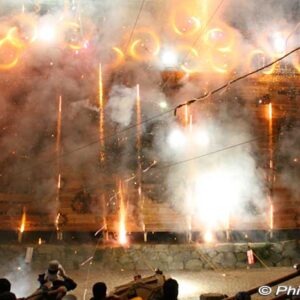
May 4: Shinoda Hanabi is a super spectacular and artistic fireworks display at Shinoda Shrine in Omi-Hachiman. Torch fireworks, Niagara Falls, and panel-type fireworks provide an explosive, close-up experience. For people who cannot wait till summer to see fireworks. Beware of a forest of camera tripods and photographers in front. Get there early if you want to take good shots. Not recommended if you don’t like sudden and loud explosions. Intangible Folk Cultural Property. Walk from Omi-Hachiman Station. Map here.

misaki

May 4: Misaki Shrine Fire Festival in Aisho, near JR Inae Station.

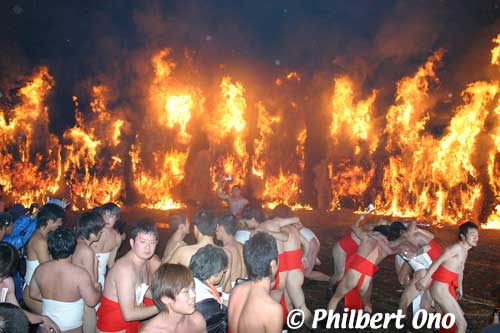
May 4: The Misaki Shrine Fire Festival in Aisho climaxes with a towering clump of bamboo set afire to create a fire column well over 10 meters high. It starts at 7:30 pm when people carry 2-meter long torches from their homes to the shrine. A taiko drum is also carried and beaten. Very dramatic (no marshmallows). The shrine is a 20-min. walk from JR Inae Station. See my video here. Map here.

Hyozu matsuri

May 5: Hyozu Matsuri in Yasu.

May 5: Hyozu Matsuri is Shiga’s preeminent mikoshi (portable shrine) festival with 35 mikoshi paraded around Hyozu Taisha Shrine in Yasu. Two of them are carried only by spunky young women called “Ayame,” meaning iris flowers. Very colorful and lively festival as they frequently stop, yell, and hold up the mikoshi high in the air. Beware that it can be dusty on the gravel paths. Other mikoshi are carried by children and men. See my video here. Map here.

Sushikiri matsuri

May 5: Sushi-kiri Matsuri at Shimoniikawa Shrine in Moriyama.

May 5: The Sushi-kiri Matsuri sushi-cutting festival at Shimoniikawa Shrine in Moriyama has two young lads very stylistically and meticulously cutting funa-zushi fermented fish (crucian carp native to Lake Biwa) as an offering. All throughout, they are verbally heckled by some men. Not visually spectacular, but unusual and intriguing. The best part is at the end when they give free morsels of funa-zushi to spectators. Shiga’s best-known delicacy from Lake Biwa. Also see my YouTube video here. Map here.

naginata moriyama

May 5: Naginata Odori Matsuri at Azu Jinja Shrine in Moriyama.

May 5: Naginata Odori Matsuri at Azu Jinja Shrine in Moriyama consists of colorful dances and music by children, taiko drumming, a naginata dance and acrobatics by boys using a pole sword. They conduct a roundtrip procession from Azu Shrine to Azu Wakamiya Shrine. A great variety of eye candy for Children’s Day. Also see my YouTube video here. Map here.

Namura sekku

May 5: Sekku Matsuri Festival bull's eye at Namura Shrine in Ryuo. Click image to see more info and photos.

May 5: Sekku Matsuri Festival at Namura Shrine in Ryuo is for horse lovers. After children carry around a portable shrine, yabusame horseback archery is held in front of the shrine gate. Several horses make their runs, but only one of them shoots arrows at the targets. A good excuse to visit this shrine noted for its elegant-looking, thatched-roof main gate and Nishi Honden hall which is a National Treasure. The shrine’s architecture is from the Kamakura Period. See my video here. Map here.

Cherry blossoms in Shiga

Kaizu-osaki

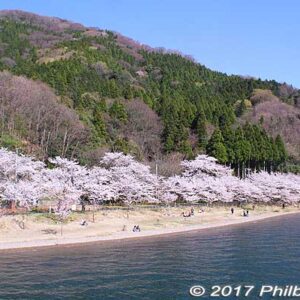
Kaizu-Osaki along the northern lake shore in Takashima. Cherry blossoms with Chikubushima island in the background. Beware of the narrow lakeshore road jammed with cars. 30-mi. walk from JR Makino Station (Kosei Line). Rental bicycles available.

Besides skiing, the best thing about winter is being able to look forward to spring. After a long and cold winter this year, we can hardly wait for the welcomed warmth of spring. Synonymous with spring is sakura, or cherry blossoms. Shiga Prefecture has many great spots for cherry blossoms, including two of Japan’s 100 Famous Cherry Blossom Spots at Kaizu-Osaki and Nagahama Castle’s Hokoen Park.

According to the cherry blossom forecast, the flowers should be in full bloom around April 15-20. Note that they bloom later in northern Shiga (Takashima and Nagahama) than in southern Shiga (Otsu). To see the current blooming condition, see the Weather News Sakura page for Shiga. The markers’ warmer colors until red (full bloom) indicate how far the flowers have bloomed.

Here are my photos of some of Shiga’s best sakura spots. Click on the photo to see more photos of the respective sakura spot.

Nagahama Castle in Hokoen Park near JR Nagahama Station (Hokuriku Line). A breath-taking number of cherry trees surround the castle. Be sure to go up the castle tower to see the sakura too.

Hikone Castle is another incredible place for sakura. I recommend going in the morning to take photos.

Mishima ike

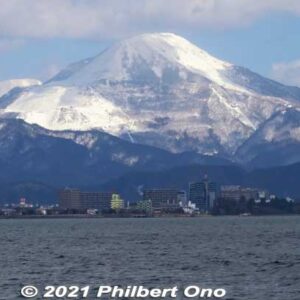
Mishima Pond and Mt. Ibuki in Maibara. Prime spot to photograph Shiga's highest mountain and cherry blossoms.

Yasu

Weeping cherry tree in Omi-Fuji Karyoku Koen Park (also called Omi-Fuji Green Acres) next to Mt. Mikami in Yasu.

hachiman-bori

A walk along the sakura-lined Hachiman-bori Moat in Omi-Hachiman is very pleasant.

zeze

Zeze Castle Park in Otsu includes cherry blossoms planted here in memory of the college rowers from Kanazawa University who died in a rowing accident on Lake Biwa in April 1941.

sakamoto

One of the most beautiful weeping cherry trees at Hiyoshi Taisha Shrine in Otsu. Near Sakamoto Station on the Keihan Ishiyama-Sakamoto Line.

miidera

Cherry blossoms lit up at night at Miidera temple in Otsu.

Essential Vocabulary

  • sakura さくら or 桜 - Cherry blossom and Japan’s national symbol and flower. By far, it is the most celebrated flower in Japan.
  • tsubomi つぼみ – Flower buds.
  • sakura zensen 桜前線 – Cherry blossom front as they bloom across Japan from Okinawa to Hokkaido.
  • kaika 開花 – Flowers started blooming. This is about a week before the tree reaches full bloom.
  • mankai 満開 – Full bloom. You will hear this on the news often.
  • hayasaki 早咲き – Early-blooming flowers. A few varieties of cherry blossoms bloom earlier than usual.
  • hanami or ohanami 花見 – Flower-viewing picnic (often with alcohol) under the cherry blossoms at a park. The most common way to celebrate spring under the flowers and commonly seen in the news. Hanami picnics are usually not allowed in shrines and temples.
  • sakura matsuri さくらまつり or 桜祭り- Cherry blossom festival. Not a religious festival, but can take the form of various events and stage entertainment.
  • Somei Yoshino 染井吉野 - The most common and coveted species of cherry blossoms whose light pink (almost white) flowers bloom in fluffy bunches on the tree.
  • yo-zakura 夜桜 – Cherry blossoms lit up at night. Some temples and parks light up the flowers at night.
  • shidare-zakura しだれ桜 or 枝垂桜 - Weeping cherry blossoms with long, hanging branches of flowers.
  • Sakura Meisho さくら名所 – Famous cherry blossom spot. It is most often a castle, public park, garden, shrine/temple, or riverside.
  • Sakura, Sakura さくら さくら- Famous folk song about cherry blossoms.
  • chiru, chitta 散る、散った – Flowers fell off the tree. Happens a few days after full bloom when the petals fall like pink snow.
  • sakura fubuki さくら吹雪 – Swirling cherry blossom petals. Occurs when the wind blows off the flower petals, creating a pink snow.

Heavy snowfall in Shiga

Lake Yogo with deep snow.

Shiga and the Japan Sea Coast (especially Niigata Prefecture) got a heavy dump of snow during Feb. 2 and 3, 2012. Nagahama and Imazu (Takashima) in northern Shiga have gotten over 70 cm of snow. On Feb. 3, some 160 troops from the Ground Self-Defense Forces were dispatched to Imazu to help remove snow. The last time they dispatched military personnel for snow removal was 31 years ago in Jan. 1981.

On the morning of Feb. 3, people in central Nagahama, such as in Kurokabe Square, were busy shoveling snow. Maibara and Hikone also got a good amount of snow. Some 35 kindergartens and elementary and junior high schools in Nagahama and Maibara canceled classes on Feb. 3 due to hazardous roads. Meanwhile, 105 schools either delayed the start of classes or canceled afternoon classes.

Snowy and icy roads are also causing car accidents. During Feb. 2-3, about 300 accidents occurred mainly due to road slippage. Twenty-two people were injured. Higashi-Omi, Hikone, and Omi-Hachiman saw the most car accidents with 76, 63, and 50 accidents respectively.

People are also getting injured while shoveling snow off their rooftops or falling into roadside gutters hidden by the snow. Some agricultural greenhouses also collapsed under the snow, even as south as Kora town.

The snowfall’s peak is passing, but shinkansen trains are being delayed between Nagoya and Kyoto on Feb. 4.

Take extra precautions when traveling to or in Shiga. Be very careful when walking on icy surfaces. Beware of cars that cannot stop due to road slippage. And don’t forget about the Hong Kong flu that’s going around. A very high number of cases have been reported in neighboring Gifu, so take precautions especially for the kids and elderly. Stay safe this winter.

Shiga fireworks in summer 2010

Here’s the fireworks (hanabi) schedule for Shiga Prefecture in summer 2010 listed by date:

July 17, 2010
Echigawa Gion Noryo Hanabi Taikai in Aisho, 7:30 pm – 9:20 pm
Along the Echigawa River bank near Miyukibashi Bridge. If rained out, to be postponed to July 18.
愛知川祇園納涼祭花火大会
More info: 愛荘町秦荘観光協会/愛荘町愛知川観光協会 TEL:0749-37-8051
http://www.biwa.ne.jp/~e-machi/new/hanabitaikai.html

July 24, 2010
Kashiwabara-juku Yaito Matsuri fireworks, 9 pm – 9:20 pm
Near JR Kashiwabara Station in Maibara.
柏原宿やいとまつり
More info: 中山道柏原宿やいと祭実行委員会 TEL:0749‐57‐0256
http://yaito.kashiharasyuku.com/

Aug. 1, 2010
Hikone Dai-Hanabi Taikai at Matsubara Beach, Hikone, 7:45 pm – 8:30 pm
30-min. walk from Hikone Station. If rained out, to be postponed to Aug. 4.
彦根大花火大会
More info: (社)彦根観光協会 Phone: 0749-23-0001
http://www.hikoneshi.com/event/?itemid=641

Ogoto Onsen Noryo Hanabi Taikai in Ogoto Port, 8 pm – 8:30 pm
20-min. walk from Ogoto Onsen Station. Fireworks can be seen from most ryokan in Ogoto.
おごと温泉納涼花火大会
More info: おごと温泉観光協会 Phone: 077-578-1650
http://www.ogotoonsen.com/sightseeing/hanabi/

Omi-Imazu Furusato Natsu Matsuri, 9:00 pm – 9:30 pm
Climax of Imazu’s summer festival starting from 1 pm.
近江今津ふるさと夏祭り やっさ!今津!!2010
More info: 近江今津ふるさと夏まつり実行委員会事務局 Phone: 0740-22-2108
http://www.takashima-kanko.jp/new/20100620_613.html

Hachiman Tenbin Matsuri in Omi-Hachman, 7:30 pm
At Kitanoshosawa area. Shuttle buses provided.
八幡てんびんまつり
More info: 八幡てんびんまつり事務局 Phone: 0748-32-6654
http://tenbinmaturi.hp.infoseek.co.jp/

Aug. 5, 2010
Nagahama Kita-Biwako Hanabi Taikai at Nagahama Port, 7:30 pm
10-min. walk from Nagahama Station. Very crowded so go early to save a spot or pay 3,000 yen for special seating. If rained out, to be postponed to Aug. 9.
長浜・北びわ湖大花火大会
More info: 長浜市観光振興課 Phone: 0749-65-6521
http://nagahamashi.org/news/hanabi2010.html

Aug. 6, 2010
Biwako Dai-Hanabi Taikai at Hama-Otsu and Nagisa Park, 7:30 pm – 8:30 pm
This is the big one, but prime viewing areas all charge admission of about 4,000 yen (even for children above age 3). The free area is farther away and terribly crowded. People are no longer allowed to save a place with vinyl mats, etc., until the fireworks day. Would you believe people saved a viewing place on Nagisa Park as early as 2 weeks before the fireworks day? If rained out, to be postponed to Aug. 10.
びわ湖大花火大会
More info: びわ湖大花火大会実行委員会 TEL:077-511-1530
http://www.biwako-visitors.jp/hanabi/index.html

Aug. 7, 2010
Makino Summer Carnival at Makino Sunny Beach in Takashima
マキノサマーカーニバル2010
More info: 四季遊園マキノ交流促進協議会事務局 Phone: 0740-28-8002
http://www.biwako-visitors.jp/search/event_12577.html

Ujisato Matsuri Summer Gathering in Hino
Fireworks is the climax of this summer festival (bon dance, etc.) held in the northern parking lot of Hino Town Hall.
氏郷まつり「夏の陣」2010
More info: 日野町イベント実行委員会 Phone: 0748-52-6562
http://www.town.shiga-hino.lg.jp/contents_detail.php?co=cat&frmId=1386&frmCd=4-15-2-0-0

Kotonarie Summer Festa in Higashi-Omi’s Hibari Park
Part of an illumination festival.
コトナリエサマーフェスタ2010
More info: 東近江市湖東商工会 Phone: 0749-45-2571
http://www.biwako-visitors.jp/search/event_373.html

Aug. 9, 2010
Ishiyama-dera Sennichikai and Setagawa fireworks, 8:30 pm – 9 pm
Fireworks along the Seta River near Ishiyama-dera. 10-min. walk from Ishiyama-dera Station on the Keihan Line.
石山寺千日会と瀬田川に煌く炎のページェント
More info: (社)石山観光協会 Phone: 077-537-1105
http://www.biwako-visitors.jp/search/event_304.html

Aug. 16, 2010
Somagawa Natsu Matsuri near Kibukawa Station, Koka
Fireworks are part of the summer festival with taiko drummers and lantern floating on the river.
杣川夏まつり
More info: 甲賀市観光協会 Phone: 0748-65-0708
http://www.biwako-visitors.jp/search/event_301.html

Aug. 17, 2010
Setagawa River Hanabi Taikai at Seta River in Otsu, 7:50 pm – 9 pm
Near Seta-no-Karahashi Bridge. Short walk from Karahashi-mae Station on the Keihan Line. Fireworks will climax a waterborne festival on boats.
瀬田川花火大会
More info: 瀬田川流域観光協会 Phone: 077-537-1105
http://www.biwako-visitors.jp/search/event_303.html

Aug. 25, 2010
Kinomoto Jizo Dai-ennichi fireworks near JR Kinomoto Station
木之本地蔵大縁日 8月22日(日)~25日(水)(花火は25日のみ)
More info: ふるさと夏まつり実行委員会 Phone: 0749-82-5902
http://www.biwako-visitors.jp/search/event_12358.html

Golden Week 2010 in Shiga

We saw fine weather during Golden Week in Shiga from late April to early May 2010. I went to see a slew of festivals in Shiga during this time. I traveled to Maibara, Ryuo, Tsuchiyama (Koka), Takashima, Yasu, and Kora. I’m trying to see all the major Golden Week festivals in Shiga. The problem is, many of them are held on the same day and at the same time. It will still take me a few more years to see them all, but after this GW, I can say that I’ve see more than half of them.

Here’s what I saw during Golden Week 2010 in Shiga Prefecture (in chronological order):

Photos: Sakata Shinmeigu Yakko-buri Procession 坂田神明宮の蹴り奴振り

Photos: Yuge Fire Festival 弓削の火祭り

Photos: Kenketo Matsuri Festival and Odori Dance ケンケト祭・踊り

Photos: Omizo Matsuri Festival 2010 大溝祭

Photos: Shichikawa Matsuri Festival 2010 七川祭

Photos: Hyozu Matsuri Festival 兵主祭

Photos: Takatora Summit in Kora 2010 高虎サミットin甲良

Attn: JR Tokaido and Kosei Line users

On March 13, 2010, Japan Railways implemented revised train schedules. Note that there are now fewer train runs on the JR Tokaido and Kosei Lines in Shiga and Kyoto. JR has eliminated train runs which saw low ridership. If you use these two lines, you should refer to the revised train schedules and trash the old one.

On the Tokaido Line, the last train from Kyoto Station to Yasu Station now leaves at 12:34 am instead of 12:58 am. In the mornings and evenings of Sundays and national holidays, there is one less train run going from Yasu to Maibara and from Maibara to Yasu. (So four fewer train runs on Sundays and holidays.)

As for the Kosei Line between Kyoto and Katata Stations, the four train runs per hour between 10 am and 2 pm on weekdays will be reduced to only three train runs per hour in both directions. Between Kyoto and Omi-Maiko Stations, there will be one less train run in both directions in the evenings during both weekdays, Sundays, and holidays.

The Kusatsu Line and Hokuriku Line are not affected by cuts in train runs (although the train schedule may be different from before).

Shiga movie: Satoyama (里山)


A full-length movie filmed in Shiga Prefecture called Satoyama (里山) will be released to theaters in Japan from Aug. 22, 2009.

In July, I was invited to a movie screening in Tokyo. The movie is a narrated documentary showing how people in Shiga interact and coexist with nature. The term “Satoyama” literally means “Human habitat and Mountain.”

A farming couple growing mushrooms on numerous tree branches, a honeybee keeper making sweet honey, etc. Besides people, the film also shows fantastic scenes of insects, birds, boars, and other wildlife. A pair beetles wrestling and one loses by being flung off the tree. A bird plunging into the river water to catch a small fish in its beak (shown in slow motion). Amazing how the photographer was able to plant the camera at the right places.

It is a very beautiful and engrossing film. The cinematography is first-class and the movie has won several international awards. Much of the movie was filmed in Takashima (probably Kutsuki) and Maibara. Shiga photographer Imamori Mitsuhiko also appears in the movie showing kids around the wilderness. The movie was produced by NHK and it was originally shown on TV as an “NHK Special.” Parts 1 and 2 of the Satoyama TV series were re-edited and combined with additional footage to make this fantastic movie.

See the movie trailer at the official Web site: http://satoyama.gyao.jp/

The Japan Times also published an excellent article about the meaning of the word “satoyama.”

http://search.japantimes.co.jp/cgi-bin/fl20090823x1.html

3rd Imazu Regatta

The 3rd Imazu Regatta was held on Aug. 17, 2008. Imazu Jr. High and Takashima High rowing clubs and people from Kyoto also rowed. I donated copies of the Lake Biwa Rowing Song CD as one of the prizes. They played the song during the regatta.
http://photoguide.jp/pix/thumbnails.php?album=704

Adogawa and Nakae Toju

Visited the Nakae Toju museum in Adogawa for the first time. There’s also a nice Michinoeki called Toju-no-Sato Adogawa. Bought some Adoberry jam and cakes. Good stuff. It also has a nice folding fan museum. Great place to buy gifts from Shiga. Highly recommended. 
Photos here: 
http://photoguide.jp/pix/thumbnails.php?album=110

Photo exhibition at Imazu Public Library

I’m holding a photo exhibition now at Imazu Public Library near Omi-Imazu Station (West exit). It will be until July 30. 

I’m showing photos of the Imazu Jr. High School Rowing Club’s rowing trip on Biwako which I took last Aug. (also see the above note). I also have photos of Biwako Shuko no Uta. 

Imazu Library site: 
http://lib.city.takashima.shiga.jp/iliswing/we/tosho/shoukai/imadu/imadu.html 

Also, on Aug. 17 at Imazu, the 3rd Imazu Regatta will be held. This is a rowing race which anyone can participate, even non-experienced rowers. You can even go there alone, and they will put you together with other people to row on the same boat. The race course is only 500 meters. More details at their site: 
http://www.eonet.ne.jp/~t-imazurowing/

Harie one of Japan’s 100 Best Spring Waters

On June 5, 2008, the Ministry of the Environment announced Japan’s 100 Best Spring Waters of the Heisei Era (平成の名水百選) and four of them are in Shiga Prefecture including one in Takashima: Harie-no-Shozu (針江の生水) in Shin-Asahi. The 100 locations were selected based on the water’s quality, volume, and how well it was used and preserved by the community.

Photos of Harie here.

Hakodate-yama and Kunizakai Ski Resorts for sale

In Oct. 2007, Ohmi Railways announced that it is looking to sell the Hakodate-yama Ski Resort in Imazu and Kunizakai Ski Resort in Makino (both in Takashima) due to a drastic drop in skiers in recent years. They also plan to sell Hikone Prince Hotel in Hikone.

Update: All three of these facilities have since been sold.

Stray dogs rejected in Imazu

On Oct. 6, 2007, a dog lovers organization in Osaka drove two truckloads of stray dogs to Imazu, intending to keep them at a facility there. But they came across 250 residents sitting on the road leading to the facility to protest the move. The trucks arrived at past 1 am, and after 8 hours, they turned back. Among the road sitters was the mayor of Takashima.

Rowing with Imazu Jr. High School Rowing Club


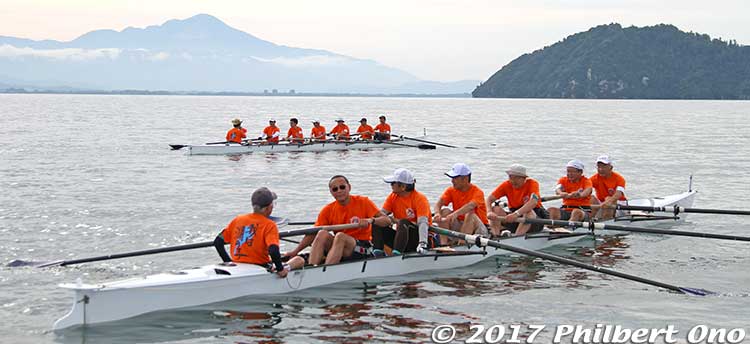
On Aug. 8, 2007, I went rowing on Biwako (琵琶湖周航) with the Imazu Jr. High School Rowing Club from Nagahama to Imazu. It was a very hot and sunny day with little wind. Almost 50 club members and three teachers went on this rowing trip. 

I was allowed to join them. Every Aug., they row from Imazu to Nagahama, stopover in Nagahama, and row back to Imazu. This year, they couldn’t row from Imazu to Nagahama due to high waves. So on Aug. 7, they took a bus to Nagahama and stayed overnight. 

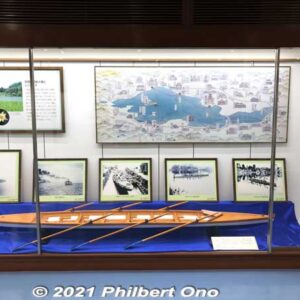
They used six rowing boats including two fixed-seat boats (フィックス艇) made of wood. These two fixed-seat boats are replicas of the same type of rowing boat used by Oguchi Taro when he wrote the song “Biwako Shuko no Uta” 90 years ago. I really wanted to try rowing on this boat on Biwako to see what it was like. 小口太郎の気分になりたかった。 

This fixed-seat boat has long been obsolete so it is quite rare to be able to row on one. Competitive rowing boats today all have sliding seats which make it easier to row. So fixed-seat boats have fixed seats which don’t move. And compared to modern rowing boats which are very narrow and light (made of fiberglass, etc.), fixed-seat boats are wider and heavier (wood), making it harder to row and slower. 

But it was fun rowing with the jr. high students (more girls than boys). The fixed-seat boat looks very sleek and beautiful cuttting through the waters of Lake Biwa. I really like the design. It was like rowing on a classic piece of art. 

The two replica boats were donated to Imazu where they are stored in a large boathouse. The first one is named “Chiaki/Taro” and the second is called “Yodo.” 

See more photos here: 
http://photoguide.jp/pix/thumbnails.php?album=589

Lake Biwa Cruise and choir contest

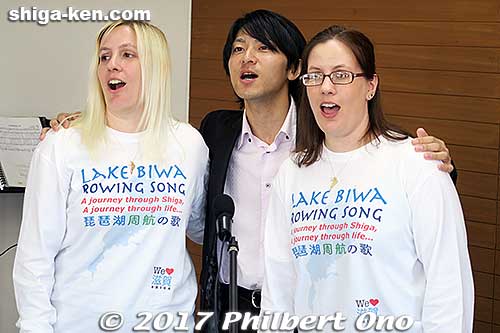
We had a fun time in Imazu during the weekend of June 16-17, 2007. On the 16th (Sat.), there was a 3-hour Lake Biwa Cruise to commemorate the 90th anniversary of Biwako Shuko no Uta. Jamie and Megan Thompson sang the English song in the chartered boat and also on Chikubushima.We also introduced and sold the CD on the boat and quite a few people bought it. In the evening, we attended a lecture about the song and also a dinner reception where we met the mayor of Takashima. I gave him a free copy of the CD.

Photos: http://photoguide.jp/pix/thumbnails.php?album=581

Newspaper (Kyoto Shimbun):
http://photoguide.jp/pix/displayimage.php?album=587&pid=17364

On the next day Sunday, the Thompson sisters sang the song at the Biwako Shuko no Uta choir contest in Imazu. We also sold the CD there. There were 25 choirs from Shiga, Hokuriku, Kyoto, etc. Each choir had to sing two songs, one must be Biwako Shuko no Uta, and the other can be any song. The 1st place prize was 100,000 yen.

We could also experience rowing on the same type of boat used by songwriter Oguchi Taro 90 years ago. The local junior high school kids took us for a boat ride on Biwako near Imazu Port. Great fun.

Photos: http://photoguide.jp/pix/thumbnails.php?album=582

On June 19 (Tue.), e-radio (FM Shiga) introduced our CD and song on an afternoon radio program hosted by Chiho Ono (not my relative). I was in Tokyo so I couldn’t listen to the program, but a few of our friends have told us that they heard it. I think that was the first time a radio station played the song from the CD. Thanks to Chiho.

And on June 24 in Hikone’s Viva City Hall, Jamie sang the song at an international event organized by a local int’l exchange organization called VOICE. We were able to introduce and sell the CD there as well.

Enjoy!