Shiga News – by Philbert Ono Rotating Header Image

Higashi-Omi

Shiga treated to annular solar eclipse

Annular solar eclipse above Tokyo. Click on image to enlarge.

A large swath of Japan was treated to an annular solar eclipse at around 7:30 am on May 21, 2012. People in southeastern Shiga Prefecture joined the masses in Tokyo, Nagoya, and Osaka to view the rare annular eclipse over most of Japan’s Pacific Ocean side. The rest of Japan could at least see a partial eclipse. An annular solar eclipse occurs when the moon comes between the sun and Earth and casts a shadow on Earth. The moon is farther away from Earth than during a total solar eclipse, so it does not cover the sun totally, exposing only a solar ring. In Japanese, an annular solar eclipse is called kinkan nisshoku (金環日食), literally “devoured sun with golden ring.”

People in the southeastern half of Shiga Prefecture could see the annular solar eclipse with the perfect ring of fire. The area from Maibara to Otsu was close to the northern boundary of the annular shadow path. Beyond that in Nagahama and Takashima, people could only see a partial solar eclipse. The annular ring could be seen for about 5 minutes at the center of the annular shadow path which went through central Tokyo. The further away you are from shadow’s center, the less time the ring appears.

In Shiga, the ring appeared for a maximum of about 3 minutes depending on the location. It was around 3 minutes in Koka and Higashi-Omi starting at 7:29 am. People in central Otsu saw it for about 2 minutes from 7:29 am. In Maibara, it was about a minute or less at 7:31 am. Nagahama and Takashima were outside the annular shadow and could only see a partial solar eclipse (a crescent sun). The last time an annular solar eclipse occurred in Shiga Prefecture was 282 years ago. Gee, I wonder how they viewed it at the time, if they even knew about it.

I was in Tokyo and photographed the eclipse about 1.5 km from the shadow’s center so I had the maximum 5 minutes to view and photograph the ring. We were lucky to have fleeting breaks in the veil of clouds during the eclipse. The clouds actually made it look more dramatic. A cloudless sky would create a totally black background in the photo. The ring appeared at 7:34 am in Tokyo. The last time this occurred in Tokyo was 173 years ago in 1839. The next annular solar eclipse in Tokyo will be three centuries from now. Too bad about Mt. Fuji being totally fogged over. People up there saw nothing. Map of the annular eclipse path: http://eclipse.gsfc.nasa.gov/SEgoogle/SEgoogle2001/SE2012May20Agoogle.html

It was also cloudy in Shiga at the time of the eclipse, but the sun did peep out of the clouds now and then and most got a chance to see the ring. Koka was the first to see the eclipse in Shiga starting at 6:17 am. Many school kids in Shiga went to school about an hour early and gathered on the school grounds to view the eclipse using solar eclipse sunglasses. Earth science students at Maibara High School used high-powered telescopes to successfully observe and photograph Baily’s beads which appear at the moment when the ring forms. Since Maibara is along the fringe of the annular shadow, it was a prime spot to view Baily’s beads. The students even appeared on national TV news that day on NHK at 7 pm.

The temperature dropped slightly by 0.6 C to 1 C in Shiga during the eclipse. The sky also became slightly darker during the peak, but it was still very bright. The photos look dark because of the dark filter on the lens. You cannot see the ring without a dark filter or solar eclipse glasses. Even at the peak of the eclipse, the sun was still a bright spot in the sky. Some people in Japan got married or engaged or gave a wedding or engagement ring to their fiance during the eclipse. To me, it looked like a heavenly angel’s halo without the angel. It certainly was worth getting up early to see it.

Golden Week festivals in Shiga

Kusatsu shukuba

April 29: Kusatsu Shukuba Matsuri celebrates Kusatsu's history as a stage town on the Nakasendo and Tokaido Roads. Numerous events and activities are held such as flea markets, street & stage performances, and Japanese dances. The main highlight is the Kusatsu Jidai Gyoretsu procession of people dressed in historical costumes from 11:30 am to 2:30 pm. Near JR Kusatsu Station.

Golden Week is Japan’s spring vacation from late April to early May with a string of national holidays. April 29 is Showa Day (set to April 30 this year since the 29th is Sun.), May 3 is Constitution Day, May 4 Greenery Day, and May 5 Children’s Day. This year’s calendar in 2012 can make it a nine-day holiday for the working folk if they only take off on two working days (May 1 and 2).

In Shiga, it is prime time for matsuri festivals. There are so many matsuri during this time that it took me at least 4 or 5 years to see most of them because many are held at the same time. You really have to decide which one to see. The festivals will be extra special this year because many GW festivals were canceled or postponed last year due to the 3/11 triple disasters.

Here are some of the GW matsuri I recommend seeing. A wide variety for sure. Click on the image to see more photos and information of the respective festival. Maps of the shrine locations, etc., are provided by the Map links.

kaizu rikishi

April 29: Kaizu Rikishi Matsuri Festival in Makino, Takashima.

April 29: Kaizu Rikishi Matsuri features men dressed as sumo wrestlers (rikishi) carrying two mikoshi portable shrines around their respective lakeside neighborhoods near JR Makino Station. They wear kesho mawashi ceremonial aprons. They jostle the mikoshi during the day from 1 pm to 3 pm, and then from 5 pm. At around 8 pm, they proceed to Kaizuten Jinja Shrine for the festival climax with lit torches. Be aware that the festival goes on until after 10 pm which may be past your last train home. Also, if you’re walking back to Makino Station from the shrine, be careful as part of the highway has no sidewalk. Bring a flashlight so the cars (and big trucks) can see you on the road at night. Otherwise, it’s very hazardous. See my video here. Map here.

hino matsuri

Hino Matsuri at Umamioka Watamuki Shrine. Click image to see more info and photos.

May 3: Hino Matsuri in Hino is the largest festival in eastern Shiga Prefecture and one of Shiga’s grandest float festivals. Sixteen ornate floats and three portable shrines are paraded through the streets and gather at Umamioka Watamuki Shrine amid festival music of flutes and taiko drums. It’s all day long from morning till late afternoon when the floats leave the shrine. The three portable shrines are taken across town to the Otabisho and back. Buses run from Hino Station to Umamioka Watamuki Shrine. If you have time, I also highly recommend taking the bus from Hino Station to Shakunage Gorge (しゃくなげ渓) for a relaxing nature stroll in a gorge adorned with shakunage (rhododendron), Hino’s official flower. See my video here. Map here.

Kenketo matsuri

May 3: Kenketo Odori at Takigi Jinja Shrine (龍樹神社).

May 3: Kenketo Odori at Takigi Jinja Shrine (龍樹神社) in Tsuchiyama, Koka is a dance performed by eight boys aged 7 to 12. The dance was originally started to ward off calamities. The boys wear tall peacock feathers on their heads. The delightful dance is a National Intangible Folk Cultural Property. From Kibukawa Station (JR Kusatsu Line and Ohmi Railways), catch the Aikuru Bus and get off at Higashi Maeno. The shrine is a short walk toward the river. Also see my video at YouTube. Map here.

Kenketo ryuo

May 3: Kenketo Festival at Suginoki Shrine in Yamanoue, Ryuo town, Shiga. Click image to see more info and photos.

May 3: The Kenketo Festival is held at few Shinto shrines in Ryuo and neighboring Higashi-Omi. It is mainly a naginata (pole sword) dance and procession by boys dressed in costume. They travel to these different shrines and perform, but the main venue is Suginoki Shrine in Yamanoue, Ryuo town, Shiga. Also see my YouTube Video here. Map here.

Shichikawa matsuri

May 4: Shichikawa Matsuri in Takashima. Click image to see more info and photos.

May 4: The Shichikawa Matsuri at Oarahiko Shrine in Takashima features a procession of yakko-furi laborers carrying archery targets (photo), yabusame horse runs, and a portable shrine procession. This is the largest festival in the Kosei area (western Shiga) and the only one featuring horses in Kosei. Attracts a good crowd. The shrine is near Shin-Asahi Station (JR Kosei Line), but renting a bicycle at the station is recommended. See my video here. Map here.

Omizuo matsuri

May 4: Omizo Matsuri in Takashima. Click image to see more info and photos.

May 4: Omizo Matsuri has five ornate floats pulled around the neighborhood of JR Omi-Takashima Station (JR Kosei Line). The festival eve on May 3 has the floats festooned with paper lanterns as they are pulled around in the evening. On May 4, they pull the floats around during the day and gather at Hiyoshi Jinja Shrine. When entering the shrine, they dramatically run while pulling the float. Also see my video at YouTube. Map here.

 Iba-no-saka-kudashi Matsuri

May 4: Iba-no-saka-kudashi Matsuri in Higashi-Omi near Notogawa Station.

May 4: Iba-no-saka-kudashi Matsuri held by Sanposan Shrine in Higashi-Omi, Shiga Prefecture is an unusual festival with three portable shrines hauled down a steep mountain (Kinugasa-yama) for about 500 meters. It doesn’t sound that far, but it’s all steep, rocky terrain. The mikoshi bearers can easily get injured. This is also one of the hardest festivals to view. You have to climb up this steep, rocky mountain and perch on a ledge. One earthquake and you can fall. The locals have an easy time climbing up the mountain though, even with kids. See my video here. Map here.

Shinoda hanabi

May 4: Shinoda Hanabi in Omi-Hachiman. Intangible Folk Cultural Property.

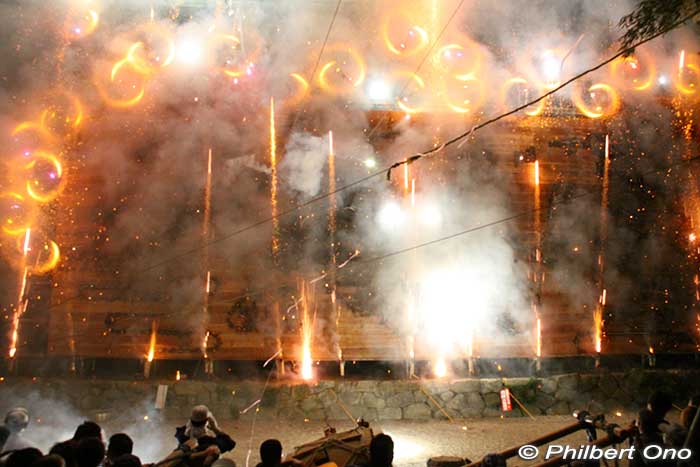
May 4: Shinoda Hanabi is a super spectacular and artistic fireworks display at Shinoda Shrine in Omi-Hachiman. Torch fireworks, Niagara Falls, and panel-type fireworks provide an explosive, close-up experience. For people who cannot wait till summer to see fireworks. Beware of a forest of camera tripods and photographers in front. Get there early if you want to take good shots. Not recommended if you don’t like sudden and loud explosions. Intangible Folk Cultural Property. Walk from Omi-Hachiman Station. Map here.

misaki

May 4: Misaki Shrine Fire Festival in Aisho, near JR Inae Station.

May 4: The Misaki Shrine Fire Festival in Aisho climaxes with a towering clump of bamboo set afire to create a fire column well over 10 meters high. It starts at 7:30 pm when people carry 2-meter long torches from their homes to the shrine. A taiko drum is also carried and beaten. Very dramatic (no marshmallows). The shrine is a 20-min. walk from JR Inae Station. See my video here. Map here.

Hyozu matsuri

May 5: Hyozu Matsuri in Yasu.

May 5: Hyozu Matsuri is Shiga’s preeminent mikoshi (portable shrine) festival with 35 mikoshi paraded around Hyozu Taisha Shrine in Yasu. Two of them are carried only by spunky young women called “Ayame,” meaning iris flowers. Very colorful and lively festival as they frequently stop, yell, and hold up the mikoshi high in the air. Beware that it can be dusty on the gravel paths. Other mikoshi are carried by children and men. See my video here. Map here.

Sushikiri matsuri

May 5: Sushi-kiri Matsuri at Shimoniikawa Shrine in Moriyama.

May 5: The Sushi-kiri Matsuri sushi-cutting festival at Shimoniikawa Shrine in Moriyama has two young lads very stylistically and meticulously cutting funa-zushi fermented fish (crucian carp native to Lake Biwa) as an offering. All throughout, they are verbally heckled by some men. Not visually spectacular, but unusual and intriguing. The best part is at the end when they give free morsels of funa-zushi to spectators. Shiga’s best-known delicacy from Lake Biwa. Also see my YouTube video here. Map here.

naginata moriyama

May 5: Naginata Odori Matsuri at Azu Jinja Shrine in Moriyama.

May 5: Naginata Odori Matsuri at Azu Jinja Shrine in Moriyama consists of colorful dances and music by children, taiko drumming, a naginata dance and acrobatics by boys using a pole sword. They conduct a roundtrip procession from Azu Shrine to Azu Wakamiya Shrine. A great variety of eye candy for Children’s Day. Also see my YouTube video here. Map here.

Namura sekku

May 5: Sekku Matsuri Festival bull's eye at Namura Shrine in Ryuo. Click image to see more info and photos.

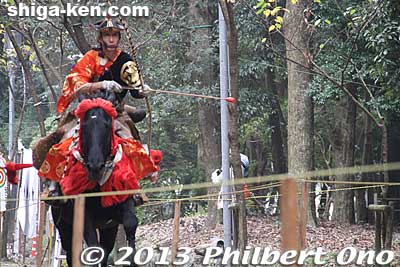
May 5: Sekku Matsuri Festival at Namura Shrine in Ryuo is for horse lovers. After children carry around a portable shrine, yabusame horseback archery is held in front of the shrine gate. Several horses make their runs, but only one of them shoots arrows at the targets. A good excuse to visit this shrine noted for its elegant-looking, thatched-roof main gate and Nishi Honden hall which is a National Treasure. The shrine’s architecture is from the Kamakura Period. See my video here. Map here.

Hina-matsuri doll festivals in Shiga

Hina dolls in Gokasho. Click image to see more photos.

Hina-matsuri dolls (雛祭りの雛人形) are being displayed at various locations in Shiga to celebrate Girl’s Day on March 3.

The most hina ningyo dolls I’ve ever seen in Shiga were in the Omi-shonin merchant homes and museums in Gokasho, Higashi-Omi. They are on display until March 20 (9 am to 4:30 pm) in the former residences of Tonomura Uhee (外村 宇兵衛), Tonomura Shigeru (外村 繁), Nakae Jungoro (中江 準五郎), and Fujii Hikoshiro (藤井 彦四郎邸). The homes are large, stately Japanese-style mansions. Must-see for architecture buffs. Buy a single 600 yen ticket and you can enter all the homes. Closest train station is Ohmi Railways Gokasho Station.

Hina dolls are also displayed at other places in Shiga:

Omi-Hachiman: Former Ban family residence (旧伴家住宅) until March 20 (closed Mon.). Omi merchant home which also served as a girls school and public library until 1997. Spacious room with a large display of Hina dolls. The former Nishikawa Residence (Kyu-Nishikawa-ke Jutaku 旧西川家住) also has doll display. This is a large Omi merchant home designated as an Imnportant Cultural Property.

Hino: Omi Hino Merchant House (近江日野商人館) until March 4. The former home of Hino merchant Yamanaka Hyouemon was donated to the town in 1981. Now a museum exhibiting the history and artifacts of the Hino merchants. Admission 300 yen. Another place is Hino Machikado Kan-okan (日野まちかど感応館) which is a former home along Hino’s main road. It is also a tourist information office. Free admission.

Otsu: Saikyoji temple (西教寺) until March 3 (9 am to 4:30 pm). Dolls from the Edo Period are also on display. This temple in Sakamoto is noted for the grave of Akechi Mitsuhide. Admission 400 yen. English Website.

Have a Happy Girl’s Day!

Japanese map in pdf: http://www.ohmitetudo.co.jp/railway/event/2012/hinameguri/img/hinameguri1.pdf
http://www.ohmitetudo.co.jp/railway/event/2012/hinameguri/img/hinameguri2.pdf

Heavy snowfall in Shiga

Lake Yogo with deep snow.

Shiga and the Japan Sea Coast (especially Niigata Prefecture) got a heavy dump of snow during Feb. 2 and 3, 2012. Nagahama and Imazu (Takashima) in northern Shiga have gotten over 70 cm of snow. On Feb. 3, some 160 troops from the Ground Self-Defense Forces were dispatched to Imazu to help remove snow. The last time they dispatched military personnel for snow removal was 31 years ago in Jan. 1981.

On the morning of Feb. 3, people in central Nagahama, such as in Kurokabe Square, were busy shoveling snow. Maibara and Hikone also got a good amount of snow. Some 35 kindergartens and elementary and junior high schools in Nagahama and Maibara canceled classes on Feb. 3 due to hazardous roads. Meanwhile, 105 schools either delayed the start of classes or canceled afternoon classes.

Snowy and icy roads are also causing car accidents. During Feb. 2-3, about 300 accidents occurred mainly due to road slippage. Twenty-two people were injured. Higashi-Omi, Hikone, and Omi-Hachiman saw the most car accidents with 76, 63, and 50 accidents respectively.

People are also getting injured while shoveling snow off their rooftops or falling into roadside gutters hidden by the snow. Some agricultural greenhouses also collapsed under the snow, even as south as Kora town.

The snowfall’s peak is passing, but shinkansen trains are being delayed between Nagoya and Kyoto on Feb. 4.

Take extra precautions when traveling to or in Shiga. Be very careful when walking on icy surfaces. Beware of cars that cannot stop due to road slippage. And don’t forget about the Hong Kong flu that’s going around. A very high number of cases have been reported in neighboring Gifu, so take precautions especially for the kids and elderly. Stay safe this winter.

New Year’s worshippers in Shiga

Taga Taisha on New Year's Day.

The Shiga Prefectural Police Department has estimated that 1.31 million people will pray at shrines and temples in Shiga during the first three days of 2012. This is more than New Year’s in 2011. Going to pray at a shrine or temple during New Year’s is called hatsumode (初詣).

Shiga’s most popular shrines during New Year’s and the estimated number of worshippers during the first three days of the 2012 have been announced as follows:

1. Taga Taisha Shrine (多賀大社) in Taga, next to Hikone, 470,000 worshippers
2. Nagahama Hachimangu Shrine (長浜八幡宮) in Nagahama, 150,000 worshippers
3. Omi Jingu Shrine (近江神宮) in Otsu, 140,000 worshippers
4. Tarobo Shrine (太郎坊宮) in Higashi-Omi, 120,000 worshippers
5. Hiyoshi Taisha Shrine (日吉大社) in western Otsu, 100,000 worshippers

As usual, Taga Taisha will see the lion’s share of worshippers. No doubt, the shrine’s auspicious name is a major draw. “Taga” means many felicitations. Perfect for new year’s prayers.

And on New Year’s Eve, Buddhist temples will be ringing in the new year at around midnight. At Hikone Castle, there is the Time-Keeping Bell or Jiho-sho (時報鐘) which the public can ring from 11:30 pm. The bell is on the way to the tenshu castle tower. The castle gate will be open from 11 pm.

More GW festival videos

Two more Golden Week (late April – early May) festival videos and photos.

Held on May 4 near Notogawa Station, the Iba-no-saka-kudashi Matsuri Festival is said to be one of the most unusual festivals. Young men carry (or drag) three heavy portable shrines down a steep mountain riddled with rough spots. I stayed near the bottom or finish line and declined to go up any further because I was too heavy with camera equipment and the slope was too steep. Here’s the video:

Photos: http://photoguide.jp/pix/thumbnails.php?album=829

Another festival I saw was at Namura Shrine in Ryuo on May 5, 2011. The Sekku Matsuri is a prayer for the healthy growth of children and rich harvest. The highlight is the yabusame horseback archery.

Photos: http://photoguide.jp/pix/thumbnails.php?album=461

Yokaichi giant kite under construction

New design of Yokaichi giant kite announced on July 10, 2010 at Yokaichi Odaki Kaikan, Higashi-Omi. Photo by Yokaichi Odako Kaikan.

Every three years, the giant kite flown at Higashi-Omi’s annual Yokaichi Odako (Giant Kite) Matsuri festival in May is replaced with a new one. And this year in 2010 is when they are building a new giant kite to replace the old one which saw its third and last flight in May 2010.

The retired giant kite was installed in the Yokaichi Giant Kite Museum (Yokaichi Odako Kaikan 八日市大凧会館) on July 4, 2010. Meanwhile, the new giant kite is now under construction for about a month from July 10 to Aug. 13, 2010 at the annex behind the museum. The great thing is that anyone can come in and help build the giant kite. No prior training nor experience required. Just go there and someone will tell you what to do. It could be twirling paper strips, pasting paper, or maybe even painting. Or you can just go and watch them work. The work progresses quickly.

The giant kite is about the size of 100 tatami mats. Three years ago, I went there a few times to help build the kite. It was very interesting. See photos here.

One thing you have to understand about the giant kite’s design is that it expresses a certain theme using a combination of word play with an illustrated pair of animals and one or two kanji characters. The design theme for the new kite in 2010 is “Healthy mind and body” (心身 健やか).

The upper half of the design has a pair of dragons. The kanji for dragon is 辰 (tatsu). There are two of them, so it is 辰辰. This tatsu kanji can also be pronounced as shin. So the kanji pair is pronounced as “shin-shin” which is the intended word play for the kanji characters 心身 (meaning mind and body) also pronounced “shin-shin.”

The bottom half of the design is dominated by the kanji 健 for sukoyaka (健やか) which means “healthy.” And so the design means “Healthy mind and body” (心身 健やか). The large kanji is always painted in bright orange. For this kite design, a professional kanji calligrapher was hired to write the 健 kanji for the kite. Incidentally, 2012 will be the year of the dragon when this kite will still be flying.

The design was based on two winning design entries by two eleven-year-old kids who won the design competition. Every three years, the public is invited to submit designs for the new giant kite. For 2010, the design theme was “health” (kenko 健康).

On July 10, 2010, the Yokaichi Odako Preservation Committee announced the winning designs and the final design. This is what they do if there is no single outstanding design entry. They pick the best designs from multiple winners and base the final design on them. This also happened the last time three years ago. The design winner(s) receives only recognition and no prize.

Volunteers work on the Yokaichi giant kite in 2007.

The Yokaichi Giant Kite Museum (Yokaichi Odako Kaikan 八日市大凧会館) is within walking distance from Yokaichi Station on the Ohmi Railways (map here). Also see the progression of the new giant kite’s construction at the Yokaichi Odako Kaikan blog here.

Japan’s oldest clay figure in Higashi-Omi

Making national news in May 2010 was the discovery of Japan’s oldest clay figure (called “doguu” 土偶) in Higashi-Omi. Slightly larger than a human thumbnail, the tiny clay figure is about 1.3 cm tall and depicts the upper torso of a female. Though the head is missing, the figure shows an ample bust and narrower waist.

The clay sculpture has been dated as from the early Jomon Period, about 13,000 years ago. It was found in the Aidani-kumahara ruins (相谷熊原遺跡) in Higashi-Omi’s Eigenji area near the Echigawa River. They found it in a pillar hole.

The clay figure will be on public display as follows:

Period Place Hours Addresss/Phone Closed
June 9-20 Eigenji Public Library 10:00-18:00 東近江市山上町830-1
0748-27-8050
Mon., Tue.
June 23-July 4 Notogawa Museum
(能登川博物館)
10:00-18:00 東近江市山路町2225
0748-42-6761
Mon., Tue., June 25
July 7-16 Azuchi Castle Archaeological Museum
(安土城考古博物館)
9:00-17:00 近江八幡市安土町下豊浦6678
0748-46-2424
Mon.
July 17-Aug. 31 Shiga-ken Maizo Bunkazai Center
(滋賀県埋蔵文化財センター)
9:00-17:00 大津市瀬田南大萱町1732-2
077-548-9780
Sept. 3-12 Omi-Shonin Museum
(近江商人博物館)
9:30-16:30 東近江市五箇荘竜田町583
0748-48-7101
Mon.

Info in Japanese:
http://www.shiga-bunkazai.jp/event/kokuchi/aidani.html

Higashi-Omi buses collect used cooking oil

Chokotto bus at Yokaichi Station

Chokotto bus at Yokaichi Station

Those cute little buses you see outside Yokaichi Station and elsewhere in the city, called Chokotto bus, have started collecting used cooking oil from September 1, 2009. Bring an old PET bottle (label detached) of your used cooking oil and give it to the bus driver. In return, you will receive a 100-yen ticket which can be used for your next ride on the bus. One ride costs 200 yen for adults, so it’s a 50% discount.

The collected oil will be converted to biodiesel fuel (called BDF in Japan) which the buses use as fuel. BDF has very clean emissions in its exhaust which may smell like tempura. You can actually breathe in the BDF exhaust from the vehicle’s exhaust pipe without any health risk.

Yokaichi giant kite festival 2008

On Sun., May 25, I went to see the Yokaichi Giant Kite Festival. I got there after 1 pm, just when they were preparing to fly the giant kite. 

At about 1:45 pm, they flew the big kite for over 3 min. The longest flight I’ve ever seen. Everyone was happy and relieved. It was a new giant kite, and its maiden flight. But they flew it only once. After that, most people went home. 

They also roped off most of the area so we could only see the kite from behind. It’s very difficult now to take good pictures of this kite.

Making Yokaichi giant kite

As you may know, the Yokaichi giant kite is replaced with a new one every three years. This year is when they will make a new giant kite. 

During this past weekend on July 7-8, they announced the new kite design and started making the new giant kite. I missed this event three years ago, so I was determined to see it this time. 

I attended the kite design announcement on Sat., and also participated on the first day on Sun. when they started to make the giant kite. Now I can say that I helped to make the giant kite which will fly from next May. 
http://www.chunichi.co.jp/article/shiga/20070709/CK2007070902030697.html 

I helped with the Paper Joining 紙継ぎ operation. About 400 sheets of washi paper from Mino (Gifu) were pasted together to make a giant sheet of paper equivalent to 100 tatami mats. I took pictures of course. 
http://photoguide.jp/pix/thumbnails.php?album=586 

The Giant Kite Preservation Society 八日市大凧保存会 makes the kite with the help from the public. Anybody can go to the Yokaichi Giant Kite Museum Annex 八日市大凧会館別館 and help make the kite. All the kite-making steps can be easily done by anyone. 

The hozonkai people are also very friendly and glad to answer questions about the kite. It will take about a month to finish the kite. They have a schedule too: 
http://www.gaido.jp/machikado/machikado.php?ID=1732 

I plan to go back again a few more times. It will be interesting to see how we draw and paint the design on the kite paper. If you are an art student or like to fly kites, I highly recommend this. 

http://mytown.asahi.com/shiga/news.php?k_id=26000000707030002

Yokaichi Giant Kite crashes into bamboo

Yokaichi Giant kite stuck in bamboo forest.

On May 27, 2007, I went to see the annual Yokaichi Odako Matsuri or Giant Kite Festival.

Slightly past noon, they launched the first flight of the giant kite. What we were all waiting for. It was a pretty windy day, so the kite immediately went straight up and very high. What should have been a long and high flight ended 50 seconds later in a totally unexpected and spectacular head-first crash into a bamboo grove.

It took about 3 hours for them to finally recover the kite, after cutting down some bamboo trees, disassembling the kite and rolling it up. The kite was badly damaged, but repaired in June, taking about 20 days, for display at the Giant Kite Museum.

Photos here: Yokaichi Giant Kite Festival 2007 

This is the second “accident” at this kite festival in 3 years. In 2005, the giant kite snapped in half in the sky and crashed to the ground hitting a few spectators. The bamboo used in the frame was reported to be “too green” and thus weaker. It is also the second time in history that the kite has crashed into a bamboo grove.

Too bad for the people who arrived at the festival after the kite crash. They did not see the giant kite at all.

Lake Biwa Rowing Song photo exhibition at Yokaichi

I have a Lake Biwa Rowing Song photo exhibition at Yokaichi Public Library (2nd floor gallery) until May 20. 

I will be at the gallery on Sat. the 12th from lunch time until maybe 2 pm or so. If you have time to visit, please come! 

There will be a CD player playing my CD. The gallery is also like a coffee shop where you can sit down and drink coffee and talk.

Gokasho


During New Year’s vacation, I visited Gokasho again. My second time. This time, I took many pictures with my digital camera. The pretty Hinamatsuri dolls were also displayed. I now have 170 pictures of Gokasho online: 

http://photoguide.jp/pix/thumbnails.php?album=472 
http://photoguide.jp/pix/thumbnails.php?album=109 

I got off at Gokasho Station on Ohmi Railways. It is an easy walk to the first Omi merchant home called Fujii Hikoshiro residence 藤井 彦四郎邸. Then I walked to the Omi Merchant Museum 近江商人博物館, then to the cluster of three Omi merchant homes 近江商人屋敷. 

It was very easy to find everything because there are clear signs on the roads from the train station. Maps are also available at all the museums and homes. Very good tourist information and signs. 

For the Omi merchants, the most famous saying is the “Sanpo-yoshi” 三方よし (売り手よし、買い手よし、世間よしの)principle. I think it’s a universal principle and I always followed it long before I found out about Omi shonin. (Hmm, maybe I was an Omi shonin during a previous life.) 

I’m still thinking about the best English translation for this Sanpo-yoshi. Something like “Good for me, good for you, and good for all.” 

I’ll let you know if and when I think of a good translation. 

At the end of the day, I also went to the Iki-iki-kan 生き活き館 tourist info office. There is also a souvenir shop where you can buy many goodies made in Gokasho. I spoke with a kind old lady there who told me about growing vegetables and making cookies and senbei. Well, I bought hakusai cabbage, goma cookies and senbei. Very good! From there, I took a bus to Notogawa Station. 

If you don’t have a car, it might be better to start touring Gokasho by taking a bus at Notogawa Station and starting at Iki-iki-kan since the tourist info office is there. Gokasho Station has a map in front of the station, but no tourist info office.

Higashi-Omi has no English Web site for sightseeing

Imagine that your friends from overseas will visit you in Higashi-Omi. How would you explain or introduce your city in English? The city hall’s Web site has some English pages introducing Higashi-Omi. The English is good quality so you can give them this URL: 
http://www.city.higashiomi.shiga.jp/outside/English/ 

However, they still don’t have any English info about sightseeing and festivals in Higashi-Omi. (In Japanese only.) And I tried to search for information about sights in HigashiOmi explained in English and it seems only my Web page comes up. 
http://photoguide.jp/txt/Higashiomi%2C_Shiga 

However, it’s still not finished. I’m still working on it. If you want to help me list up the sights of your city in English, I would welcome your input very much. I have only seen the kite festival, Notogawa waterwheel, and Eigenji. I know there are many more sights in HigashiOmi. JR Notogawa Station is probably Shiga’s nicest train station (shaped like a waterwheel on both sides). 

Changing the subject, I also found photo albums of HigashiOmi’s sister city exchange with Marquette this past summer. Looks like they had fun. Maybe you know someone in the pictures:

http://www.carlwozniak.com/Higashiomi/index.htm