Shiga News – by Philbert Ono Rotating Header Image

Aisho

Entries about Aisho-cho town, Shiga Prefecture.

Golden Week festivals in Shiga

Kusatsu shukuba

April 29: Kusatsu Shukuba Matsuri celebrates Kusatsu's history as a stage town on the Nakasendo and Tokaido Roads. Numerous events and activities are held such as flea markets, street & stage performances, and Japanese dances. The main highlight is the Kusatsu Jidai Gyoretsu procession of people dressed in historical costumes from 11:30 am to 2:30 pm. Near JR Kusatsu Station.

Golden Week is Japan’s spring vacation from late April to early May with a string of national holidays. April 29 is Showa Day (set to April 30 this year since the 29th is Sun.), May 3 is Constitution Day, May 4 Greenery Day, and May 5 Children’s Day. This year’s calendar in 2012 can make it a nine-day holiday for the working folk if they only take off on two working days (May 1 and 2).

In Shiga, it is prime time for matsuri festivals. There are so many matsuri during this time that it took me at least 4 or 5 years to see most of them because many are held at the same time. You really have to decide which one to see. The festivals will be extra special this year because many GW festivals were canceled or postponed last year due to the 3/11 triple disasters.

Here are some of the GW matsuri I recommend seeing. A wide variety for sure. Click on the image to see more photos and information of the respective festival. Maps of the shrine locations, etc., are provided by the Map links.

kaizu rikishi

April 29: Kaizu Rikishi Matsuri Festival in Makino, Takashima.

April 29: Kaizu Rikishi Matsuri features men dressed as sumo wrestlers (rikishi) carrying two mikoshi portable shrines around their respective lakeside neighborhoods near JR Makino Station. They wear kesho mawashi ceremonial aprons. They jostle the mikoshi during the day from 1 pm to 3 pm, and then from 5 pm. At around 8 pm, they proceed to Kaizuten Jinja Shrine for the festival climax with lit torches. Be aware that the festival goes on until after 10 pm which may be past your last train home. Also, if you’re walking back to Makino Station from the shrine, be careful as part of the highway has no sidewalk. Bring a flashlight so the cars (and big trucks) can see you on the road at night. Otherwise, it’s very hazardous. See my video here. Map here.

hino matsuri

Hino Matsuri at Umamioka Watamuki Shrine. Click image to see more info and photos.

May 3: Hino Matsuri in Hino is the largest festival in eastern Shiga Prefecture and one of Shiga’s grandest float festivals. Sixteen ornate floats and three portable shrines are paraded through the streets and gather at Umamioka Watamuki Shrine amid festival music of flutes and taiko drums. It’s all day long from morning till late afternoon when the floats leave the shrine. The three portable shrines are taken across town to the Otabisho and back. Buses run from Hino Station to Umamioka Watamuki Shrine. If you have time, I also highly recommend taking the bus from Hino Station to Shakunage Gorge (しゃくなげ渓) for a relaxing nature stroll in a gorge adorned with shakunage (rhododendron), Hino’s official flower. See my video here. Map here.

Kenketo matsuri

May 3: Kenketo Odori at Takigi Jinja Shrine (龍樹神社).

May 3: Kenketo Odori at Takigi Jinja Shrine (龍樹神社) in Tsuchiyama, Koka is a dance performed by eight boys aged 7 to 12. The dance was originally started to ward off calamities. The boys wear tall peacock feathers on their heads. The delightful dance is a National Intangible Folk Cultural Property. From Kibukawa Station (JR Kusatsu Line and Ohmi Railways), catch the Aikuru Bus and get off at Higashi Maeno. The shrine is a short walk toward the river. Also see my video at YouTube. Map here.

Kenketo ryuo

May 3: Kenketo Festival at Suginoki Shrine in Yamanoue, Ryuo town, Shiga. Click image to see more info and photos.

May 3: The Kenketo Festival is held at few Shinto shrines in Ryuo and neighboring Higashi-Omi. It is mainly a naginata (pole sword) dance and procession by boys dressed in costume. They travel to these different shrines and perform, but the main venue is Suginoki Shrine in Yamanoue, Ryuo town, Shiga. Also see my YouTube Video here. Map here.

Shichikawa matsuri

May 4: Shichikawa Matsuri in Takashima. Click image to see more info and photos.

May 4: The Shichikawa Matsuri at Oarahiko Shrine in Takashima features a procession of yakko-furi laborers carrying archery targets (photo), yabusame horse runs, and a portable shrine procession. This is the largest festival in the Kosei area (western Shiga) and the only one featuring horses in Kosei. Attracts a good crowd. The shrine is near Shin-Asahi Station (JR Kosei Line), but renting a bicycle at the station is recommended. See my video here. Map here.

Omizuo matsuri

May 4: Omizo Matsuri in Takashima. Click image to see more info and photos.

May 4: Omizo Matsuri has five ornate floats pulled around the neighborhood of JR Omi-Takashima Station (JR Kosei Line). The festival eve on May 3 has the floats festooned with paper lanterns as they are pulled around in the evening. On May 4, they pull the floats around during the day and gather at Hiyoshi Jinja Shrine. When entering the shrine, they dramatically run while pulling the float. Also see my video at YouTube. Map here.

 Iba-no-saka-kudashi Matsuri

May 4: Iba-no-saka-kudashi Matsuri in Higashi-Omi near Notogawa Station.

May 4: Iba-no-saka-kudashi Matsuri held by Sanposan Shrine in Higashi-Omi, Shiga Prefecture is an unusual festival with three portable shrines hauled down a steep mountain (Kinugasa-yama) for about 500 meters. It doesn’t sound that far, but it’s all steep, rocky terrain. The mikoshi bearers can easily get injured. This is also one of the hardest festivals to view. You have to climb up this steep, rocky mountain and perch on a ledge. One earthquake and you can fall. The locals have an easy time climbing up the mountain though, even with kids. See my video here. Map here.

Shinoda hanabi

May 4: Shinoda Hanabi in Omi-Hachiman. Intangible Folk Cultural Property.

May 4: Shinoda Hanabi is a super spectacular and artistic fireworks display at Shinoda Shrine in Omi-Hachiman. Torch fireworks, Niagara Falls, and panel-type fireworks provide an explosive, close-up experience. For people who cannot wait till summer to see fireworks. Beware of a forest of camera tripods and photographers in front. Get there early if you want to take good shots. Not recommended if you don’t like sudden and loud explosions. Intangible Folk Cultural Property. Walk from Omi-Hachiman Station. Map here.

misaki

May 4: Misaki Shrine Fire Festival in Aisho, near JR Inae Station.

May 4: The Misaki Shrine Fire Festival in Aisho climaxes with a towering clump of bamboo set afire to create a fire column well over 10 meters high. It starts at 7:30 pm when people carry 2-meter long torches from their homes to the shrine. A taiko drum is also carried and beaten. Very dramatic (no marshmallows). The shrine is a 20-min. walk from JR Inae Station. See my video here. Map here.

Hyozu matsuri

May 5: Hyozu Matsuri in Yasu.

May 5: Hyozu Matsuri is Shiga’s preeminent mikoshi (portable shrine) festival with 35 mikoshi paraded around Hyozu Taisha Shrine in Yasu. Two of them are carried only by spunky young women called “Ayame,” meaning iris flowers. Very colorful and lively festival as they frequently stop, yell, and hold up the mikoshi high in the air. Beware that it can be dusty on the gravel paths. Other mikoshi are carried by children and men. See my video here. Map here.

Sushikiri matsuri

May 5: Sushi-kiri Matsuri at Shimoniikawa Shrine in Moriyama.

May 5: The Sushi-kiri Matsuri sushi-cutting festival at Shimoniikawa Shrine in Moriyama has two young lads very stylistically and meticulously cutting funa-zushi fermented fish (crucian carp native to Lake Biwa) as an offering. All throughout, they are verbally heckled by some men. Not visually spectacular, but unusual and intriguing. The best part is at the end when they give free morsels of funa-zushi to spectators. Shiga’s best-known delicacy from Lake Biwa. Also see my YouTube video here. Map here.

naginata moriyama

May 5: Naginata Odori Matsuri at Azu Jinja Shrine in Moriyama.

May 5: Naginata Odori Matsuri at Azu Jinja Shrine in Moriyama consists of colorful dances and music by children, taiko drumming, a naginata dance and acrobatics by boys using a pole sword. They conduct a roundtrip procession from Azu Shrine to Azu Wakamiya Shrine. A great variety of eye candy for Children’s Day. Also see my YouTube video here. Map here.

Namura sekku

May 5: Sekku Matsuri Festival bull's eye at Namura Shrine in Ryuo. Click image to see more info and photos.

May 5: Sekku Matsuri Festival at Namura Shrine in Ryuo is for horse lovers. After children carry around a portable shrine, yabusame horseback archery is held in front of the shrine gate. Several horses make their runs, but only one of them shoots arrows at the targets. A good excuse to visit this shrine noted for its elegant-looking, thatched-roof main gate and Nishi Honden hall which is a National Treasure. The shrine’s architecture is from the Kamakura Period. See my video here. Map here.

Shiga fireworks in summer 2010

Here’s the fireworks (hanabi) schedule for Shiga Prefecture in summer 2010 listed by date:

July 17, 2010
Echigawa Gion Noryo Hanabi Taikai in Aisho, 7:30 pm – 9:20 pm
Along the Echigawa River bank near Miyukibashi Bridge. If rained out, to be postponed to July 18.
愛知川祇園納涼祭花火大会
More info: 愛荘町秦荘観光協会/愛荘町愛知川観光協会 TEL:0749-37-8051
http://www.biwa.ne.jp/~e-machi/new/hanabitaikai.html

July 24, 2010
Kashiwabara-juku Yaito Matsuri fireworks, 9 pm – 9:20 pm
Near JR Kashiwabara Station in Maibara.
柏原宿やいとまつり
More info: 中山道柏原宿やいと祭実行委員会 TEL:0749‐57‐0256
http://yaito.kashiharasyuku.com/

Aug. 1, 2010
Hikone Dai-Hanabi Taikai at Matsubara Beach, Hikone, 7:45 pm – 8:30 pm
30-min. walk from Hikone Station. If rained out, to be postponed to Aug. 4.
彦根大花火大会
More info: (社)彦根観光協会 Phone: 0749-23-0001
http://www.hikoneshi.com/event/?itemid=641

Ogoto Onsen Noryo Hanabi Taikai in Ogoto Port, 8 pm – 8:30 pm
20-min. walk from Ogoto Onsen Station. Fireworks can be seen from most ryokan in Ogoto.
おごと温泉納涼花火大会
More info: おごと温泉観光協会 Phone: 077-578-1650
http://www.ogotoonsen.com/sightseeing/hanabi/

Omi-Imazu Furusato Natsu Matsuri, 9:00 pm – 9:30 pm
Climax of Imazu’s summer festival starting from 1 pm.
近江今津ふるさと夏祭り やっさ!今津!!2010
More info: 近江今津ふるさと夏まつり実行委員会事務局 Phone: 0740-22-2108
http://www.takashima-kanko.jp/new/20100620_613.html

Hachiman Tenbin Matsuri in Omi-Hachman, 7:30 pm
At Kitanoshosawa area. Shuttle buses provided.
八幡てんびんまつり
More info: 八幡てんびんまつり事務局 Phone: 0748-32-6654
http://tenbinmaturi.hp.infoseek.co.jp/

Aug. 5, 2010
Nagahama Kita-Biwako Hanabi Taikai at Nagahama Port, 7:30 pm
10-min. walk from Nagahama Station. Very crowded so go early to save a spot or pay 3,000 yen for special seating. If rained out, to be postponed to Aug. 9.
長浜・北びわ湖大花火大会
More info: 長浜市観光振興課 Phone: 0749-65-6521
http://nagahamashi.org/news/hanabi2010.html

Aug. 6, 2010
Biwako Dai-Hanabi Taikai at Hama-Otsu and Nagisa Park, 7:30 pm – 8:30 pm
This is the big one, but prime viewing areas all charge admission of about 4,000 yen (even for children above age 3). The free area is farther away and terribly crowded. People are no longer allowed to save a place with vinyl mats, etc., until the fireworks day. Would you believe people saved a viewing place on Nagisa Park as early as 2 weeks before the fireworks day? If rained out, to be postponed to Aug. 10.
びわ湖大花火大会
More info: びわ湖大花火大会実行委員会 TEL:077-511-1530
http://www.biwako-visitors.jp/hanabi/index.html

Aug. 7, 2010
Makino Summer Carnival at Makino Sunny Beach in Takashima
マキノサマーカーニバル2010
More info: 四季遊園マキノ交流促進協議会事務局 Phone: 0740-28-8002
http://www.biwako-visitors.jp/search/event_12577.html

Ujisato Matsuri Summer Gathering in Hino
Fireworks is the climax of this summer festival (bon dance, etc.) held in the northern parking lot of Hino Town Hall.
氏郷まつり「夏の陣」2010
More info: 日野町イベント実行委員会 Phone: 0748-52-6562
http://www.town.shiga-hino.lg.jp/contents_detail.php?co=cat&frmId=1386&frmCd=4-15-2-0-0

Kotonarie Summer Festa in Higashi-Omi’s Hibari Park
Part of an illumination festival.
コトナリエサマーフェスタ2010
More info: 東近江市湖東商工会 Phone: 0749-45-2571
http://www.biwako-visitors.jp/search/event_373.html

Aug. 9, 2010
Ishiyama-dera Sennichikai and Setagawa fireworks, 8:30 pm – 9 pm
Fireworks along the Seta River near Ishiyama-dera. 10-min. walk from Ishiyama-dera Station on the Keihan Line.
石山寺千日会と瀬田川に煌く炎のページェント
More info: (社)石山観光協会 Phone: 077-537-1105
http://www.biwako-visitors.jp/search/event_304.html

Aug. 16, 2010
Somagawa Natsu Matsuri near Kibukawa Station, Koka
Fireworks are part of the summer festival with taiko drummers and lantern floating on the river.
杣川夏まつり
More info: 甲賀市観光協会 Phone: 0748-65-0708
http://www.biwako-visitors.jp/search/event_301.html

Aug. 17, 2010
Setagawa River Hanabi Taikai at Seta River in Otsu, 7:50 pm – 9 pm
Near Seta-no-Karahashi Bridge. Short walk from Karahashi-mae Station on the Keihan Line. Fireworks will climax a waterborne festival on boats.
瀬田川花火大会
More info: 瀬田川流域観光協会 Phone: 077-537-1105
http://www.biwako-visitors.jp/search/event_303.html

Aug. 25, 2010
Kinomoto Jizo Dai-ennichi fireworks near JR Kinomoto Station
木之本地蔵大縁日 8月22日(日)~25日(水)(花火は25日のみ)
More info: ふるさと夏まつり実行委員会 Phone: 0749-82-5902
http://www.biwako-visitors.jp/search/event_12358.html

Japanese school for Brazilians reopens in Aisho

Santana Gakuen (サンタナ学園) in Aisho is a school catering to Brazilian children. However, due to the children’s parents losing their factory jobs in Shiga due to the recession, the kids could no longer afford the tuition. The school’s enrollment of over 100 shrank to 67 by last autumn, and 40 of them were unable to pay the tuition. The school could no longer pay the Japanese teacher and so the school was closed in early 2009.

Coming to the rescue was Okuda Yuko (奥田祐子), an English teacher who met the school principal (Tanaka Kenko 中田ケンコ校長) and offered to teach Japanese to the kids as a volunteer. So the school reopened on June 11, 2009 after a six-month closure.

Ms. Okuda currently teaches at the school two or three times a week, mainly to kids in grades 1 to 4, much to the relief of the school’s principal. The children are eager to learn Japanese.

Okuda-san is also involved in the establishment of Aisho’s international association (愛荘国際交流協会設立準備会) to be formed later this year. (She’s the coordinator.) She hopes to expand Aisho’s international programs to include art, flower arranging, and cooking.

I wish her and her associates the best for the school and international association.

Kongorinji temple installs new Mandala

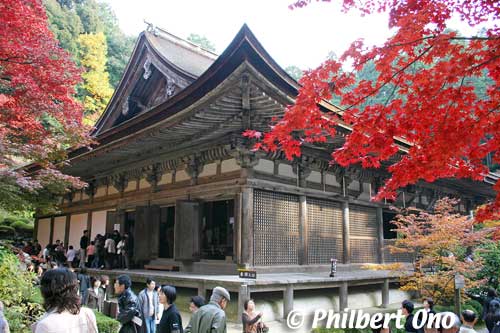
Kongorinji Hondo Hall (National Treasure)

The new Mandala is in this Kongorinji Hondo Hall (National Treasure).

Kongorinji temple (金剛輪寺), one of the Koto Sanzan temple trio of Tendai Buddhist temples (National Treasures) in eastern Shiga, lost its precious Mandala about 140 years ago during the Meiji Era (it is now owned by Nezu Art Museum in Tokyo and designated as an Important Cultural Property). They tried to get it back from the museum but to no avail.

So in April 2005, they set out to create a duplicate Mandala and it was recently completed after four years of painstaking art work. A service was held on May 10, 2009 at the temple to transfer a spirit to the Mandala and to install it in the temple. The service was officiated by the 91-year-old Tendai Zasu abbot (the sect’s top priest) as well. The Mandala, called Kongokai Hachiju-isson Mandala (金剛界八十一尊曼荼羅), is now open for public viewing in the temple’s Hondo hall until May 31, 2009. Public viewings of the Mandala will be held only once a year.

Buddhist art lovers will marvel at the Mandala’s depiction of 81 buddhas in the cosmos, with natural pigments brought in from China. Kamakura-Era techniques for the pigments and silk were used to create the 2-meter square painting on silk. The silk came from silkworms (in Ehime Pref. 愛媛県西予市) still creating the old type of silk used during the Kamakura Period. The pigments were also from crushed natural minerals like cinnabar for red, azurite for blue, and malachite for green. The Mandala cost about 30 million yen to make, made possible through the donations of almost 2,000 people.

*The temple is accessible by bus on weekdays from JR Inae Station on the Biwako/Tokaido Line. Buses leave at 9:17, 11:32, and 15:00. Buses do not run on weekends.

http://kongourinji.jp/image/flyer_090510.pdf

Kongorinji Web site: http://kongourinji.jp/

Aisho to form int’l association in April 2010

I’ve been informed that Aisho town in eastern Shiga will form the Aisho International Association in April 2010 and preparations are currently underway.

They have an interim Web site here:
http://blogs.yahoo.co.jp/aishointernational

Email address: aishointernational@yahoo.co.jp

Selling more bin-temari in Aisho


Bin-temari

Bin-temari

Chunichi Shimbun newspaper reported on April 9, 2009 that sales of bin-temari in Aisho town has increased by 150% during fiscal 2008 compared to last year. The local tourist association sold some 173 bin-temari this year, priced from 18,000 yen to 30,000 yen.

“Bin” means bottle, and “temari” is a threaded ball. The bin-temari is a round glass ball with a threaded ball inside. Bin-temari come in different sizes and an infinite number of threaded-ball designs. It also makes a great wedding gift since the round shape symbolizes harmony of the heart and family. You can also clearly see inside. The bin-temari is a symbol of Aisho.

The tourist association sells the bin-temari through its Web site and at their tourist info counter at Echigawa Station on the Omi Railway Line.

Their Web site (Japanese only):
http://www.biwa.ne.jp/~e-machi/08_bintema.html 

More bin-temari photos here:
http://photoguide.jp/pix/thumbnails.php?album=245

Yamabiko Yusui one of Japan’s 100 Best Spring Waters

On June 5, 2008, the Ministry of the Environment announces Japan’s 100 Best Spring Waters of the Heisei Era (平成の名水百選) and four of them are in Shiga Prefecture including one in Aisho-cho: Yamabiko Yusui (山比古湧水) in Matsuo-dera. The 100 locations were selected based on the water’s quality, volume, and how well it was used and preserved by the community.

English Web page for Aisho-cho

I’ve made a simple Web page in English introducing Aisho-cho: 
http://photoguide.jp/txt/Aisho-cho,_Shiga 

Also Google Map of Aisho: 
http://maps.google.com/maps/ms?ie=UTF8&hl=en&msa=0&msid=105501786212832952601.0004442a73a914bb420f1&z=13&om=0

Echigawa Public Library wins “Library of the Year” award

On Dec. 12, 2007, the Echigawa Public Library 愛知川図書館 won the “Library of the Year” Award from among 5,000 libraries in Japan. The date was also the library’s 7th anniversary. The library staff was praised for having field-specific expertise (museum curation, education, etc.) and being active in promoting and vitalizing the town. The library opened on Dec. 12, 2000. It has 165,000 books and lent out over 230,000 books during 2006. For a town of 20,000 people, these are very high figures.