Shiga News – by Philbert Ono Rotating Header Image

日本語

Japanese entries.

Hikone: A Journey in Time (manga review)

HikoneManga1

Hikone: A Journey in Time (cover)

The Hikone Board of Education has published a manga comic booklet in English titled, Hikone: A Journey in Time. Targeting tourists, the black-and-white manga explains about Hikone’s feudal history and cultural sights through the eyes of John, a fictitious 20-year-old lad from Michigan (Shiga’s sister state) visiting Hikone while staying with a Japanese family. The A5-size, 70-page booklet is available for 500 yen at the Hikone Castle Museum next to the ticket booth where you enter Hikone Castle.

The manga story starts off with John visiting Hikone Castle with his host family, the Tachibanas who have a 12-year-old daughter named Hana. A lightning bolt during a rainstorm transports John and Hana back in time to the year 1600 during the Battle of Sekigahara (in Gifu). A mysterious and beckoning cat named Toku serves as their time-warp tour guide as they witness the Eastern Forces’ Tokugawa Ieyasu defeat the Western Forces’ (and Shiga native) Ishida Mitsunari. Then they see Ieyasu’s major ally Ii Naomasa consequently awarded the domain of Hikone and his successors building Hikone Castle and the town. Ii Naosuke is also introduced as the Tairo (Chief Minister) of the Tokugawa government in 1858 who made the decision to open up Japan to the Western powers led by Commodore Perry (very good manga likeness).

Naosuke is later assassinated by radical samurai from Mito in 1860 while on his snowy way to Edo Castle’s Sakurada-mon Gate. Although the manga shows him being shot and stabbed in his palanquin, it does not show (nor mention) that he was also dragged out of his palanquin and beheaded.

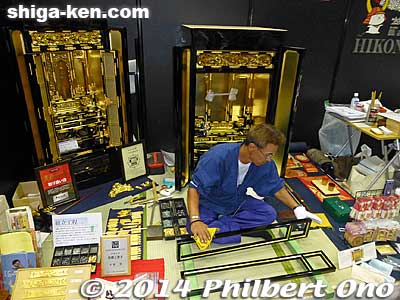
Toku the talking cat then takes John and Hana to see Hikone’s cultural products like kotoyaki pottery and Takamiya jofu textiles and Korean emissary processions. John and Hana are later zapped back to the present day as the cat disappears. The manga continues with the legendary story of the maneki-neko or beckoning cat saving Ii Naotaka (3rd lord of Hikone) from a lightning bolt at Gotokuji temple in Tokyo. John also visits a butsudan Buddhist altar factory where Hana’s dad works. I wish they also mentioned that many of the butsudan parts are crafted elsewhere (such as in neighboring Maibara) and then assembled in Hikone.

The end of the book has short English articles about the Korean Road (along which the Korean emissary traveled in Hikone on the way to Edo), Hikone Castle being on the World Heritage Site Tentative List, Hiko-nyan (Hikone’s official mascot), and a list and map of cultural properties in Hikone. It doesn’t elaborate on Hikone Castle’s prospects of actually becoming a World Heritage Site which I think is a long shot. It has languished on the Tentative List for 20 years since Japan first nominated it in 1992. The manga is apparently part of a strategy to gain support for Hikone Castle’s designation as a World Heritage Site.

Actually, I think they should first push Lake Biwa’s designation as a national park (it’s a quasi-national park). It’s one of the world’s oldest lakes with unique native species and has a long satoyama history of people living and interacting with the lake. And besides Hikone Castle, there are numerous nationally historic, cultural, and scenic sites around the lake such Mt. Shizugatake, Anegawa River, Mt. Ibuki, Nagahama Castle, Lake Yogo, Azuchi Castle, and Harie.

The manga provides whirlwind/superficial coverage of Hikone’s history, so some important details are missing. But it does give the newcomer a good, if not amusing, idea of what Hikone is about. It’s good enough for me to buy a copy to give to friends visiting Shiga.

The booklet is an excellent attempt by a local Board of Education to reach out to foreign tourists, a very rare project indeed. All local Boards of Education should follow suit. After all, they are the ones who have the expertise in local history and culture. The tourist bureaus are not terribly interested in explaining about local culture and history (because they are not academics nor researchers) and don’t care so much about serving a minority (foreign) segment of visitors. When they do produce something in English, it’s usually pretty shoddy.

The Hikone Board of Education contracted Kyoto Seika University to produce the booklet. The manga was drawn by a graduate of the university, Kojima Eiyu (小島瑛由). He did a fine job. The English translation was done by a manga researcher at Kyoto Seika University International, Jessica Bauwens-Sugimoto, and the editing was supervised by Peter J. Morris, Executive Director of International Programs at the University of Shiga Prefecture (not to be confused with Shiga University, a national university).

Employing native English speakers was wise (compared to using machine translation or a Japanese translator), but the booklet still has too many typos and grammatical issues. Apparently, the translator and editor weren’t given a chance to proofread their work. Many Japanese in printing/publishing don’t understand that translators/writers need time to proofread their work. I bet it was a rush job and the translator had only the Japanese text to translate, without the benefit of seeing the manga cells. It’s like translating a photo caption without seeing the photo. It’s very difficult. The translator/editor should also be given adequate leeway to modify the English text/dialog to suit the foreign readership and convey the meaning accurately.

The booklet includes a separate insert providing a Japanese translation of the English dialog on each page. (It seems to be the Japanese source text that was translated into English.)

Some 3,000 copies have been printed for the first printing. According to the Shiga Hikone Shimbun, the production cost was 2.6 million yen (867 yen per copy) which means they are taking a substantial loss by selling it for so cheap at 500 yen. The BOE published it to mark the 75th anniversary of Hikone. For more information, call the Hikone Board of Education at 0749-26-5833.

If they will revise this manga for another printing, here are my suggestions/corrections (excluding typos and grammatical errors) for improvement:

  • On the booklet’s cover, instead of touristy photographs, why not have a large manga in color to indicate that it’s a manga booklet? It would be more eye-catching.
  • John’s dad is Japanese and mom is American. But the story does not play up this tidbit at all. His parents don’t say anything and we can only question his nationality.
  • The word “cool” is used too often.
  • The asterisk used to cite Japanese terms should appear at the end of the word, not above it.
  • Page 7 describes Hana as a “little girl.” I wouldn’t call a 6th grader “little.”
  • On page 7, delete “the” in “I especially love the castles.” (An example of a grammatical error.)
  • “City” need not be appended to “Hikone.” It’s not part of the city’s name (like Kansas City or New York City). Appending “city” would be necessary only if the name of the city is the same as the prefecture, such as Hiroshima, to prevent confusion. I also recommend teaching how to pronounce “Hikone.” Most Americans might pronounce it Hee-cone with a silent e.
  • Page 10 does not say where Uoya-machi  is and its relation to the castle.
  • Page 11 should mention that the Horse Stable and Tenbin Yagura are Important Cultural Properties. Too bad there’s no illustration of the Horse Stable’s interior. No mention of the Nishinomaru 3-story turret which is also an Important Cultural Property. It doesn’t show the exhibits inside Hikone Castle Museum. Should mention that the castle is a short walk from Hikone Station.
  • Page 14 says that you can walk around the outside balcony. This seems to be a mistranslation. It’s not about walking around the outside balcony (which we cannot do since the balcony is too small), it’s about the cornice-like balcony that goes around the tower. Also on the same page, “one can only climb up 1 or 2 meters” needs to be clarified/explained further.
  • The use of capital letters is inconsistent: For example, Hikone Castle and Hikone castle.
  • Page 16 should mention the other three castles (Matsumoto, Inuyama, and Himeji) which are also National Treasures.
  • Page 19 should caption the statue of Ii Naosuke.
  • Page 24 has “…East and West. Led by Ishida Mitsunari and Tokugawa Ieyasu.” This makes it look like Mitsunari led the East and Ieyasu the West. It should be vice versa.
  • Page 25 should mention where Sekigahara is. And that the battle sites can be easily visited from Sekigahara Station, not far from Hikone.
  • Page 36 shows Naosuke’s entourage leaving his residence near Edo Castle (or perhaps entering Sakurada-mon Gate). However, the text says that he met trouble as he was entering Sakurada-mon Gate. This implies that he was assassinated at or inside the gate or castle grounds. Not so. He was attacked soon after leaving his residence and well before they reached Sakurada-mon Gate.
  • The practice of breaking up a sentence into two (or more) speech bubbles doesn’t bode well in English.
  • Page 42 should explain the Noh illustrations.
  • Page 48 has mistranslations in the second cell. Hana asks, “So did many Westerners come to Japan?” Toku answers, “Actually, not at all. But for many years before, there were many visits from Korea.” This exchange should read, “Did only Westerners come to Japan?” and Toku answering, ”No, there were also Korean visitors from centuries before.” There were the Dutch at Dejima, so it’s not “not at all.”
  • Page 60 should mention that funa-zushi is the origin of sushi instead of “the only true fermented sushi in Japan.” (As if there are fake fermented sushi in Japan.)
  • “Hikonyan” should be spelled “Hiko-nyan.” Otherwise, people are apt to mispronounce it as “Hikon-yan,” for example.
  • 冊子の全体的の印象はよいですが、なんか英語訳が急いで作られた感じがする。スペルミス、文法のミス、説明不足、誤訳などが結構あります。もっと時間をかけて最終のチェックが必要。教育委員会の英文出版物としてもっときちんとした正しい英語が重要。英語を勉強している生徒たちに間違った英語・訳を普及させたくない。
    HikoneManga2

    Sample manga page from Hikone: A Journey in Time.

    Japanese translation insert (cover).

    HikoneManga4

    Sample Japanese insert page.

2012年の大近江展

Shiga Prefecture Food and Craft Fair (Dai-Omiten) at Takashimaya Department Store in Nihonbashi, Tokyo. Feb. 24 to March 1, 2012.

東京日本橋の高島屋で開催中の第24回 琵琶湖夢街道 大近江展へ行きました。

とても美味しそうな見せ方。近江牛。

気に入った商品のディスプレー。しかし、この商品は米ではなく、だんごであった。

このパッケージのデザインは今一と思った。ザゼンソウと周航歌は米と関係ないし、一瞬、ザゼンソウから収穫された米と思わせる。パッケージのデザインは売れ行きを大きく左右する重要な要素。

この左義長祭りの飾りがとっても迫力あったけど、一番人が少ない場所に隠れていてほとんどの来場者が見ていないと思う。もったいない。せっかく八幡から持ってきたのにもっと目立つところに置かないとね。会場のど真ん中とか入口の付近。食べ物でできたものだから近江展とよく似合うと思った。滋賀の「見る」魅力をもっと表に引き出せないのか。

外国人が多い東京に大近江展の外国語の宣伝がまったくありませんでした。びわこビジターズビューローの外国語Facebookやホームページにまったく掲載なし。

Takashimaya Department Store in Nihonbashi, Tokyo is currently holding the Dai-Omiten (大近江展) food and craft fair featuring stuff from Shiga Prefecture. In one corner, this Sagicho Festival float decoration is on display. The festival has 13 floats and each one has an elaborate decoration with the year’s Oriental zodiac sign. What’s incredible is that the decorations are made of edible things. For example, the dragon’s teeth are cashew nuts. The Sagicho festival is held in mid-March (17th and 18th this year) in Omi-Hachiman, Shiga. The food fair is on the 8th floor, from 10 am to 8 pm (until 6 pm on March 1), until March 1. http://www.biwako-visitors.jp/pdf/oumiten.pdf

滋賀の英文観光地図パンフレット

左が旧版、右が最新版の英文Map of Shiga。

社団法人びわこビジターズビューローが発行したMap of Shigaの英文地図のパンフレットを拝見しました。旧版と比べると英文が全然改善されてない。形だけが変わっていて中身がそのまま。

旧版のMap of Shigaのよくない英語をそのまま流用されている。むしろスペルミスや間違っている文法が増えている。Native speakerによるcheckがやっていない。

地図には近江八景と琵琶湖八景が強調しているけど、これらは観光の目玉にならない。残念ながら、広重が見た詩的な近江はもうありません。琵琶湖八景を当てにする観光客も少ないと思います。県庁の英文観光ページにも同じです:http://www.pref.shiga.jp/multilingual/english/about/attractions.html

地図(と県庁のHP)に強調して欲しいのはまず国宝。寺院と神社は勿論、高槻の国宝の観音さんもいかが?そして戦国時代の史跡。特に大河ドラマに登場した場所。広重が好きなら宿場町もハイライトしよう。あとは各市町の観光案内所(電話番も)、自転車が借りれる駅(載れる道も)、道の駅(物産センター含む)。なぜJTBやKinki Nippon Touristのofficeがあるけど自分の案内所と物産センターが載ってないのか?

地図の裏面(下の写真)は滋賀の観光スポットを簡単に紹介しているけど、とても物足りない。滋賀の魅力が十分に伝わってこないし、全市町の名所が載せていない。高島市、米原市、日野町などが全然載ってない。お祭りの紹介もゼロ。英語もずさん。”Biwako Hana Funsui”にある”ajutages”っていったい何?

そしてなんと琵琶湖も全然紹介してない。どういう湖とか、基本的な説明なし。近江舞子も竹生島も全く紹介なし。Biwako Visitors Bureauの名称にも地図の表紙にも「ビワコ」があるのに紹介してない。あんだけ「Biwako, Biwako, Biwako」ばかり言っているのに。

しかし、滋賀は琵琶湖だけじゃない。県民も「琵琶湖」より「滋賀」の名称が圧倒的に好んでいます。Shiga Lakestarsのプロバスケチームの名前も投票で決まったけど、Biwako Lakestarsは全くダメだった。琵琶湖は国立公園にもなっていないし、摩周湖や十和田湖のように「美しい湖」というイメージが全国的にありません。滋賀県すら聞いたことない外国人にBiwakoと言ってもピントこない。Ninja, samurai, National Treasuresの方がずっと通じやすい。

滋賀の総合的な観光案内パンフを作りたい場合、別紙にするべき。地図は地図だけにして裏面には主な市街の拡大地図が望ましい。

Map of ShigaはやはりBVBのHP/FBと同じ性質である。形だけで中身が不十分。企画と実行がよく考えていない。せっかく奇麗に印刷したのに、もったいない。

この他の指摘と意見は下記にまとまりました。今度の改訂版に参考になればと思います。

表紙

  • Map of Shigaの名称をMap of Shiga Prefectureに。なぜかというと、信州の志賀高原とよく間違われる。
  • Lake Biwa JapanをLake Biwa, Japanに。
  • 相応しい滋賀の観光キャッチコピーがあったらいい。
  • 滋賀は日本のどこにあるか分かるように日本の地図に滋賀がマークされた小さい地図もあるといい。

裏表紙

  • “Access Map”の”Access”は和製英語です。正しい英語は英文ガイドブックなど参考してください。
  • By Train, etc.の見出しですが、etc.は見出しに使わない。アクセスの説明も不十分。新幹線駅の利便性や京都からの電車乗車時間などもっと優しく説明しよう。
  • Tourist SectionをTourist Information Officesに。県内にある全ての観光案内所を掲載してください。文字をもっと小さくしたら入ると思う。なぜ高島市が載っていないのか。あんなでっかい市の観光案内所の案内が何でない?
  • 英文住所にある”City”や”Town”は不要。でもShigaが必要。
  • コロン(:)の後に必ず一個のスペースを入れる。Tel: Address: など。

表面(地図)

  • ローマ字やスペルミスが多数。よくチェックしてください。
  • 県内と県外の部分が両方緑色となっているため、県境が見にくい。旧版の地図の方が見やすい(県外が白い)。市町の境も非常に見にくい。
  • 強調している近江八景はローマ字で英語になっていない。Karasaki no Yauの意味は分かる訳ない。分からないものを載せても意味がない。
  • サイクリングロードも色付きで表示するとより使い物になる。(この他の指摘は上記。)

裏面(下の写真を参考)

多数言い回しが悪い英語がある。たとえば:

  • “Hikone Castle”にある”350,000 koku”と言ってもkokuの説明が必要。”Hikone Castle is considered”もおかし。2007年の400年祭(開催中)のこともまだ載っている。
  • Enryakujiに”registered as a world inheritance”はWorld Heritage Site。
  •  Sightseeing Guidance of Shiga PrefectureとMajor Tourist Sightsの違いが分かりません。同じことですよ。

その他

  • 旧版の地図と比べるとA4版は不便。例えばサイクリングしているとき。
  • 地図には観光スポット、ホテルなどの紹介は大津に片寄っている。湖北の方が湖が奇麗のにあまり強調されていない。大津に関しては大津市観光協会の英文パンフで十分。
  • 英文地図や外国語パンフは県内の全ての観光案内所へ配布するべき。大津駅の観光案内所だけに置くことは不公平と不便。
  • 観光案内所に外国語でEnglish map availableのような標識も置くか外国語パンフレットを誰でも見えるところに置く。
Map of Shiga

Map of Shigaの裏面。クリックすると拡大できます。

上記のアドバイスは別に素晴らしいアイデアではなく、ごく当たり前の常識事項です。僕はなぜここまで気にしているというと、滋賀へ訪れる外国人の友人にこんな英文パンフレットを上げると恥ずかしいからです。滋賀ってしっかりしていない印象がする。悪いイメージに繋がる。例えば、変な日本語の観光パンフレットを日本人の友人に上げたいと思いますか?

Happy 2012!

Wishing everyone in Shiga a Happy New Year.

Praying for a safe, healthy, and prosperous 2012.

明けましておめでとうございます。

(Dragon photo was shot at Taga Taisha Shrine’s lantern festival in Aug.)

2010 Shiga calendar in English


滋賀県の2010年の英文カレンダーを作りました!(日本語は下にあります。)

For the first time, I have created and published a 2010 calendar for Shiga Prefecture in English. The calendar features my photos of Shiga, showing its beautiful seasons, traditional festivals, architecture, Lake Biwa, and a few “fun” things. Each monthly photo has an English caption, and both Japanese and American holidays are included.

You can see a preview of the calendar’s 12 months above. Click on the right arrow button. To see a larger view, click on the Full Screen Mode button. (Then you can read the captions too.)  The last page is displayed as black, but it’s actually white. The calendar size is 8.5 inches x 11 inches when closed. When open and hung on the wall, the calendar is 17 in. high and 11 in. wide.

The calendar is available for sale online at lulu.com based in the U.S. Just click on the Buy Now button (and get your credit card ready). The price is $15.22 plus shipping. Shipping within the U.S. will cost only a few dollars via ordinary mail. If you’re in Japan, the postage will cost $10.48 for one copy only. If you order five or more copies at one time, the calendar cost and shipping cost will get much cheaper. ($38.92 to ship 10 copies, for example.) It takes about 3 weeks for your order to arrive in Japan via ordinary mail. Express mail and trackable shipping options are also available, but expensive. You can also order from Japan and have the calendar shipped to an address in the U.S. or other countries which may be cheaper. It is cheapest to ship within the U.S. Makes a great gift.

Below is a list of photos in the calendar. I tried to include as many cities and towns as possible, but it was impossible to include all 26 municipalities of Shiga in a 12-month calendar. I plan to publish a Shiga calendar every year from now on, so those missing cities/towns will be included in the 2011 calendar and later.

Cover: Shigaraki-ware tanuki (raccoon dog)
Jan.: Nagisa Park rape blossoms, Moriyama
Feb.: Hokoen Park plum blossoms and Nagahama Castle, Nagahama
Mar.: Tsuchiyama Saio Princess Procession, Koka
Apr.: Hikone Castle cherry blossoms
May: Niu Chawan Matsuri, Yogo
June: Taga Taisha rice planting festival, Taga
July: Omi-Maiko beach, Otsu
Aug.: Imazu Regatta, Takashima
Sep.: Azuchi Castle replica (Nobunaga no Yakata museum), Azuchi
Oct.: Ibukiyama Taiko Drum Dance, Maibara
Nov.: Kongorinji temple, Aisho
Dec.: Mascot characters (Dotaku-kun, Tabimaru, Hiko-nyan)

The calendars are also selling for 2,000 yen at the Biwako Shuko no Uta Shiryokan museum (Phone: 0740-22-2108) in Imazu, Takashima. For those who cannot order in English, they can call this museum and order in Japanese.

You can also access the calendar page directly with this link:
http://www.lulu.com/content/lulustudio-calendar/2010-shiga-prefecture/7556294

ただいま滋賀県の2010年の英文カレンダーを初めて出版いたしました。国内外の外国人が滋賀県の魅力をもっと知ってもらうために作りました。

色とりどりの花や紅葉 、伝統的なお祭り、歴史的な建築、大自然とのふれあい、そしてちょっと面白い写真も選んでカレンダーにしました。写真は私がすべて撮りました。(ひこにゃんの写真だけハワイの友人が撮ってくれました。)

なるべく多くの市町を紹介しておりますが、やはり12ヶ月しかないので掲載されていない市町もあります。取り上げていない市町は、2011年以降のカレンダーに入れる予定です。アメリカと日本の祝日も掲載しています。

このカレンダーは海外のインターネットショップで委託販売中。中身の拝見(Preview)とご注文は上記の画像でできます。矢印のボタンをクリックしてすべての月の写真が見れます。(Full Screen Modeのボタンをクリックすると拡大できます。)購入したい場合、Buy Nowのボタンをクリック。ただし、注文ページは英語です。

日本からも注文できますが、 輸入品のため、ちょっと割高になります。でも5冊以上の注文では送料などの単価が安くなります。普通の郵便だと届くまで大体3週間かかります。または、日本で注文してアメリカなどの友人へ送ることもできます。アメリカ内の送料が一番安いです。

滋賀県内では、びわ湖高島観光協会の今津支所(琵琶湖周航の歌資料館内)で店頭販売中(電話での注文もOK、Tel: 0740-22-2108)。 販売価格は2000円(送料別)です。

注文ページの直接リンクはここ:
http://www.lulu.com/content/lulustudio-calendar/2010-shiga-prefecture/7556294

Event notice: Sports Recreation Shiga 2008

The Sports Recreation event will be held in Shiga during Oct. 18-21, 2008. On the first day Oct. 18 at Kibogaoka Park in Yasu, there will be some entertainment on a side stage called スポレク「夢」ステージ near the Nishi-guchi west gate during 9:30 am to 11:15 am. 

During this entertainment time, we will appear and sing “Lake Biwa Rowing Song”(Biwako Shuko no Uta in English) on this outdoor Yume stage at around 10:20 am. Jamie and Megan Thompson will sing the song. If you have time, please come down to see us. 

On the same day, the Spo-rec opening ceremony will start on the center stage at 12:30 pm. From JR Yasu Station, there will be free shuttle buses going to the park every 10-15 min. Note that if the weather is bad, the show will be canceled. Light rain will be no problem though. 

http://www.pref.shiga.jp/edu/sporec/koso.html 

スポレクの開会式の日、10月18日(土)に希望が丘文化公園内に「夢」ステージで色々な団体が9:30-11:20 amに出演します。 私たちは、10:20ごろに出演して「琵琶湖周航の歌」英語版を披露いたします。歌うのはジェイミーとメゲン・トンプソンの双子姉妹。 

「夢」ステージは、希望が丘文化公園の西口の近くにあります(池の前)。そして中央ステージで開会式が12:30ごろ始まります。野洲駅から無料バスあります。 

会場: 滋賀県立希望が丘文化公園内 スポレク滋賀2008会場内 県民ステージ) 
主催: エフエム滋賀 
Tel: 077−527−0814

琵琶湖周航の歌 英語版CD

待望の琵琶湖周航の歌 英語版CDが2007年6月16日に発売されました。定価800円。お陰さまで売れ行きが好調。

  • 歌はジェイミーとメゲン・トンプソン姉妹(美しいハーモニー!!)
  • 4曲収録:英語版(ピアノ伴奏、アカペラ)、日本語、ピアノ(カラオケ)
  • 12ページのCDブックレットに英語版歌詞、日本語歌詞、歌の紹介(英語と日本語)、歌碑紹介、滋賀の英文概要
  • 英語版の歌い方の手本や滋賀の物産として最高!海外の友人などにいいお土産。英語の勉強にも!
  • CDジャケットのデザインは「のぼる狭霧や さざなみの」というモチーフ
  • 英語版作詞・CD制作:オノ・フィルバート

CDは、滋賀県高島市今津町中沼1-5-7の琵琶湖周航の歌資料館で販売中。同資料館で通信販売もやっています。電話でも注文できます:

英語版CD注文: Tel/Fax: (0740) 22-2108

(休館日: 月曜、祝日の翌日。支払い方法は現金書留か為替。)

  • 定価800円(税込み、送料別)
  • 銀行振込を希望する方は、メールください: bid@photojpn.org
  • 大量(30部以上)の注文は1割以上の割引もあります。学校での大量注文も割引あります。問い合わせはbid@photojpn.orgへ。(琵琶湖周航の歌資料館では割引できません。

詳細は:

http://photoguide.jp/txt/Biwako_Shuko_no_Uta

Event notice: Biwako Shuko no Uta choir contest

第11回「琵琶湖周航の歌」音楽祭合唱コンクール 

私が作成した「琵琶湖周航の歌」の英語版がまた公の場で歌われます。 歌の発祥地である滋賀県高島市今津町は、毎年の6月にこの歌の合唱コンクールを開催していて、今年はアメリカ人のJamie and Megan Thompson姉妹がゲストとして午後12:15に出場して英語版を歌う予定です。関西、近畿、北陸地方などの様々なコーラスが参加します。 

そして、会場内で英語版CDも発売されます。 

入場料は500円。コンクールは午前10時から始まるが、姉妹は何時ごろに出るかまだ分かりません。 分かりましたらまたお知らせします。 

高島市民会館 滋賀県高島市今津町中沼1丁目3番地1 
(JR湖西線近江今津駅から徒歩5分。駅構内に観光案内あり)TEL: 0740-22-1764 

同時に今津町にある琵琶湖周航の歌資料館に英語版の写真展も開催されます。5月22日〜7月1日 
(このお知らせを自由にメール、ブログなど転送・転載してもOK.) 

The 11th Biwako Shuko no Uta Choir Contest will be held on June 17, 2007 at Takashima, Shiga. Various choirs from the Kansai, Kinki, and Hokuriku regions will participate to sing two songs: Biwako Shuko no Uta and one other song. 

Jamie and Megan Thompson have also been invited to sing my English version of the song. The contest starts at 10 am and lasts all day. The Thompsons will sing at 12:15 pm. Please come if you can. Imazu is a lovely place to visit as well. 

Place: Takashima Shimin Kaikan, near Omi-Imazu Station on the Kosei Line. Get out the East Exit. The station also has a tourist info booth.

NHK “Nodo Jiman” 出場します!

–速報– 

明日の26日にNHK総合テレビ「のど自慢」の番組に出場します! 

歌は「琵琶湖周航の歌」の英語版です。私が作成した英語版がアメリカ人の姉妹、Jamie & Megan Thompsonが出場して歌います。

11月26日 12:15〜13:00 NHK総合テレビ 
http://www.nhk.or.jp/nodojiman/

今日、その予選会が開催されて姉妹が通過しました!! 

明日の「のど自慢」は、Meganさん在住の香川県三豊市から生中継。僕は東京にいますが、テレビで見ます。

My English version of “Biwako Shuko no Uta” will be performed on NHK TV’s famous “Nodo Jiman” amateur singing contest tomorrow on Nov. 26 at 12:15 pm to 1 pm.

The song will be sung by  Jamie & Megan Thompson who passed the preliminary screening today. The show will be broadcast live from Mitoyo, Kagawa Prefecture.

「琵琶湖周航の歌」が外国人弁論大会に優勝

2007年2月25日に滋賀県彦根市で開催された「外国人による日本語スピーチ大会」にJamie Thompsonが優勝(最優秀賞)しました。Jamieは、私が作成したこの歌の英語版を歌ってくれた人です。

この大会は、滋賀県内に日本語を勉強している外国人のための日本語弁論大会。今年で3回目。滋賀県知事の代理や、彦根市長、滋賀議員などの来賓も来ました。審査員に國松前知事もいました。残念ながら嘉田知事が来れませんでした。

Jamieのスピーチは、「琵琶湖周航の歌の冒険」でした。歌の英語版に関わった出来事と発表経緯が紹介された。昨年に今津での発表会、CDレコーディング、NHKのど自慢の出場などの話。スピーチは6分しかできないので全部話したかったことができなかったけど、13名のうちになんと優勝!!

表書状、男性用の電子カミソリ、1ケースのビール、カレー、竹生島のクルーズ券、と沢山もろた。

そして総合の評価をした審査員が突然に「一度、例の英語版の歌を歌ってくれないか」と頼まれてちょっとびっくりしたJamieが見事に2番まで歌いました!!僕も泣きそうだった。来場者300人。ホールがいっぱい。

今日の毎日新聞の朝刊の滋賀版にこの弁論大会を大きく報道された。中日新聞も記事が載りました。

http://photoguide.jp/pix/displayimage.php?album=587&pid=17367
http://photoguide.jp/pix/displayimage.php?album=587&pid=17368
http://photoguide.jp/pix/displayimage.php?album=587&pid=17366

そして来週の日曜日(3月4日)に長野県岡谷市の国際交流協会が国際集いを開催します。そこにも現地の一人の女性がこの英語版を歌います。私も出席して歌を紹介します。歌の写真展もやります。

http://www.oiea.jp/jpn/aboutus/other/15thanniversary.htm

*岡谷市は、歌を作詞した小口太郎の故郷です。