Shiga News – by Philbert Ono Rotating Header Image

What’s New

Happy 2012!

Wishing everyone in Shiga a Happy New Year.

Praying for a safe, healthy, and prosperous 2012.

明けましておめでとうございます。

(Dragon photo was shot at Taga Taisha Shrine’s lantern festival in Aug.)

Kyoto International Photo Showcase 2011

日本語

Updated: Our group photo exhibition in Kyoto went very well. It was great meeting people and explaining about our pictures and work. Thank you to all who came to see us.

Photos of the exhibition here:
http://photoguide.jp/pix/thumbnails.php?album=833

Exhibition details:
I organized a group photo exhibition in Kyoto held on Nov. 16-20, 2011 at the Kyoto International Community House in Kyoto, near Keage Station (5 min. by Tozai Line subway from Yamashina Station). The exhibition room was open from noon to 7 pm (till 5:30 pm on the 20th). We had a gathering on Nov. 19 (Sat.) at 5 pm – 7 pm and on Nov. 20 (Sun.) at 4 pm – 5:30 pm when the public was invited to meet the artists. Free admission.

The theme was “Home Sweet Hometown.” Many of us foreigners in Japan have lived here for so long that Japan has become our second hometown. We love our hometowns in Japan so much that we often photograph it. We shall now share some images of our beloved hometown. I showed photos based on the Lake Biwa Rowing Song (Biwako Shuko no Uta). I have shown these pictures at various places in Shiga, but this was the first time for me to show them in Kyoto.

Also, Bruce Osborn showed Maibara Oyako (Parent-Child) Portraits. They come from the exhibition he is currently having at Maibara Station until March 2012.

Most of the other artists are based in Kyoto showed mainly Kyoto.

Featured Artists
Micah Gampel: “My Furukiyoki” self-portraits with friends in Kyoto. Very amusing collection of prints.
Peter Macintosh: Huge mural of Kyoto geisha photos taken over the past 10 years.
Motoyasu Matsutani: Pretty pictures of Kyoto.
Peter Miller: Copperplate photogravures of furusato scenes in Japan such as Shirakawa-go and Kamakura.
Philbert Ono: Introduction of Shiga’s hometown song, Lake Biwa Rowing Song. (Biwako Shuko no Uta) created by Kyoto University Rowing Club members in 1917.
Bruce Osborn: Maibara (Shiga Prefecture) Oyako (Parent-child) portraits taken in the four seasons.
John Wells: Mixed media (oil painting, sumie painting, etc.) of Kyoto scenes/objects.

Kyoto International Photo Showcase 2011

The Japan Times inserted a nice announcement for our show in the Nov. 13, 2011 issue:

The Japan Times, Nov. 13, 2011, page 2 (National News)

Oyako photo exhibition in Maibara Station

Oyako photo exhibition in Maibara Station.

My friend Bruce Osborn, an American pro photographer based in Hayama, Kanagawa Prefecture, is now having a grand photo exhibition inside Maibara Station on the Tokaido/Hokuriku Lines in northern Shiga Prefecture. The theme is Oyako (parent and child 親子) portraits. The city of Maibara set up and opened the new Maibara Station Oyako Gallery (米原駅Oyakoギャラリー) on July 16, 2011, and Bruce’s 60+ oyako portraits are the first to be displayed. The exhibition is titled, Kakegae-no-nai-mono (Irreplaceable Things) (かけがえのないもの).

If you go out of the ticket wicket, you will immediately see his large portrait panels mounted on the large window in the main corridor. There are more portraits decorating the corridor toward the east exit. The portraits are all black and white and show one or two parents together with his or her child. Most of the portraits are of Japanese celebrities such as Kayama Yuzo and Yokoo Tadanori. They mainly come from Bruce’s longtime Oyako photo series published in the Mainichi Shimbun newspaper. Bruce has been shooting oyako portraits since 1982 and it’s his life work. He has been widely published and even has a few oyako books published. He has photographed over 3,000 oyako and even calls the fourth Sunday of July “Oyako Day” when he shoots oyako portraits assisted by his Japanese wife Yoshiko.

But the main interest for us in Shiga are the Oyako portraits of local people in Maibara shown in four large panels. The four panels represent the four seasons. Each seasonal panel has a number of portraits of ordinary Maibara folk posed as parent and child(ren) taken outdoors in Maibara. They all show a hometown background in Maibara. Bruce tells me that he went through an awful lot to make some of these portraits of 20 oyako in Maibara. For portraits in winter, he and his crew spent a freezing time in Oku-Ibuki, a ski ground. I thought he was crazy to lug heavy lighting equipment up snowy Mt. Ibuki in winter. It took him two years to complete the Maibara Oyako series during which he visited Maibara a few times in the four seasons.

I dropped by Maibara Station a few days before the opening on July 16, 2011 when he and his crew were setting up the exhibition on the corridor walls. He used giant inkjet printers to print out the photos and they had set up a wood shop inside the train station to make the wooden frames and panels. Took them a few days to finish the job.

Maibara oyako

Maibara Oyako portraits.

Maibara oyako

Maibara oyako in winter.

Another great thing is that the captions are in Japanese and English. And they include interesting quotes about child-rearing from the parent. The exhibition will run until March 31, 2012. You can see the exhibition while Maibara Station is open from early morning until late night when the last train leaves. Free admission, but  you have to give your train ticket and go outside the wicket to see the photos in the corridor. Too bad that most people transferring trains at Maibara Station won’t see the oyako portraits because of this. Thus, the portraits will be mainly seen by people who live and work near Maibara Station. I wish they also put a few portraits on the walls inside the station where we can see them when changing trains. Maibara Station certainly has lots of wall space everywhere.

Maibara Station has finally completed its major renovation and the large, new corridor connecting the west and east sides has remained empty and white these past few years. Finally, there is something nice decorating its walls. Initially, there were plans to have famous artist Hiro Yamagata, a Maibara native, to paint those huge white walls in a psychedelic motif. But it was apparently too expensive and it never happened. Bruce’s oyako portraits is a great alternative, a lot cheaper, and they fit in with Maibara’s current slogan of Kizuna (human bonds) and furusato (hometown).

Photos of Maibara Station and Oyako Gallery: http://photoguide.jp/pix/thumbnails.php?album=149
Bruce Osborn’s Oyako web site: http://www.oyako.org/en/oyakonohi/
Maibara’s Oyako page

Shiga’s nuclear backyard

Fukushima’s nuclear power plant crisis has rattled the nerves of Shiga’s residents and local governments. We are beginning to realize how vulnerable Japan’s nuclear power plants are, how vulnerable nearby residents are, how power companies have deceived the public about nuclear plant safety, how inept they are in emergencies, and how the government nuclear watchdog and power companies have ignored safety warnings and advice from nuclear and earthquake experts for years. Sadly, the Fukushima accident could have been largely or completely prevented.

Shiga Prefecture is next to Fukui Prefecture in the north, where a string of eleven nuclear power plants dot the coast of Wakasa Bay in three locations. This is Japan’s highest concentrations of nuclear power plants. The closest nuclear reactor is only 13 km (8 mi.) from Shiga Prefecture’s border in Yogo (northern Nagahama).

The nuclear plants in Fukui are operated by Kansai Electric Power Co. (KEPCO) which supplies electricity to most of the Kansai and Kinki regions, including Shiga, Kyoto, Osaka, Hyogo, Nara, and parts of Mie, Gifu, and Fukui Prefectures. About 48% of KEPCO’s power is generated by nuclear plants, all in Fukui. This is the highest percentage of any region of Japan. Compare this with the Tokyo region’s 23% dependence on nuclear power before the Fukushima accident. Overall, Japan relied on nuclear power for about 23% of the power generated before the Fukushima accident. In its advertising, KEPCO has actually been boasting that half of its power is nuclear-generated. Say that now, and many of us in Kinki/Kansai will only shudder.

When the evacuation zone around the Fukushima nuclear plants was expanded from 10 km to 20 km (12 mi.), alarm bells went off in the governor’s office in Shiga. According to the safety manual, the standard evacuation zone around a troubled nuclear plant in Japan was to be only 10 km (6 mi.). If this overly optimistic scenario were to be trusted, Shiga would be in the clear. But 20 km meant that residents in northern Shiga would fall in the evacuation zone if a nuclear accident occurred in Fukui. This has prompted Shiga Governor Kada Yukiko to order a revamp of Shiga’s countermeasures against nuclear plant emergencies. The existing plan assumes that the evacuation zone will be 10 km. Thus, it does not include any evacuation plans for Shiga residents since we are farther than 10 km away. But Shiga must now incorporate evacuation plans in its countermeasures as soon as they figure out how far the evacuation zone should be. They must also take wind conditions into account.

I wonder though, if 20 km is a realistic distance when you think about the US government’s recommended 80 km (50 mi.) which would reach deep into Shiga territory from Wakasa Bay. However, evacuating Shiga residents within 80 km would be extremely disruptive and very difficult as it would include heavily populated areas. It is understandable for authorities to keep the evacuation zone as small as possible. Also, any major radiation leaks from Fukui would inevitably contaminate Lake Biwa which supplies water to the Kansai region. The stakes are very, very high when it comes to nuclear power safety.

Meanwhile, to ease our fears, KEPCO has announced major reinforcements and additional backup power supply and pumping systems to be installed or built. They also plan to build an anti-tsunami wall and also thoroughly train workers for emergencies. They will spend 5 to 10 trillion yen (about $595 million to $1.19 billion) on these countermeasures.

Well, that’s nice to hear. But it also implies that their nuclear reactors’ safety measures have been pretty inadequate during all these decades since the 1970s when most of them were built. Like right now, they are geared for only a 2-meter-high tsunami. Fukushima’s tsunami was well over 10 meters. These nuclear power plants have not been accident-free either. For example, in 2004, the Mihama nuclear plant had hot steam scalding five workers to death.

Let’s hope and pray that Japan, the power companies, and the entire world will learn from Fukushima and we will never see something like this ever again.

Kusatsu Shukuba Matsuri canceled

The Kusatsu Shukuba Matsuri Festival is canceled for 2011.

Many festivals (matsuri) in Japan are being canceled or scaled back in consideration of the Tohoku disaster. It’s unfortunate since spring is prime time for festivals.

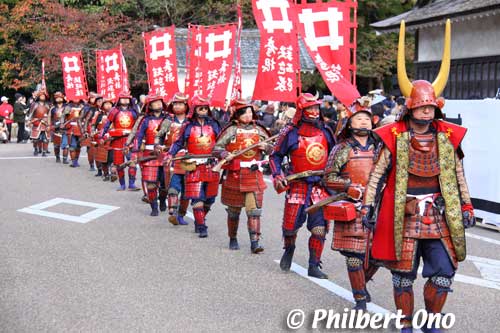
The Kusatsu Shukuba Matsuri festival scheduled for April 23-24, 2011 has been canceled. It’s too bad since it’s a nice festival highlighted by a parade of women in kimono and men in samurai costume.

I hope cancellation of matsuri will be minimal. Of course, we all feel sad about what happened in Tohoku, but cancelling these events where we can get together and relieve stress makes it more demoralizing and somber. Look at the TV stations, they continue to broadcast comedy shows.

Omi-Hachiman’s Sagicho Matsuri was held as scheduled in March even after the Tohoku disaster, albeit with less revelry. For those who had worked meticulously for months on their sagicho floats, cancelling the festival would make it a great waste.

Kusatsu Shukuba Matsuri official Web site here.

Shiga’s response to Tohoku earthquake/tsunami in March

This is a summary of Shiga’s response to the Tohoku earthquake and tsunami which I will continue to update.

The local Shiga TV news broadcast by NHK Otsu on March 31, 2011 reported the following:

- The JA Group farmer’s cooperative donated 10 tons of Omi-mai rice grown in Shiga. Some 2,000 5-kilogram bags of rice were packed onto a truck bound for Fukushima.

The local Shiga TV news broadcast by NHK Otsu on March 25, 2011 reported the following:

- Otsu-based ramen noodle restaurant chain called Rairaitei (来来亭) donated 100 million yen to the Japan Red Cross’ Shiga Chapter. Shiga Governor Kada Yukiko accepted the donation from the president of Rairaitei on behalf of the Shiga Chapter.

- Two weeks after the Tohoku disaster, about 200 people (57 families) have evacuated to Shiga from the stricken areas in Tohoku. They are staying at public housing offered rent-free for six months.

The local Shiga TV news broadcast by NHK Otsu on March 24, 2011 reported the following:

- Nagahama and Takashima have started accepting donations for food, water, and other provisions. Both cities will accept donations for about a week.

- Bottled water has sold out in Shiga. Supermarkets have empty racks where bottled water were sold. Even the smaller 500 ml bottles of water are gone. Sports drinks, tea, and other beverages are still available. Apparently, people are hoarding, buying water for friends/relatives in Tokyo area where tap water was reported to have higher levels of radiation, or buying for Tohoku disaster victims.

The local Shiga TV news broadcast by NHK Otsu on March 23, 2011 reported the following:

- Otsu and a few other local governments in Shiga have begun accepting donations of food and relief goods from the public. Canned food, bottled water, rice, disposable diapers, batteries, etc., are being accepted at specified locations. The collected goods will be trucked to the affected areas by the Japan Ground Self-Defense Forces stationed in Otsu. Otsu will accept such donations until March 31. Ritto, Yasu, Moriyama, Omi-Hachiman, and Koka are also accepting donations of relief goods. Best to call your city hall to check what and where you can donate.

- Students from Tohoku attending a major university in Shiga Prefecture can have their tuition fully or partially waived if their parents or guardian suffered devastating losses, major injury, or death in the earthquake or tsunami. They can contact their university for more info.

The local Shiga TV news broadcast by NHK Otsu on March 22, 2011 reported the following:

- Nippon Electric Glass Company (日本電気硝子), based in Otsu, has donated 100 million yen to the Japan Red Cross as aid for the Tohoku disaster victims. The company makes glass panels for LCD televisions and cell phone displays. The donation was given to the Shiga Chapter of the Japan Red Cross. Shiga Governor Kada Yukiko happens to be the head of the Shiga Chapter and she received the donation personally on behalf of the Japan Red Cross. The Shiga Chapter has already received over 266 million yen in donations as of March 22, 2011.

- A municipal medical center in Omi-Hachiman called Omi-Hachiman Sogo Iryo Center (近江八幡市立総合医療センター) has started accepting dialysis patients from the stricken areas in Tohoku. It can accept up to ten out-patients who need artificial dialysis three times a week. Out-patients will be put up in a business hotel near the medical center and a free shuttle bus will be provided. Getting dialysis treatments is hard in the Tohoku area with many hospitals either inoperative or without power.

The local Shiga TV news broadcast by NHK Otsu on March 18, 2011 reported the following:

- Yanmar, a company founded in Shiga that makes industrial machinery, is sending 30 portable power generators to Iwate Prefecture. The truck carrying the generators left Nagahama.

- The Go and Azai Sisters Expo being held in Nagahama is continuing to accept donations for the Tohoku disaster victims. On March 19 (Sat.), a few mascot characters will be on hand to collect donations from expo visitors.

- Also beware of scammers seeking “donations.” They are going door-to-door disguised as local government workers or NPO workers or sending faxes urging people to donate. Do not give money to these scammers. They are operating all over Japan.

The local Shiga TV news broadcast by NHK Otsu on March 15, 2011 reported the following:

- Shiga Prefecture is making available 34 public housing apartment units free of rent to people affected by the Tohoku quake/tsunami. It has started accepting applications (first-come, first-served) for these units in Otsu, Yasu, Takashima, Higashi-Omi, and Nagahama. Rental period is 6 months, but renewable. Call this number in Japanese for more info: 077-528-4234 ( 県土木交通部住宅課)

- In addition, many cities and towns in Shiga are making a total of 78 apartment units available to disaster victims for rent. Contact the city/town hall for more info.

The local Shiga TV news broadcast by NHK Otsu on March 14, 2011 reported the following:

- People wanting to travel to the affected areas in Tohoku (northeastern Japan) to do volunteer work are being asked to refrain from trying to go there for the time being. Public transportation is still nil and the danger of aftershocks and the unstable nuclear power reactor still exist. We first have to allow the Self-Defense Forces troops and other professionals continue with search and rescue operations, not to mention more grisly work.

- Also, donations of provisions from the public is not being accepted right now because they still cannot be transported to the affected area en masse. Organizations accepting such donations will have to store them somewhere until they can be transported to the Tohoku area.

- Right now, it is best to give monetary donations at reputable collectors such as your local city/town hall and Heiwado stores. NHK offices and the Red Cross are also accepting donations.

- The Shiga Prefectural Government is coordinating with Kyoto to send personnel and provisions to mainly Fukushima Prefecture. They already have over 250 people from Shiga and Kyoto’s fire departments, police departments, and medical institutions on site.

- Shiga Prefecture and its cities and towns are sending emergency provisions equivalent to one-fourth of the inventory Shiga has stored for emergencies. This afternoon, they packed 6,700 blankets and 38,000 servings of biscuits in trucks now heading for Namie Town Hall (浪江町役場) in Fukushima Prefecture. In addition, six Shiga prefectural staff rode in the trucks and will gather information and help comfort victims.

- A total of 229 students attending universities in Shiga who are from the Tohoku area and who went back home for the spring vacation cannot be contacted. Officials at Ritsumeikan, Ryukoku, and Shiga University are working to confirm their students’ safety. Of course, the problem is, cell phones are out of commission or difficult to get through in the Tohoku region now.

Praying for all in Tohoku.

Fewer JR train runs in Shiga

From April 2011, JR trains in Shiga and the Kansai area will be running less frequently. West Japan Railway Co. announced that factories in Tohoku and Ibaraki Prefecture which make train motor parts are inoperative. They still do not know when the parts can be procured again.

Without these parts for train motors, JR West is unable to maintain their trains properly. Therefore, to reduce the trains’ maintenance requirements, they will run trains less frequently from April.

In Shiga from April 11, the JR Kosei Line between Kyoto and Omi-Maiko will have only three train runs per hour between 10 am to and around 5 pm instead of four or five runs. Also, from Maibara to Omi-Shiotsu on the JR Hokuriku Line, the extra train runs on weekends and national holidays will be eliminated from April 11. These extra train runs were provided to accommodate tourists visiting northern Shiga in conjunction with the current NHK Taiga Drama Go whose backdrop includes Nagahama.

The fewer train runs shouldn’t affect rush-hour commuters. The Osaka Loop Line, Sagano Line, and Nara Line will also see fewer train runs.

JCMU students evacuating Shiga

JCMU students will miss Hikone Castle's spectacular sakura this year.

The 43 students studying Japanese at The Japan Center for Michigan Universities (JCMU) in Hikone have been ordered to return to the U.S. by March 25, 2011. The 2011 Spring semester students have been in Shiga since September 2010.

On March 18, the JCMU head office in Lansing, Michigan suspended the spring semester and gave the evacuation order based on a US State Department travel advisory issued after the Tohoku earthquake/tsunami/radiation threat.

This travel advisory has since been revised and it no longer says that all Americans should leave Japan (no matter where they are). It recommends evacuation only within the 80km (50 mi.) radius from the nuclear plant in Fukushima.

This is a very regrettable development because Shiga Prefecture (and Kyoto) has been physically unaffected by the Tohoku disaster. It’s totally safe here, and things are normal (except for the current shortage of bottled water).

All the prefectures in Japan have been monitoring radiation levels, and absolutely no increase in radiation levels has been detected in Shiga.

I understand that worried families and school admins back home want their kids to leave Japan. But like so many sensationalized press reports, official reports, travel warnings, and mass behavior, leaving Shiga is a gross overreaction.

Japan is not a leper in this world. Unfortunately, outside the stricken areas, the psychological stress/damage/toll on people is greater than actual physical stress. Smoking a cigarette is much more lethal than breathing the air in Tokyo. I really hope people come to their senses soon.

To those leaving JCMU, I’m very sorry to see you go, especially when you’ll miss the cherry blossoms. Take care, and I hope that the May and Summer Programs will go ahead this year.

Earthquake hotline for foreigners

An NPO in Otsu called National Managerial Council for Multicultural Information & Assistance (Tabunka Kyosei Manager Zenkoku Kyogikai 多文化共生マネージャー全国協議会) has set up a telephone hotline for foreigners in Japan wanting information about the Tohoku earthquake/tsunami, victims, etc. The NPO has staff speaking most major languages including English, Portuguese, Spanish, Chinese, and Tagalog.

The hotline telephone numbers are as follows:

English: 080-3503-9306

Chinese: 080-3691-3641

Portuguese: 080-3486-2768

Spanish: 080-3454-7764

Operators will answer from 9 am to 8 pm every day. Hotlines for other languages will be added later.

Also see their multi-lingual Web site: http://eqinfojp.net/

Shiga unaffected by earthquake

Northern Japan got hit with a major earthquake on March 11, 2011. We felt it in Tokyo as well, and it was the worse earthquake I ever experienced. I was at home and rushed out as soon as it became clear it was a big one. My books, flat-panel TV, stereo speakers, etc., toppled over. Fortunately, no damage except for a few scratches on the TV. I’m alive and well.

The earthquake was also felt in Shiga Prefecture, but at a much lower intensity (magnitude 3 compared to magnitude 5 in Tokyo). It was just a little jiggle and no more in Shiga. No damage nor injuries reported in Shiga.

Your friends or family in Shiga are safe if they were here on the day of the quake.

I’m now in Shiga after getting tired of all the aftershocks in Tokyo. With scheduled power outages (rolling blackouts), canceled or stopped train lines, more aftershocks, and the ongoing nuclear power plant crisis, Tokyo is an unnerving place to be right now.

Philbert Ono

Hiko-nyan runner at Tokyo Marathon 2011

Hiko-nyan runner at 2011 Tokyo Marathon.

I watched and photographed the 5th Tokyo Marathon on Feb. 27, 2011 at Tokyo Big Sight. It was a warm, sunny day for over 33,000 runners chosen by lottery from among a staggering 330,000 applicants.

There were 106 runners from Shiga Prefecture. I saw two runners wearing Hiko-nyan and I got a picture of one of them. Too bad he was running on the other side of where I was standing. Couldn’t get a clearer shot. The other runner had a small Hiko-nyan doll on his cap. Unfortunately, I missed photographing him since I was shooting another scene with a video camera. This is the first time I saw Hiko-nyan at the Tokyo Marathon.

More 2011 Tokyo Marathon photos here.

Shiga Lakestars Head Coach Ishibashi fired

Former Lakestars head coach Ishibashi gives a high-five to a fan.

Ishibashi Takatoshi (石橋貴俊) has been fired as the head coach of the Shiga Lakestars, one of the bj league’s pro basketball teams in the Western Conference. The team announced the dismissal on Feb. 22, 2011.

The news is quite shocking as the Lakestars is still one of the top four teams in the Western Conference with 19 wins and 15 losses. The Lakestars’ official Web site announced in a brief, two-sentence statement that Ishibashi was dismissed and that 31-year-old Assistant Coach Nema Hirokazu will be the interim head coach until a replacement is found. No explanation was given for the firing.

But Kyoto Shimbun newspaper reported that team president Sakai Nobusuke (坂井信介) explained that besides wanting to break the recent string of losses (five games in a row), he wants the team back in 1st or 2nd place in the conference and win in the playoffs. He concluded that a change in the head coaching was necessary to this end.

Right now, the top four teams in the Western Conference is in a very tight race. They are separated only by 2 wins/losses. The Lakestars was actually in 1st place in Jan. 2011, but five consecutive losses from Feb. 6 put them down to 3rd place. The string of losses is certainly disappointing, but I don’t think it’s enough to fire the HC.

I still haven’t seen a Lakestars game this season (notice that I haven’t posted any photos this season). I have to confess that I’ve lost much of my enthusiasm for the team after former head coach Robert Pierce and Bobby Nash were released despite their popularity among fans. I like Joho and Wara, but as for most of the others, I can’t even remember their names and faces. They change too often. The high turnover of players and coaches has been disenchanting and it makes it difficult for me to develop a real bond with the team. I just don’t know these people.

And look at the way they announce such firings. No explanation at all. Not even a public “thank you” to poor Ishibashi-san. It’s like they are discarding a piece of machinery. Cold, very cold. So anyone and everyone on the team is expendable. Here today, and maybe gone tomorrow. It must be stressful for them to think about it.

The team president’s policy seems to be “win at all costs.” Sure, a winning team gets more sponsors and more money. But sports should not be only about winning and/or money. It’s about teamwork, working together, overcoming adversity together, never giving up, and forging a bond with fans. It’s really about doing your best.

I’m really concerned about the local children when they see how “winning is everything” and how coaches and players can be discarded like a paper toss to the trash can at anytime. Kids look up to pro teams, players, and coaches. These adults must set a good example.

OK, so five losses in a row. Work to turn a negative into a positive. That’s what sports should be about. The kids should see and learn that it’s also about the struggle, personal experience and growth, physical health, and self-improvement. Winning isn’t everything. Losing is part of the game and kids should learn how to face it and deal with it.

Sumo wrestler Nionoumi from Shiga

The January 2011 Hatsu Basho grand sumo tournament saw a newly-promoted Juryo wrestler named Nionoumi (鳰の湖). Nionoumi is from Otsu, Shiga Prefecture. His ring name (shikona) means Lake of the Grebe (“Nio” means grebe), in reference to Shiga’s official bird and Lake Biwa.

He belongs to the Kitanoumi Stable run by former Yokozuna Kitanoumi, one of sumo greatest yokozuna. Born in Dec. 1986, Nionoumi debut as a sumo wrestler in March 2002. He is about 173.5 cm tall and weighs 139 kg. During the Hatsu Basho tourney, NHK News (starting at 6:10 pm on weekdays) in Otsu broadcast his bouts every day and we held high hopes for him.

At age 24, he is still young enough to earn promotion to the top Makunouchi Division. It’s been quite  few years since the last time we saw a sumo wrestler from Shiga in the top two divisions of sumo.

Unfortunately, at the Hatsu Basho ending on Jan. 23, 2011, Nionoumi had a losing record of 5 wins and 10 losses in his Juryo debut. This means that he will likely be demoted back to the Makushita Division from his current rank of Juryo No. 12. Out of 15 bouts in a tournament, a sumo wrestler must have at least 8 wins to earn a promotion. Let’s hope Nionoumi bounces back and reaches Juryo and Makunouchi ranks.

See his official profile here:
http://sumo.goo.ne.jp/eng/ozumo_meikan/rikishi_joho/rikishi_2476.html

Update: Unfortunately, due to the yaocho bout-fixing scandal, the Japan Sumo Association has cancelled the Spring sumo tournament that was to be held in March in Osaka. We won’t be seeing Nionoumi until at least May (or later if the May tournament is cancelled too).

Home page revamped

The home page at shiga-ken.com has been revamped to be an online portal to Shiga Prefecture.

I used to have a long list of links to all my online photo albums, but now I have condensed the photo links and added the following link categories:

  • Maps – Google Maps of most Shiga cities and towns. I created these maps with placemarks (usually with a photo) in English.
  • Tourist Information – Links to local tourist associations in Shiga cities and towns. Most are only in Japanese.
  • Local Governments – Links to official Web sites run by the city hall or town hall.
  • International Associations – Links to international associations (kokusai koryu kyokai) in Shiga. They usually handle sister-city activities.
  • Education – Links to higher educational institutions and organizations.
  • Local News – Links to mass media covering local news in Shiga. (In Japanese only)

The home page also has a Shiga News Headlines animated banner toward the top. This displays the latest five headlines from this Shiga News blog. You can click on it to see a news feed for Shiga News. The code for this headlines banner can also be installed on your Web site by clicking on “Grab this Headline Animator.”

Shiga News Headlines

↑ Grab this Headline Animator

A similar headlines animated banner for each city and town in Shiga is also being installed in the “About” pages for each city and town. For example:
http://photoguide.jp/txt/Aisho-cho,_Shiga#Miscellaneous

Shiga News - Aisho

↑ Grab this Headline Animator

I hope the home page will now be more useful to everyone.

About Kora-cho, Shiga in English

I finally created an “About” page in English for Kora town, Shiga Prefecture. It includes a Google Map of Kora which I also created.

See it here:

http://photoguide.jp/txt/Kora-cho,_Shiga

Kora-cho is the only municipality in Shiga which doesn’t have a tourism Web site. They do have tourist pamphlets, but nothing online.