by Philbert Ono
The 79th Japan Games (第79回国民スポーツ大会) were held successfully in Shiga Prefecture for the first time in 44 years from September 28 to October 8, 2025. They were coupled with the 24th Japan Para-Athlete Games (第24回全国障害者スポーツ大会) also in Shiga on October 25th–27th, 2025.
Formerly called the National Sports Festival of Japan (国民体育大会) or Kokutai (国体) for short, the Japan Games is a national sports competition held annually mainly in September-October with athletes representing all 47 prefectures competing in over 30 sports held in the host prefecture. Winter sports are also held in January–February in a supplemental prefecture with enough snow if the host prefecture doesn’t have enough snow and ice.
The host prefecture changes every year to different regions in no specific order. Last year, it was held in Saga Prefecture, and next year it will be in Aomori Prefecture. Each prefecture has held the Japan Games only once or twice in the past 79 years. So it’s a very rare event to be held in your prefecture.
I had never seen the Japan Games (nor Kokutai), so it was time to finally see it right here in Shiga. I was able to see and photograph six Japan Games sports (photos below). Had to miss the para-athlete games though.
It was all free, no reservations required except for the Opening/Closing Ceremonies attended by Imperial family members.
Contents
- About the Japan Games
- Japan Games in Shiga
- Japan Games venues in Shiga
- Shiga Prefecture in 1st place
- Watching the Japan Games
- Opening Ceremony in Hikone
- Athletics (Hikone)
- Rowing (Lake Biwa, Otsu)
- Field Hockey (Ibuki, Maibara)
- Canoe Sprint (Notogawa, Higashi-Omi)
- Sumo (Nagahama)
- Boxing (Higashi-Omi)
- Closing Ceremony (Hikone)
- Look of the Japan Games
- Next Japan Games in 2026, Aomori
About the Japan Games (Kokutai)

In 2024, the National Sports Festival of Japan (Kokumin Taiiku Taikai 国民体育大会) or Kokutai (国体) was renamed Kokumin Sports Taikai (国民スポーツ大会) in Japanese and Japan Games in English. The nickname was also changed to Koku-spo or Koku-supo (国スポ). It was first held under the new name last year in Saga Prefecture in 2024.
The 1st National Sports Festival of Japan was held in 1946 in the Kansai Region 79 years ago. Since 2001, it has included the Japan Para-Athlete Games (Zenkoku Shogaisha Sports Taikai 全国障害者スポーツ大会) or Sho-spo (障スポ). Inspired by the Paralympics which started at the 1964 Tokyo Olympics, the forerunner of Sho-spo was the annual national sports meet for the physically disabled (全国身体障害者スポーツ大会) starting in 1965 and another sports meet for the mentally challenged (全国知的障害者スポーツ大会) from 1992. These two para-sports competitions were combined in 2001 to start Sho-spo.
The Kokutai/Japan Games was started to promote sports nationwide, improve people’s physical fitness, and invigorate local sports and local culture. The Games are organized jointly by the Japan Sports Association; Japan Para-Sports Association; Japan Ministry of Education, Culture, Sports, Science and Technology; and the host prefecture’s local governments.
Japan Games athletes are categorized as men, women, and youth males and females. Youths are in their third year of junior high school up to their high school senior year. Adults are age 18 or older after high school.
Olympic or former Olympic athletes are also allowed to compete as representatives of their home prefecture. This attracts the crowds. Hikone native and Olympian sprinter Kiryu Yoshihide appeared in the 400m relay as the main attraction and crowd pleaser.
Non-Japanese athletes can also compete if they are a student at an accredited school in the prefecture or a permanent resident in the prefecture they are representing. I did see a few foreigner athletes.
The last time (and first time) the Kokutai games were held in Shiga was 44 years ago in autumn 1981, the 36th Kokutai, dubbed the Biwako Kokutai (びわこ国体) with 22,540 athletes and coaches. The main stadium was Ojiyama Stadium in Otsu where the Opening and Closing Ceremonies and athletics were held.
Out of the 33 sports competitions held in Shiga in 1981, Shiga placed first in 16 of them. At the time, the Kokutai was held in both summer (September 13th–16th, 1981) and autumn (October 13th–18th, 1981). The para-athlete games were held on October 24th–25th, 1981. Winter games were held in Yamanashi and Niigata Prefectures.

That 36th Kokutai proved to be momentous for Maibara (Ibuki district) when it hosted the field hockey event. The Shiga men’s hockey team won the event together with Gifu Prefecture when they were tied in the finals match. Ibuki district went on to become a national powerhouse in field hockey, producing a number of Olympians for Japan’s field hockey Olympic team. An enduring legacy of the first Kokutai in Shiga. (Details below.)
In 2020 and 2021, the National Sports Festival to be held respectively in Kagoshima and Mie Prefectures were canceled due to COVID-19. An exceptional decision was later made for Kagoshima to postpone it to 2023. The prefectures already scheduled to host the Games in 2023 and 2024 agreed to postpone their dates as well.
Therefore, Saga Prefecture’s Japan Games were postponed from 2023 to 2024, and Shiga’s Japan Games were delayed by one year to 2025. The numbering of the Games was retained except for Kagoshima in 2023 when it had no number. Even the canceled games retained their numbering. So the “79th” designation for Shiga does not mean the event was held 79 times.
Meanwhile, neighboring Mie Prefecture became the first prefecture in Games history to withdraw from the Japan Games altogether. Since host prefectures are decided up to 10 years in advance, Mie’s earliest possible bid for the Games was 2035 which they have secured.
Japan Games in Shiga, 2025

79th Japan Games (Koku-spo) (第79回国民スポーツ大会)
- When: September 28–October 8, 2025 (Para Games October 25–27, 2025)
- Where: Shiga Prefecture (Main stadium in Hikone)
- Nickname: わたSHIGA輝く国スポ・障スポ 2025 (No official English translation)
- Competitive sports: 37 (plus 14 para-sports)
- Official mascots: Caffy and Chaffy
- Athletes and coaches: 18,340
- Official website: https://shiga-sports2025.jp/
- Official videos (all sports): https://japangamestv.japan-sports.or.jp/kyougi-top
- Competition results: https://kirokukensaku.net/5NS25/
- Shiga’s 1st place winners: List here.
It was July 14, 2022 at a Japan Sports Association (日本スポーツ協会) directors’ meeting when it was decided to hold the 79th Japan Games in Shiga in September–October 2025.
Shiga’s catchphrase for the 79th Japan Games in Shiga was わたSHIGA輝く国スポ・障スポ (Wata SHIGA kagayaku Koku-spo/Sho-spo) or “I shall shine at Koku-spo/Sho-spo.” Sort of an extreme homonym to embed “Shiga” which does not translate into English at all.

Any recent visitor to Shiga until October 2025 may have noticed this catchphrase on ubiquitous PR signboards and banners promoting the Japan Games especially at train stations and public facilities.

Also ubiquitous were official sports mascots Caffy (キャッフィー) and his female companion Chaffy (チャッフィー) in pink. They are also shown in Japan Games sports poses.

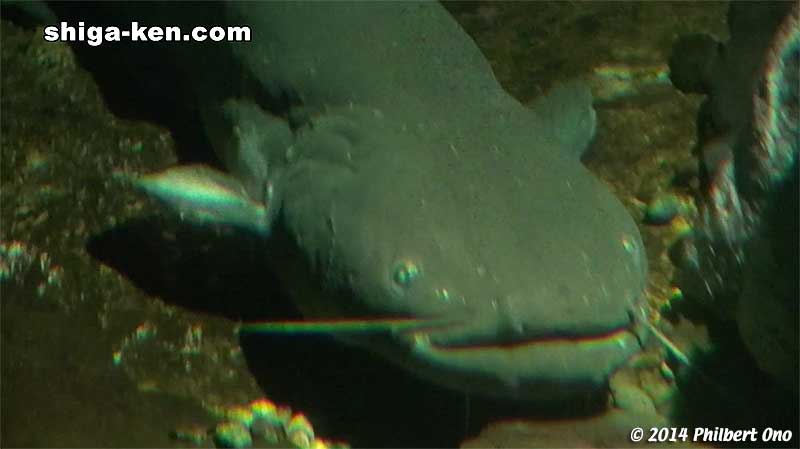
Caffy was originally the official mascot of Sports Recreation Shiga 2008, a national sports festival that was held annually from 1988 to 2011 (held in Yasu, Shiga in 2008). Chaffy was recently created for Shiga’s Koku-spo. Both Caffy and Chaffy are modeled after the Lake Biwa Giant Catfish.


A total of 37 sports and 14 para-sports were held by the 79th Japan Games. They included athletics (track and field), swimming, diving, water polo, soccer/football, tennis, rowing, canoeing, field hockey, boxing, volleyball, gymnastics, basketball, wrestling, weightlifting, cycling, judo, karate, bowling, golf, archery, kyudo archery, sports climbing, kendo, equestrian, triathlon, and even sumo. A few competitions like swimming and gymnastics were held in mid-September before the opening ceremony.
Winter sports were held during January–February before the main Games in autumn. Since Shiga is not cold enough or does not have adequate winter sports facilities, the winter sports were held outside Shiga in Okayama (figure skating and short-track speed skating), Gunma (speed skating), and Akita Prefectures (skiing).
Also, the cycling track race was held in Kyoto, rifle competition in Osaka, and equestrian in Hyogo.
There were also 26 demonstration sports such as billiards, nordic walking, and soft volleyball held in spring and summer.
A total of 18,340 athletes and coaches from all 47 prefectures participated in the 79th Japan Games.
Shiga Prefecture in 1st place (優勝)
Being the host prefecture, Shiga could afford to field athletes in many events. This brings more victories and more points to win the overall Japan Games Emperor’s Cup and Empress Cup. It’s almost like a tradition for the host prefecture to win both cups.
Shiga placed first in the following competitions:
- Archery – Youth female team
- Athletics – Men’s discus throw, Men’s 800m
- Badminton – Men’s overall
- Boxing – Men’s middleweight class
- Canoe sprint – Women’s canoe sprint Canadian single 200m and 500m, Youth female kayak single 500m
- Canoe Wildwater – Men’s kayak single 1500m
- Equestrian – Men’s six-obstacle show jumping, Youth freestyle dressage, Women’s standard show jumping, Youth team show jumping, Men’s derby, Women’s two-obstacle show jumping
- Fencing – Women’s epee, Men’s sabre
- Judo – Women’s team
- Karate – Youth male individual kumite
- Kendo – Youth male team, Men’s team, Women’s team
- Rifle shooting – Men’s 50m rifle three positions, Mixed adult’s 10m air rifle
- Rowing – Men’s coxed four, Youth female double scull
- Sailing – Women’s windsurfing (Iseda Ai)
- Tennis – Women’s team
- Trampoline – Men’s trampoline
- Triathlon – Men’s triathlon
- Weightlifting – Men’s 55kg class total lift, Men’s 55kg class clean & jerk
- Wrestling – Men’s Greco-Roman wrestling 130kg class and 87kg class, Youth male’s Greco-Roman wrestling 92kg class, Women’s wrestling 62kg class, Men’s freestyle wrestling 74kg class
79th Japan Games venues in Shiga

Japan Games competition venues were scattered all over Shiga using new or existing sports facilities both public and private. Except for Kora and Toyosato Towns, all of Shiga’s cities and towns hosted at least one competitive sport or demonstration sport. Otsu and Kusatsu hosted the most sports. Almost the entire prefecture thus had a stake in the Japan Games.
Some venues were within walking distance from the nearest train station, while others required a free shuttle bus, car, or taxi.
The equestrian venue was especially way out in Miki, Hyogo Prefecture. Really wanted to see it, but it was just too far away from Shiga even for a day trip.

The main stadium was the new Heiwado HATO Stadium (平和堂HATOスタジアム) in Hikone where the Opening and Closing Ceremonies and athletics (track and field) events were held.
Owned by Shiga Prefecture, Heiwado HATO Stadium was built in 2023 to meet the required specifications of the Japan Games. It replaced the old athletics field. The stands can seat 7,000, but there are no seat backs. The stadium has a nice view of nearby Hikone Castle. The stadium is geared for soccer while the neighboring stadium (HPL Baseball Park) is for baseball.
Local supermarket Heiwado won the stadium’s naming rights for five years by paying ¥10 million per year until March 31, 2028. “Hato” means dove, a symbol of peace and Heiwado.

All the competition venues were complemented by vendors selling Japan Games souvenirs and food.


Watching the Japan Games

The great thing about the Japan Games is that you can see a great variety of sports for free! No reservations required, and seats are usually readily available (except maybe for figure skating and gymnastics). Competitions at each venue usually last hours in a day and there’s a constant turnover of spectators, so seats usually open up. Spectators usually leave after their favored team or athlete finishes their competition. So you can just walk in and sit and watch any part of the games.
The only thing is that there are so many sports going on at the same time over a wide area that it’s hard to see all the sports you want to see. I managed to see only six sports (photos below).
The majority of spectators were from the host prefecture and friends and relatives of the athletes. I saw almost no foreigners. I thought it would be a prime opportunity to promote sports tourism in Shiga to foreign tourists, but there was little or no information in foreign languages. Koku-spo is apparently almost purely a local-only event. But it was a delight to see a few foreigner athletes competing.
Like the Olympics, there’s a torch relay, lighting of a cauldron, Opening and Closing Ceremonies (advance reservations required), and medal ceremonies where the top winners receive gold, silver, and bronze medals.
Although most people in Japan have heard of Kokutai or Koku-spo, I’ve noticed very few people among the Japanese public and my friends who have actually attended as spectators. It doesn’t get that much national media attention except when the Imperial family attends the Opening and Closing Ceremonies.
So it’s a rare event held in your prefecture only once every 40+ years. Glad I saw it since I don’t think I’ll ever see it again in Shiga.
79th Japan Games, 2025 – Opening Ceremony in Hikone
The Opening Ceremony was held at Heiwado HATO Stadium in Hikone on September 28, 2025 in the presence of Emperor Naruhito (who gave a short message) and Empress Masako. Final torch bearers included Hikone natives and Olympic medalists Kiryu Yoshihide and Ohashi Yui lighting a small cauldron during the ceremony.
Sports delegations from all the prefectures marched into the stadium. When the Shiga delegation appeared, a marching version of Biwako Shuko no Uta (Lake Biwa Rowing Song) was played (video below).
The Opening Ceremony required advance reservations.
The Emperor and Empress had arrived JR Maibara Station via shinkansen and was greeted by Shiga Governor Mikazuki on the train platform. They first had lunch at Maibara City Hall before going to the Opening Ceremony in Hikone. That night, they stayed at Biwako Hotel in Otsu.
On the next day on September 29, they watched badminton at Shiga Arena in Otsu. Later in the day, they visited the Shiga Prefectural School for the Visually impaired (滋賀県立盲学校). They left Shiga in the late afternoon from JR Maibara Station via shinkansen to Tokyo. They were seen off by a crowd lining the street to the station’s east entrance.
Their daughter Princess Aiko had also planned to attend the Japan Games on October 5th and 6th to see sports climbing and handball and visit Lake Biwa Museum and Azuchi Castle Archaelogical Museum. It was going to be her first visit to Shiga Prefecture. Unfortunately, she tested positive for COVID on October 1. She recovered from the fever on October 2, but still had a sore throat and cough. Her visit to Shiga was cancelled.
Athletics – 79th Japan Games, 2025 (Hikone)

Athletics – 79th Japan Games in Shiga (陸上競技)
When: October 3rd–7th, 2025
Where: Heiwado HATO Stadium (平和堂HATOスタジアム)
Map: https://maps.app.goo.gl/sNnYFio12GKgDP5j6
Official: https://shiga-sports2025.jp/kokuspo/competition/k_athletics
Results: https://kirokukensaku.net/5NS25/discipline_010_20251003.html
A wide variety of track and field events were held during the five days. Since different events were held at the same time, we could see a lot on each day. Athletes were running, jumping, and throwing at the same time.
Track events included sprints, middle and long distance runs, hurdles, steeplechase, relays, and race walking. Field events had high jump, pole vault, long jump, triple jump, shot put, discus throw, hammer throw, and javelin throw.

From JR Hikone Station, Heiwado HATO Stadium is about a 20-min walk. There were local buses from the station, but infrequent, so most people walked.

In the male (男子) and female (女子) categories, athletics have three different age classes. Adults (成年), Youth A (少年A), and Youth B (少年B). Youth A are athletes who are high school juniors or seniors. Youth B are in the third year of junior high school or high school sophomores.
Youth B athletes compete in only a few limited events such as the 100m sprint, 3000m run, and long jump, while Youth A compete in more events. There were also a few gender-specific events such as the pole vault only by women, and discus throw for only males.
Although the Japan Games athletics competition has 56 competition events for men, women, and youths, prefectural athletics delegations are limited to only 31 members including two coaches. This means not all prefectures are represented at each event. The delegation also cannot have more than 19 male athletes or more than 19 female athletes among the maximum total of 31. An athlete cannot compete in more than two events except for relay races.
Each prefectural team held qualifying competitions back home for athletes. Japan Games athletes must have competed in qualifying events at the prefectural level.
I watched athletics partially on three days: October 3, 4, and 5, 2025.

The main attraction was Hikone native Kiryu Yoshihide (桐生祥秀) in the mixed adult and youth male’s 4x100m relay as the first runner. He appeared twice, for the qualifying run on Oct. 3 and semi-finals the next day. However, his team was disqualified in the semi-finals (faulty baton passing), so sadly we didn’t see him again for the finals on October 5th.
He’s no stranger to Koku-spo, having competed in the 100m sprint (his specialty) while in high school at the 2011 and 2012 Kokutai. At the 2016 Rio Olympics, his 4x100m relay team won the silver medal for Japan.
In 2017, he became the first Japanese sprinter to run 100 meters in less than 10 sec. at 9.98 sec. It was sensational sports news.
This past July at the Japan Athletics Championships 2025 in Tokyo, he won the men’s 100m national title with 10.23 sec. He has brought much pride to Hikone and Shiga. I do have a video of him running. Will post it later.
All of Shiga’s athletics competitors wore Biwako Blue with the “25” bib number. Apparently, “25” denotes the year 2025.


Youth A male, 5,000-meter run finals (少年男子A 5000m 決勝) (Oct. 3). Won by Hyogo Prefecture (新妻 遼己) in 13 min. 35.33 sec. Shiga didn’t make the finals.

Men’s 3,000-meter steeplechase finals (成年男子3000m 障害 決勝) Won by Ibaraki Prefecture in 8 min. 27.35 sec. Shiga (bib 25) was 4th place. (Oct. 3)

Men’s 800-meter run, Heat 1 (成年男子800m 予選1組) (Oct. 3).

Passing the baton from the third to fourth runner for the Mixed adult and youth male’s 4×100m relay Heat 1. Kiryu Yoshihide was part of this team as the first runner. (成年少年男子共通4×100mリレー 予選1組) (Oct. 3)

Mixed adult and youth male’s 4×100m relay Heat 1. Shiga (bib No. 25, Tanaka) won Heat 1 and advanced to the semi-finals the next day. (成年少年男子共通4×100mリレー 予選1組) (Oct. 3)

Mixed adult and youth female’s 4x100m relay Heat 2 (Chiba, Yamagata, Ehime, Iwate, Gunma, Wakayama, Saga, Toyama). Passing the baton from the second to third runner. (成年少年女子共通4×100mリレー 予選2組) (Oct. 3)


Mixed adult and youth female’s 4x100m relay Heat 2, passing the baton from the third to fourth runner. Chiba won this heat and advanced to the semi-finals along with Yamagata, Ehime, Iwate, and Gunma. (成年少年女子共通4×100mリレー 予選2組) (Oct. 3)

Mixed adult and youth female’s 4x100m relay Heat 3. (成年少年女子共通4×100mリレー 予選3組). Shiga (bib 25) won this heat. Shiga, Miyagi, Shizuoka, Aichi, and Okayama advanced to the semi-finals. Gifu was disqualified, and Yamaguchi withdrew.


Youth A female 2000-meter steeplechase finals with 18 runners. Right photo is Shiga runner KATAYA Hina (片矢 陽菜) in the water obstacle. Won by Ibaraki Prefecture (シュブルチェック アンナ). Osaka and Nagano came in 2nd and 3rd. Shiga (KATAYA Hina, bib 25) placed 14th. (少年女子A 2000m障害 決勝) (Oct. 3)

Women’s hammer throw (4 kg) finals by Shiga athlete KODATE Miharu (小舘 充華) who placed 2nd with 62.85 meters. Won by Aomori Prefecture (村上 来花) with 66.22 meters. (成年女子ハンマー投 決勝) (Oct. 3)
Kodate is retiring after this season after hammer throwing for 12 years since her first year in high school. Although she’s originally from Akita Prefecture, her husband (奥村匡由), also a hammer thrower, is from Shiga. So she moved here upon marriage and represented Shiga.
Her best hammer throw is 65.74 meters, the sixth farthest in Japan. She hopes to stay connected with athletics after retirement.

Men’s javelin throw by Shiga athlete Yamada Hayato (山田 隼人) who placed 4th with 75.23 meters. Winner was Ehime Prefecture (崎山 雄太) with 80.43 meters. (Oct. 4) 成年男子やり投 決勝


Left: High jump was held at one end of the track/field. Youth male high jump finals won by Osaka Prefecture (中村 佳吾) with 2.15 meters. Shiga didn’t appear in the finals. (Oct. 3) (少年男子共通走高跳 決勝).
Right: Youth B female triple jump finals (Oct. 3) (少年女子B走幅跳 決勝)

In athletics, Shiga won in two events: Men’s discus throw (湯上 剛輝) with 57.97 meters, and in the Men’s 800m run at 1 min. 45.20 sec. (落合 晃). Congrats!

JR Hikone Station had this helpful Japan Games Information Center where we could pick up pamphlets and ask questions. They also posted info on when Kiryu Yoshihide would compete.
Rowing – 79th Japan Games, 2025 (Lake Biwa, Otsu)

Rowing – 79th Japan Games in Shiga (ローイング 旧ボート)
When: October 4th–7th, 2025
Where: Kansai Mirai Rowing Center, Otsu (関西みらいローイングセンター(滋賀県立琵琶湖漕艇場))
Map: https://maps.app.goo.gl/YMMz1RbmmZvntURX7
Official: https://otsu-kokuspo2025.jp/game/type/g_kan.html
https://shiga-sports2025.jp/kokuspo/competition/k_boat
Results: https://kirokukensaku.net/5NS25/discipline_080_20251004.html
If there’s a sport Shiga was made for, it’s rowing (and sailing). With Lake Biwa, Shiga has a long history of water sports, especially rowing, both competitive and recreational. I went to see rowing on October 7, the last day when finals races were held.
The rowing venue was the Kansai Mirai Rowing Center also long known as the Shiga Prefectural Lake Biwa Rowing Course (関西みらいローイングセンターor 滋賀県立琵琶湖漕艇場). This is a 1000-meter, straight rowing course in calm waters near the mouth of Seta River, the lake’s sole outflowing river.
This was also the rowing venue 44 years ago for the 36th Kokutai held in Shiga in 1981. About a 20-minute walk from JR Ishiyama Station.
The rowing venue has no spectator seating except for a few benches. You either stand or sit on the ground. Having a portable stool or mat is recommended.
Many rowing events are held here such as the annual Asahi Regatta, Japan’s largest annual regatta with hundreds of rowers from junior high schoolers to age 60+.

In Japanese, the sport of rowing was long called “boat” (ボート). The sport was recently officially renamed in Japanese as “rowing” (ローイング), matching the English.
As illustrated below, the Japan Games rowing competition had four categories each for men, women, youth males, and youth females: Single scull, double scull, coxed quadruple (each rower uses two oars), and coxed four (each rower uses one oar). The cox is a non-rowing member sitting in the front to control the rudder.
The first to cross the finish line (front tip of boat) after racing 1,000 meters was the winner. Races were usually over in three or four minutes.

Women’s single scull finals with Shiga (三苫 詩葉) in blue (3rd place) and Aichi (浅井 奏音) in the background who won in 3 min. 40.20 sec.
Single scull (シングル スカル) is a solo rower using two oars on a 8-meter long boat. The word “scull” means “a pair of oars.”

Double scull (ダブル スカル) has two rowers each using two oars on a 9-meter long boat. Their rowing must synchronize well.


Coxed quadruple (舵手付クォドルプル) has a cox (pilot who controls the rudder) and four rowers using two oars each. The boat is 12 meters long.

Coxed four (舵手付フォア) has a cox (pilot) and four rowers using only one oar each. The boat is 12 meters long. (Missed seeing this event at the Japan Games.)
The Japan Games doesn’t have the crowd-pleasing coxed eight category with eight rowers on one long boat.
Shiga won two rowing events: Men’s coxed four and Youth female’s double scull. Congrats!


Near the finish line were interviews, picture-taking, rowing awards ceremonies.


Japan Games information booth at JR Ishiyama Station and JR Otsu Station.

Field Hockey – 79th Japan Games, 2025 (Ibuki, Maibara)

Field Hockey – 79th Japan Games in Shiga (ホッケー)
When: October 1st–5th, 2025
Where: OSP Hockey Stadium and Maibara Ibuki No. 1 Field, Maibara (OSPホッケースタジアム、米原市伊吹第1グラウンド)
Map: https://maps.app.goo.gl/6tQVMunZAUeXLktu7
Official: https://shiga-sports2025.jp/competition/k_hockey
https://kokutai.hockey.or.jp/
Results: https://kirokukensaku.net/5NS25/discipline_090_20251001.html
More photos: Women’s field hockey match between Shiga and Yamanashi
The field hockey venue is in a scenic setting with Mt. Ibuki in the background. Two adjacent hockey fields were used. OSP Hockey Stadium was the main field with blue artificial turf, and Maibara Ibuki No. 1 Field has yellow turf and used mainly for youth matches. Both venues had shaded spectator seating (non-reserved). Smaller than a soccer field, the hockey field or pitch is 91.4 meters long and 55 meters wide.
Adult teams have 11 players, while youth teams (up to jr. high) have six. Players can shoot for the goal only while within the 14.63-meter shooting semicircle in front of the goal. The hockey ball is about the same size as a baseball and has dimples like a golf ball. Players are prohibited from shooting the ball at any player above the waist or doing anything dangerous to other players. They cannot touch the ball with any part of their body except the stick. Only the goalkeeper can touch the ball with their body.
A field hockey match is 60 minutes long with four 15-minute quarters. There is a 2-minute interval between quarters and halftime break of 10 minutes when they water the field. If the score is tied, there’s a shootout except in the finals match and 3rd place match when tied teams are declared 1st or 3rd place co-winners.


Only ten prefectural field hockey teams in each category (men’s, women’s, youth male, and youth female) play during the Japan Games. They consist of the host prefecture (automatically receiving a tournament slot) and winners of their respective nine blocks (Hokkaido, Tohoku, Kanto, Kita-Shin’etsu, Tokai, Kinki, Chugoku, Shikoku, Kyushu). Prefectures in each block hold their own field hockey tournament in August to produce the winning team to represent the block at the Japan Games in autumn.
The ten competing teams in women’s field hockey were Shiga, Hiroshima, Saga, Yamanashi, Kagawa, Iwate, Toyama, Nara, Hokkaido, and Gifu.
The ten teams in men’s field hockey were Shiga, Fukui, Shimane, Yamagata, Kagawa, Kagoshima, Tochigi, Nara, Hokkaido, and Gifu.
In the end, Shiga’s men’s team won 3rd place by beating Fukui (2-1), Shiga’s women’s team won 3rd place by tying Nara (1-1), and Shiga’s youth female team won 3rd place by beating Iwate (1-0). Shiga’s youth male team didn’t place.


Field hockey has been included as a competitive sport since the first Kokutai in 1946. Thanks to the Kokutai, field hockey in Japan has spread. However, Japan’s field hockey population remains low, about 30,000 compared to soccer’s 810,000 today.

I went to see field hockey on October 2, the second day when quarterfinals were held in all four categories. Watched Shiga’s women’s team beat Yamanashi (Kanto block winner) in the quarterfinals in a shootout (2-2). Photos below.

In Maibara’s Ibuki district, field hockey has been a symbol sport since the last Japan Games (then known as Kokutai) held in Shiga in 1981. Thanks to the 1981 Kokutai, Maibara has developed into a “Hockey Town” and since become a powerhouse in field hockey producing a number of athletes for Japan’s Olympic field hockey team.
When venues were being decided for the 1981 Kokutai in Shiga, Ibuki-cho, Santo-cho, Omi-cho, and Maihara-cho Towns (eventually merged to become the city of Maibara in 2005) decided to team up to host the field hockey competition. Since field hockey was still a very minor sport in Japan, there was a lot of local skepticism and opposition to hosting it. However, only Ibuki Town stood firm and decided to host field hockey for the 1981 Kokutai.
To prepare for the upcoming Kokutai, Ibuki Town got serious about field hockey and in 1979, the Ibuki elementary school team won the national field hockey tournament for the first time. This sparked a hockey fever in Ibuki.
At the 1981 Kokutai, Shiga’s men’s field hockey team won the competition together with Gifu Prefecture in a tied final match. Spectators of mostly relatives and friends of the players went wild. They even clamored for autographs from the players. Hockey fever hit Ibuki (later Maibara) and hasn’t stopped since.
Ibuki High School’s male and female field hockey teams have since won national high school tournaments (インターハイ). Ibuki has also produced Olympic field hockey athletes for the Japan’s national team.


Youth female hockey quarterfinal match between Fukui and Shimane (red) at Maibara Ibuki No. 1 Field.


In 2020, Shiga’s first professional field hockey team, BlueSticks Shiga was formed. Based in Maibara (OSP Hockey Stadium), they belong to the Samurai Div. 1 League.
Although Ibuki junior high and high school produced top-notch hockey players, they had nowhere to go in Shiga after graduation. They ended up on hockey teams outside Shiga. To remedy this and to invigorate field hockey in Shiga, BlueSticks Shiga was formed. Their season is from spring to autumn.

More photos of Japan Games women’s field hockey match between Shiga and Yamanashi here.
Canoe Sprint – 79th Japan Games, 2025 (Notogawa, Higashi-Omi)

Canoe sprint – 79th Japan Games in Shiga (カヌー スプリント)
When: October 3rd–6th, 2025
Where: Ibanaiko Special Canoe Course (伊庭内湖特設カヌー競技場)
Map: https://maps.app.goo.gl/R2NX5SfJEBaaL1iS6
Official: https://shiga-sports2025.jp/kokuspo/competition/k_canoe
Results: https://kirokukensaku.net/5NS25/discipline_350_20251003.html
The canoe sprint venue was near the famous giant Notogawa Waterwheel (12-meter diameter), the symbol of Notogawa. It was rebuilt as the third-generation giant waterwheel on August 28, 2025 in time for the Japan Games. The old, second-generation waterwheel was old and out of order (not turning).
However, the newly built giant waterwheel was closed to the public during the Japan Games since the immediate area was occupied by athletes and canoes.
The canoe sprint venue was the lakeside Notogawa Waterwheel and Canoe Land recreational area (能登川水車とカヌーランド) where you can normally rent a swan boat, rowboat, or canoe (closed on Mon., the day after a national holiday, and Dec. 28–Jan. 4).
It’s on the shore of an attached lake named Lake Iba or Iba-naiko (伊庭内湖). The small lake is “attached” to Lake Biwa via a short waterway. The surrounding rural area is a designated National Important Cultural Landscape (重要文化的景観). Shiga has a few other designated cultural landscapes.
I saw the canoe sprint on October 5 when it was raining. Not to be confused with the canoe slalom and wild water events held along Seta River in Otsu.

The canoe sprint course was 200, 500, or 1500 meters off the shore of the calm Lake Iba.
Competition categories for both adult and youth male and female were based on the type of canoe (kayak or Canadian), number of paddlers (single or pair), and distance (200 m, 500 m, or 1500 m).

Kayaks have the paddler sit in the canoe while looking forward and using a double-bladed paddle. There can be a single or pair of paddlers.

Canadian canoes have the paddler kneeling on one leg and using a single-bladed paddle. There can be a single or pair of paddlers.


Shiga won three canoe sprint events: Women’s canoe sprint Canadian single 200m and 500m, and Youth female kayak single (500m). Congrats!


Lakeside spectators could sit or stand along the lakeshore or sit on free, non-reserved chairs.


People could also huddle under this large canopy (rest area) to watch the canoe sprints on a TV monitor. Due to the rain, lots of people opted to watch it on the monitor.


Canoe sprint signboard at the main entrance while the waterwheel area was occupied by athletes and canoes.

This small building within Canoe Land is the Waterwheel Museum (水車資料館) and cafe named Mizuguruma (みずぐるま) which means waterwheel. The museum shows how the waterwheel was used to mill rice. During the Games, the building was used as the canoe event’s administrative office.


JR Notogawa Station is shaped like a waterwheel. Nearby was the free shuttle bus stop for the canoe sprint, soccer, and boxing venues.


JR Notogawa Station was decorated with Japan Games PR signs and unmanned information table. In front of the station is a small shopping mall, convenient to get a bite to eat or coffee before or after spectating.

Sumo – 79th Japan Games, 2025 (Nagahama)

Sumo – 79th Japan Games in Shiga (相撲)
When: September 29–October 1, 2025
Where: Nagahama Dome, Nagahama (滋賀県立長浜ドーム)
Map: https://maps.app.goo.gl/LY2sWHvue7yAx5PP6
Official: https://shiga-sports2025.jp/kokuspo/competition/k_sumo
Results: https://kirokukensaku.net/5NS25/discipline_240_20250929.html
Went to see sumo on September 29, 2025, the first day and saw the youth team’s qualifying round. This must be the only Japan Games sport with no female competitors even though there are amateur women sumo wrestlers in Japan. (They are appropriately dressed and expose little skin.)

The sumo competition had no rankings like yokozuna, ozeki, etc., found in college and professional sumo. It was basically an elimination tournament for adult and youth sumo teams and individuals representing 47 prefectures.
Each prefecture was represented by an adult sumo team of three wrestlers and youth team of five. The top 16 sumo teams winning the qualifying rounds advanced to the championship round. There also was an individual competition. No weight classes.


They don’t throw salt on the ring nor rinse their mouths with water like professional sumo wrestlers do. Shinto religious rituals and elements were excluded. The match started within 20 sec. after both wrestlers stepped into the sumo ring. Not much time for any stare-down. The two grapplers do bow to each other before and after the match though.


On the final day, Aichi Prefecture (杉本 弘樹) won the men’s individual title by defeating Kanagawa, Tottori won the adult team title by defeating Wakayama, Tottori won the youth team title by defeating Saitama, and Wakayama won the youth’s individual title by defeating Tokyo.


Nagahama Dome was one of the most convenient venues, short walk from JR Tamura Station south of JR Nagahama Station. PR banners festooned the entrance area.
Boxing – 79th Japan Games, 2025 (Higashi-Omi)

成年男子ライト級 2回戦: 三村 洸敬(勝者) 岡山県(駒大) vs. 角田 琉星 山形県(専大)
Boxing – 79th Japan Games in Shiga (ボクシング)
When: September 29–October 3, 2025
Where: Notogawa Arena, Higashi-Omi (東近江市能登川アリーナ)
Map: https://maps.app.goo.gl/Tx4TyLCDiUAWRL9r9
Official: https://shiga-sports2025.jp/kokuspo/competition/k_boxing
Results: https://kirokukensaku.net/5NS25/discipline_100_20250929.html
The boxing venue had two boxing rings with fights held almost at the same time. Men were in eight weight classes from light flyweight to light heavyweight, women in flyweight only, and youth males in eight weight classes from pinweight to middleweight. No youth female boxers.
Scoring was done by five ringside judges. There were male and female referees. I visited on September 30, 2025 and saw two men’s lightweight matches.


Spectators came and went with each match, so it was easy to get a seat. The place was relatively civil and quiet, no wild crowds like in the movie Rocky.


成年男子ライト級 2回戦: 三村 洸敬(勝者) 岡山県(駒大) vs. 角田 琉星 山形県(専大)
Since the spectator seats were below the ring, it was hard to get good shots of the boxers’ faces with the ropes in the way.


Okayama Prefecture’s Mimura Hiroyuki takes a break in his corner with his coach fanning him with a towel. He won the match.


In-between matches, cleanup crew wipes off sweat from the ring floor.


In the other ring, men’s lightweight division: Shizuoka Prefecture (Shibata Reo, blue trunks) vs. Kagawa Prefecture (Onoue Jiyu, winner).
Shiga (墨 亮多) won the men’s middleweight class on the final day October 3. Congrats!


Souvenir and food stalls outside Notogawa Arena entrance. Notogawa Arena opened in August 2020 as a gymnasium with two basketball/volleyball courts. Totally enclosed and air conditioned. Spectator capacity is 250 fixed seats.

Entrance lobby had this nice welcome table with pamphlets flanked by flowers sent by prominent boxers like Yamanaka Shinsuke.


Right: PR sign at Notogawa Ground soccer field near Notogawa Arena.
Notogawa Arena had infrequent shuttle buses from JR Notogawa Station West Exit. Otherwise, it was a 20-min. walk straight down the road. The arena was next to a soccer field.
Closing Ceremony (Hikone)
The 79th Japan Games Closing Ceremony was held on October 8, 2025 at Heiwado HATO Stadium in Hikone. Princess Kako, second daughter of Crown Prince Akishino, visited Shiga on October 7 and 8 to watch basketball and attend the Japan Games Closing Ceremony highlighted by the Blue Impulse aerobatic team flying over Hikone for the second time since June 2017.
She’s a charming and beloved Imperial family member especially after filling in for her older sister Mako who left the Imperial family to move to New York in 2021 with her commoner husband.
Her parents Crown Prince Akishino and wife Princess Kiko later attended the opening ceremony of the para-athlete games on October 25.
Look of the Japan Games

Unlike the Olympics, the Japan Games didn’t really have a uniform design or color scheme in Shiga. Each host city had its own designs and monikers like “Hikone 2025.” Only the official mascots were the same.


All those Koku-spo banners and signboards (わたSHIGA輝く国スポ・障スポ) we’ve seen at train stations and public facilities in Shiga can now be removed. It was getting a little overbearing to always see them in your face. Nice to see things returning to normal for now…


Next Japan Games in 2026, Aomori


The next Japan Games in 2026 will be in Aomori Prefecture. I can’t say “See you there!” since I don’t think I’ll be there. But if you’re in the neighborhood when it’s held next October, it’s worth seeing.
80th Japan Games (第80回国民スポーツ大会)
- When: October 10th–20th, 2026 (Para Games October 23rd–26th, 2026)
- Where: Aomori Prefecture
- Competitive sports: 37 (plus 14 para-sports)
- Official mascot: アップリート君
- Official website: https://aomorikokuspo2026.pref.aomori.lg.jp/