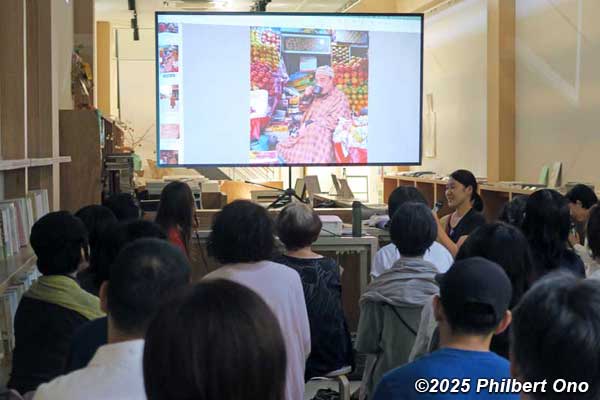
This web page gives basic info about the Nagahama Hikiyama Festival, the April 2026 festival schedule (illustrated), and a synopsis of the four kabuki plays performed by the four Hikiyama floats in 2026. Most images are screenshots from the comprehensive video (embedded above).
Updated: April 14, 2026
Nagahama Hikiyama Matsuri (長浜曳山祭) is a traditional float festival held annually on several days centering on April 15 by Nagahama Hachimangu Shrine in the city of Nagahama in northern Shiga Prefecture not far from Kyoto, Nagoya (Aichi), and Tsuruga (Fukui).
The main highlight is child kabuki actors (boys age 5 to 12) performing famous kabuki plays on four ornate wooden floats (hikiyama) pulled through the city’s main streets. Each hikiyama float has a small stage. They perform in public on four consecutive days. So if you can’t make it on one day or if the weather is bad, see it on a different day.
In 2026, the following four kabuki floats will appear out of the festival’s twelve kabuki floats.
- Float No. 1: Tokiwa-zan (常磐山)
- Float No. 2: Kujaku-zan (孔雀山)
- Float No. 3: Okina-zan (翁山)
- Float No. 4: Banzai-ro (萬歳樓)
What to know about Nagahama Hikiyama Matsuri

- Festival dates to see child kabuki performances are April 13, 14, 15, and 16. The main day is April 15. Festival dates remain the same every year regardless of the day of the week.
- The festival has a total of twelve kabuki floats, but only four of them appear in the festival to perform child kabuki. There’s also a ceremonial float (no kabuki) that appears every year.
- Three groups of four kabuki floats take turns appearing in the festival each year, so each float and group appear (performs kabuki) once every three years. To see all twelve floats, you will need to see the festival at least three years in a row.
- Each float performs kabuki three or four times each day. So you have a choice of seeing up to 16 kabuki performances a day at multiple sites. This makes it easy to see all four child kabuki plays in a day.
- Each kabuki play is 40 minutes long.
- The main festival day of April 15 (Honbi 本日) is when kabuki is performed for the gods at Nagahama Hachimangu Shrine. Kabuki is held all day from morning to evening at multiple locations. A few processions and ceremonies are also held.
- The four floats are numbered from 1 to 4, as decided by drawing lots on April 13. Float No. 1 performs first and has the honor to host the Sanbaso prayer dancer who performs first. Float No. 4 performs last on the main festival day.
- Besides child kabuki performances, there is a variety of rituals and processions. See the festival schedule below.
- The main festival sites are Nagahama Hachimangu Shrine (map), Otemon-Kurokabe area, and the Otabisho parking lot (map) near Hokoku Shrine. See the main festival map.
- The floats also perform kabuki in their respective neighborhoods on April 13, 14, and 16. See the festival map for their locations.
- All the festival sites are within walking distance from JR Nagahama Station on the JR Hokuriku Line. Easy day trip from Kyoto, Nagoya, Gifu, Tsuruga, or Fukui.
- The festival is held by Nagahama Hachimangu Shrine.
- Nagahama Hikiyama Matsuri was inscribed as a UNESCO Intangible Cultural Heritage of Humanity as one of the 33 “Yama, Hoko, and Yatai float festivals in Japan” on Dec. 1, 2016.
- If you want to know how the festival started, jump to the history section.
- Official website: https://nagahama-hikiyama.or.jp/foreign/eng.html
- Festival pamphlet in Japanese: https://nagahama-hikiyama.or.jp/web/wp-content/uploads/2026/03/down2026brochure.pdf
CONTENTS
- Nagahama Hikiyama Matsuri Festival 2026 Basic Schedule
- 2026 Nagahama Hikiyama Festival floats and kabuki plays (synopsis)
Tokiwa-zan | Banzai-ro | Okina-zan | Kujaku-zan - About Nagahama Hikiyama floats
- Nagahama Hikiyama Matsuri Festival 2026 Detailed Schedule
April 13 | April 14 | April 15 (Main day) | April 16 - About the Sanbaso dancer
- Map of float procession route
- Tips for seeing the Nagahama Hikiyama Festival
- Origin of Nagahama Hikiyama Matsuri Festival
- More info
2026 Nagahama Hikiyama Matsuri Festival Basic Schedule
The following events are open to the public. Kabuki performance dates and times in red. Scheduled times are all approximate.
April 9th–12th (Hadaka-mairi)
- 7:30 pm: Hadaka-mairi water splashing prayers at Nagahama Hachimangu Shrine and Hokoku Shrine (裸参り). Really fun to watch. Details here.
April 12 (Mikoshi procession)
- 6:30 pm: Portable shrine (mikoshi) procession from Nagahama Hachimangu to Hokoku Shrine and the Otabisho rest place (神輿渡御). Details here.
April 13 (Evening kabuki in neighborhoods)
- 6:00 pm or 7:00 pm: Child kabuki evening performances in local neighborhoods (十三日番). Details here.
April 14 (Morning kabuki, floats assemblage, and evening procession)
- 9:00 am to 1:00 pm: Child kabuki morning performances in local neighborhoods. Details here.
- 1:00 pm to 4:30 pm: All four kabuki floats move to and gather at Nagahama Hachimangu (登り山). Details here.
- 3:30 pm: Naginata float arrives at Otabisho.
- 7:00 pm: Child kabuki evening procession (yuwatari) from Nagahama Hachimangu to Hikiyama Museum (役者夕渡り). Details here.
April 15 (Main day) Details here
- 8:30 am: Morning kabuki procession and arrival at Nagahama Hachimangu Shrine (役者朝渡り).
- 8:55 am: Naginata Sword Procession arrival at Nagahama Hachimangu Shrine (長刀組太刀渡り).
- 9:05 am: Festival opening ceremony with naginata sword (長刀組翁招き).
- 9:20 am to 1:35 pm: Nagahama Hachimangu Shrine child kabuki performances by four floats in succession (狂言執行). After the 40-min. performance, each float gives three more performances as it moves through Otemon Arcade and reaches the Otabisho. Details here
- 11:25 am to 5:05 pm: Otemon Arcade child kabuki performances by four floats.
- 3:25 pm to 7:40 pm: Otabisho child kabuki performances by four floats.
- 8:00 pm: At the Otabisho, religious ceremony, portable shrine parade, and departure of all floats.
April 16 (Kabuki in neighborhoods)
- 9:30 am to 8:40 pm: Child kabuki performances all day in local neighborhoods. Details here.
Second Sat. of October (Oct. 10, 2026)
- 9:00 am–4:00 pm: At Hikiyama Museum, exhibited floats are replaced. Details here.
2026 Nagahama Hikiyama Festival floats and kabuki plays

In April 2026, the following four Nagahama Hikiyama floats will appear and perform the following kabuki plays (order to be determined later). I also provide a synopsis of each kabuki play below.
Understanding the kabuki plays may take some effort and background knowledge. Of course even if you don’t understand anything, you can just enjoy watching the costumes, acting, and theatrics and admire the beautiful floats.
*As of this writing, the Float numbers have not been set yet. Have to wait until April 13 when they draw lots. Official Japanese website will announce it.
- Float No. 1: Tokiwa-zan “Forever Unchanging Float” (常磐山) (呉服町組)
At Gappo’s Hermitage
Sesshū Gappō-ga-Tsuji (摂州合邦辻 合邦庵室の場) - Float No. 2: Kujaku-zan “Peacock Float” (孔雀山) (神戸町組)
Ichijo Okura
Ichijo Okura (一条大蔵譚) - Float No. 3: Okina-zan “Venerable Old Man’s Float” (翁山) (伊部町組)
Scene at the Former Hagi Palace
Meiboku Sendai Hagi Goten-no-ba (伽羅先代萩 御殿の場) - Float No. 4: Banzai-ro “Eternal Life Float” (萬歳樓) (瀬田町組)
The Heike and the Island of Women – Shunkan
Heike Nyogo no Shima – Shunkan (平家女護島 俊寛)
Float No. 1: Tokiwa-zan

Sesshū Gappō-ga-Tsuji (摂州合邦辻 合邦庵室の場) – At Gappo’s Hermitage (Tokiwa-zan)
Gappo Doshin was a son of a daimyo lord, but now a poor man living in a hermitage. His daughter Tamate Gozen became the second wife of Lord Takayasu Saemon. Saemon was the daimyo lord of Kawachi Province in eastern Osaka.
Saemon had two sons. One was Shuntokumaru who was his heir and legitimate son. His other son was Jiromaru born to a concubine. Jiromaru wanted to kill Shuntokumaru and take over the family estate.
Tamate Gozen was the stepmother to both sons, but she was in love with stepson Shuntokumaru. She once gave Shuntokumaru some sake to pledge her love for him in secret. But she poisoned the sake, causing him to become blind and a leper.
Shuntokumaru flees his home with his fiancée Princess Asaka and takes shelter at Gappo’s hermitage. Tamate Gozen follows him and forces her way inside to meet Shuntokumaru. Her father Gappo becomes angry and stabs her with a sword.
With her dying breath, Tamate Gozen reveals that her illicit love and the poisoning were to protect Shuntokumaru from Jiromaru. It made Shuntokumaru leave his home, away from Jiromaru. She also explains that drinking her blood can cure Shuntokumaru. Having saved him, she then dies happy.
Reference: https://www.kabuki21.com/gappo.php
Float No. 2: Kujaku-zan
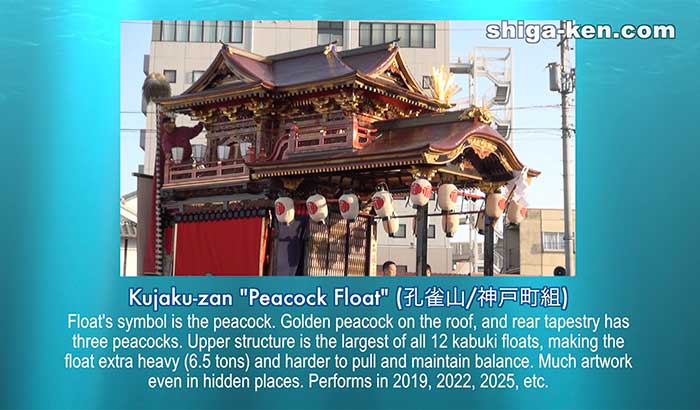
Ichijo Okura (一条大蔵譚) (Kujaku-zan)
This story takes place in 12th century Kyoto when the Genji and Heike samurai clans were fighting each other to rule Japan. During the Heiji Rebellion, Lady Tokiwa Gozen lost her husband Minamoto no Yoshitomo, the head of the Genji clan. Taira no Kiyomori, the head of the enemy Heike Clan, forced her to become his concubine in exchange for sparing the lives of her three sons.
Tokiwa Gozen was later allowed to marry Ichijo Okura Naganari, Kiyomori’s samurai retainer. Okura actually favored the Genji, but acted like an imbecile to seem harmless to the Heike. Tokiwa Gozen lived in Okura’s residence and played archery every night.
Minamoto no Yoshitomo’s loyal retainer Yoshioka Kijiro and his wife Okyo sneak into Okura’s residence and interrogates Tokiwa Gozen, even beating her. However, when they find out that Tokiwa Gozen actually wanted the Heike Clan to be overthrown, they apologize. Their conversation was overheard by Yatsurugi Kageyu, Okura’s chief retainer and a Heike Clan insider.
As Kageyu hurried to inform Kiyomori about Tokiwa Gozen’s true allegiance, Kijiro tries to stop him, but someone from behind the sliding door stabs him. Of all people, it was Okura, the imbecile who held a long sword. Okura actually wanted to restore the Genji Clan to power, but kept his true intentions a secret from the Heike by acting like an imbecile. Okura had trained in Kiichi Hōgen combat techniques.
Okura praised Tokiwa Gozen for prioritizing her children’s safety despite being seen as unfaithful. Okura entrusts Kijiro and Okyo with the Genji Clan’s most prized treasure, the Tomokirimaru sword. He then beheads Kageyu, and laughs loudly saying, “Do this with Kiyomori’s head.” He becomes his imbecile self again.
Reference: https://www.kabuki21.com/okura_monogatari.php
Float No. 3: Okina-zan
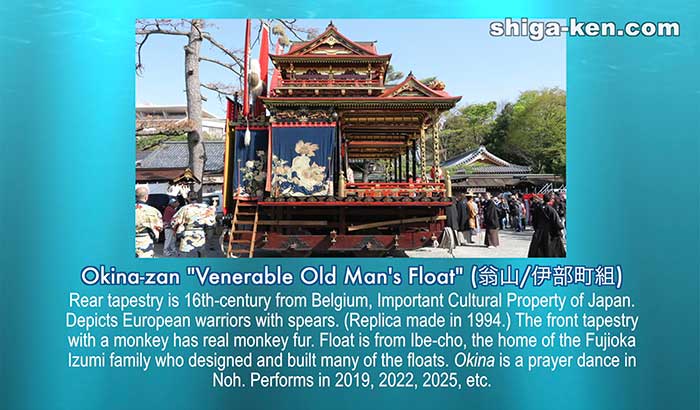
The Palace Scene from Meiboku Sendai Hagi (伽羅先代萩 御殿の場) (Okina-zan)
This story is about loyalty and sacrifice by a nursemaid named Masaoka taking care of young Tsuruchiyo, the new daimyo lord in northeastern Japan. Masaoka also has a son the same age named Senmatsu. The three of them live at the lord’s palace.
However, family enemies such as Lady Sakae Gozen, Oki-no-i, and Yashio plotted to poison Tsuruchiyo and take over the samurai domain. So Masaoka prepared Tsuruchiyo’s meals herself. But this took time, so both Lord Tsuruchiyo and son Senmatsu were hungry. Senmatsu famously said: “Even if I am hungry, I do not feel it.”
Masaoka tells her son Senmatsu to be ready to sacrifice himself and eat Tsuruchiyo’s food if it looked poisoned.
Lady Sakae Gozen then visits the palace to give some sweets for Tsuruchiyo. She insists that he eat them. Senmatsu then rushes in and eats the sweets, pretending to be Tsuruchiyo. He suffers from the poison, and Yashio kills him with a dagger to cover up the plot. His mother Masaoka remains calm and convinces the plotters that she is an ally.
She is entrusted with an important document listing the names of the plotters. Masaoka later goes to Senmatsu’s body to praise and mourn him.
Reference: https://www.kabuki21.com/takenoma_goten_yukashita.php
Float No. 4: Banzai-ro
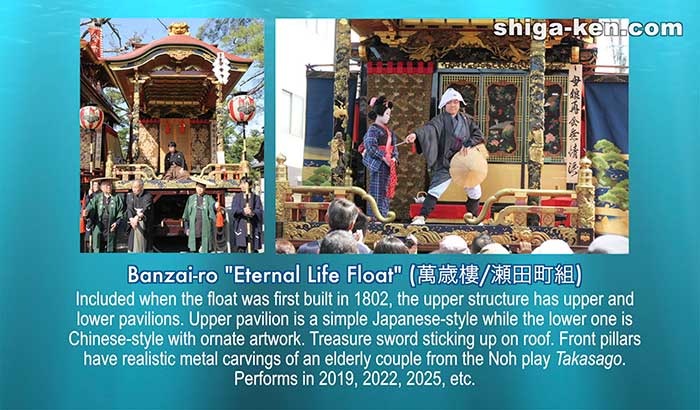
The Heike and Nyogo-no-shima Island of Women – Shunkan (平家女護島 俊寛) (Banzai-ro)
Priest Shunkan is living a miserable life of exile on Kikai Island together with Naritsune and Yasuyori, the fellow plotters of their failed revolt against Japanese ruler Taira no Kiyomori. It’s a far cry from their former lives of luxury.
Meanwhile, Naritsune has fallen in love with Chidori, a woman shellfish diver on the island. Priest Shunkan conducts a simple wedding ceremony for them with a traditional toast using mountain water instead of sake.
Then they see a ship bringing an Imperial messenger named Senoo Taro Kaneyasu who announces an Imperial order pardoning both Naritsune and Yasuyori, but not Shunkan who is shocked.
A second messenger Tanzaemon Motoyasu reveals that since Shunkan was the leader of the plot to overthrow Kiyomori, Shunkan is given a lesser pardon of being allowed to only return to his hometown of Bizen.
Shunkan is overjoyed at the good news and the three men and Chidori go to the boat to leave the island. However, Kaneyasu says that he has orders to take only three persons and refuses to take Chidori.
Naritsune says he would rather remain with his wife Chidori on the island in poverty than return to the capital without her. But he is forced to board, leaving Chidori behind. Shunkan begs Kaneyasu for leniency, but Kaneyasu refuses.
Then Kaneyasu adds to Shunkan’s grief by telling him that his wife Azumaya killed herself rather than becoming Kiyomori’s concubine. Enraged, Shunkan snatches Kaneyasu’s sword and kills him.
He then urges Chidori to board to join Naritsune, telling Tanzaemon that, by killing Kaneyasu, his pardon must now be considered null and that he must remain in exile. However, since the government order is to take back three persons, Chidori must go in his place.
The young couple and Yasuyori bid him farewell. As the ship sails away, Shunkan is left with the mooring rope slipping through his hands. From the top of a rock, Shunkan waves desperately to the ship which vanishes over the horizon.
Reference: https://www.kabuki21.com/shunkan.php
About Nagahama Hikiyama floats
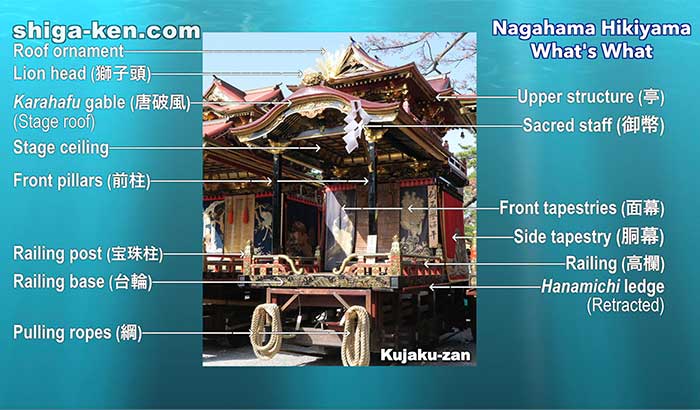
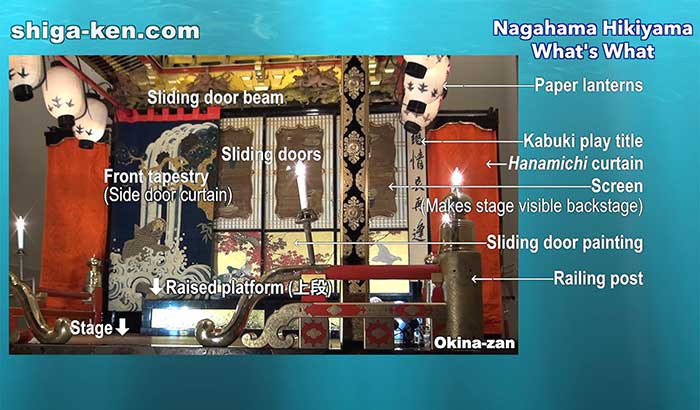
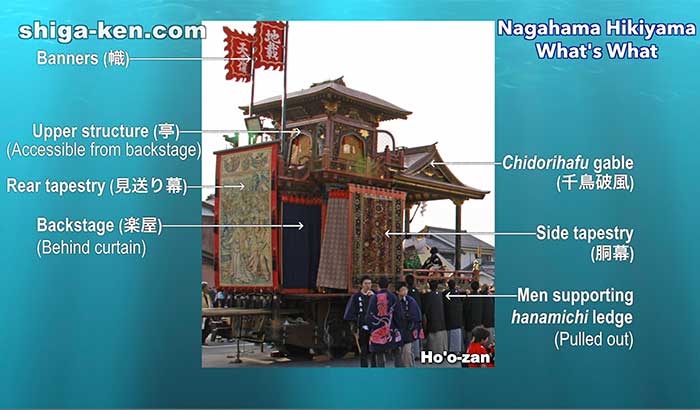
Nagahama Hikiyama Matsuri has 12 floats with a kabuki stage and one “guardian” float named Naginata-yama with no stage. The floats Each float belongs to a neighborhood in Nagahama. They come with festival musicians called shagiri.
Most of the floats were first built in the 18th and 19th centuries. They have been repaired and renovated as necessary, so they don’t look that old. They are very ornate with woodcarvings, metalwork, lacquered wood, paintings, and tapestries. “Art museum on wheels,” as they say in Japanese.
Nagahama Hikiyama Matsuri Festival 2026 Detailed Schedule
Here is a detailed schedule of Nagahama Hikiyama Festival events in 2026 (times are approximate, and delays may occur). Also see the festival map toward the end of this post. Most photos are screenshots from my video embedded above. Click on the photo to see the respective video segment.
April 9: Senko-ban Visitation (線香番)
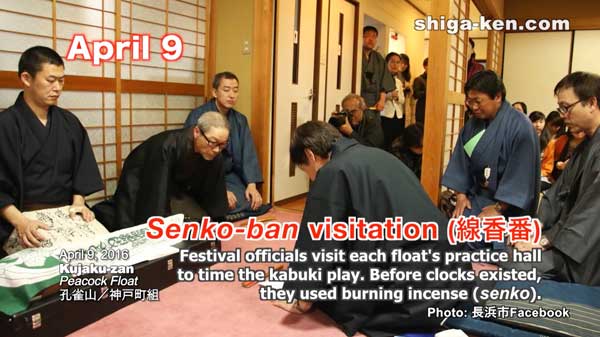
Senko-ban visitation has festival officials visiting the four floats’ kabuki practice halls in the evening to watch a kabuki rehearsal and time the performance. Before clocks were invented, they used a burning incense stick (senko) to measure the kabuki play’s length. This is also when the parents see their sons perform for the first time. However, the actors do not wear the makeup and costumes yet. This ceremony is not open to the public since the practice hall will be filled with the boys’ parents and relatives.
April 9–12: Hadaka-mairi Shrine Worship (裸参り)

For hadaka-mairi from 7:30 p.m. every night from April 9 to 12, scantily-clad young men (wakashu 若衆) from the four floats gather at their respective kabuki practice hall and parade to Nagahama Hachimangu Shrine where they pray and purify themselves by running around a well and splashing themselves with the cold well water.
They pray for a successful festival, healthy actors, and to draw a favorable lot on April 13 that determines the order of the floats’ performances. They all want to be Float No. 1 which performs first and goes home first on April 15 (main day).


From Nagahama Hachimangu Shrine, they march through Otemon-dori shopping arcade to Hokoku Shrine across town where they pray and splash in a well again.


On their last worshipping day on April 12, Otemon-dori shopping arcade has festival musicians and representatives from non-performing floats (i.e. those not performing in the festival this year) to greet the wakashu men. They play festival music (called shagiri 囃子) and offer cups of sake (rice wine) to the wakashu leaders and Kujitori-nin. They shout “Yoisa! Yoisa!” the whole time and drink a lot of sake. This is when to see hadaka-mairi.
You will notice that they wear different colored headbands. The young man wearing a red headband is the Kujitori-nin (籤取り人) who will draw the lot at the lot-drawing ceremony on April 13. The men wearing a blue headband are the guards (警護) who direct the wakashu. The men with a white headband are the rank and file. When a float’s wakashu pass by another float’s wakashu, a scuffle may break out since they are rivals in drawing lots. Quite a spectacle at both shrines and in-between.
April 12: Portable Shrine Procession (Mikoshi togyo 神輿渡御)
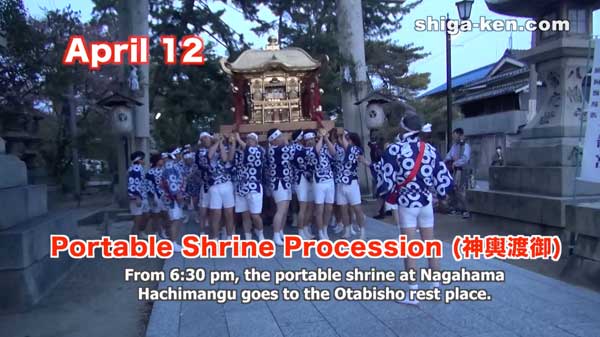
On April 12 from 6:30 pm, men carry a mikoshi portable shrine from Nagahama Hachimangu Shrine to the Otabisho rest place across town while shouting, “Yoisa!” They go through the Otemon-dori arcade and a few side streets. Along the way, festival musicians from other floats greet the portable shrine (no sake is served).
Nagahama Hikiyama Matsuri’s festival music is called shagiri (しゃぎり) instead of hayashi (囃子). The portable shrine was made in 1676 by Fujioka Kanbe’e (藤岡甚兵衛) with donations from shrine parishioners. The Fujioka family was a renown woodcarver and Buddhist altar maker in Nagahama.
The portable shrine brings the deity closer to the people and chases away evil spirits. They occasionally raise the portable shrine to wish happiness and safety to the people around it. The portable shrine arrives at the Otabisho at about 7:30 pm. The Otabisho is a rest place for the god traveling in a portable shrine. The portable shrine remains in the Otabisho until April 15 evening.
March–April: Kabuki practice (Closed to public)
If you can watch the boys practice kabuki, you will come to appreciate how much work it takes to put on a kabuki play. Sometimes they even break down and cry.


Kabuki practice at Kujaku-zan and Tokiwa-zan in 2016.
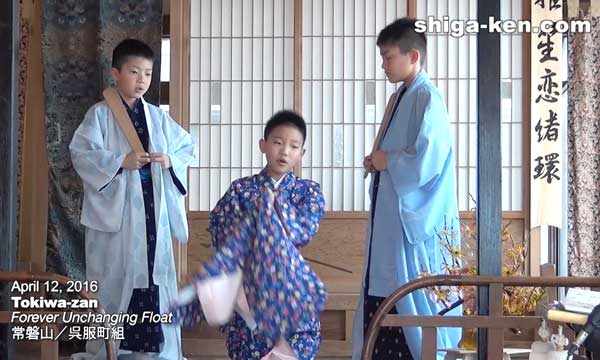
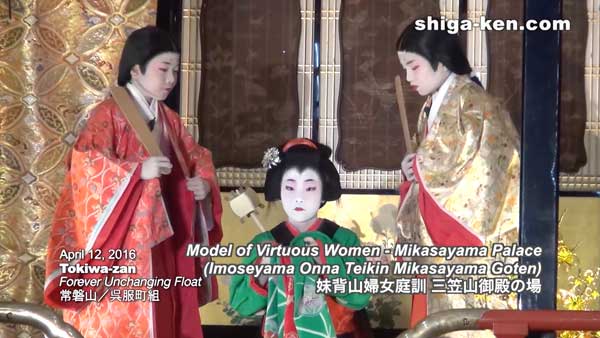
The kabuki play is directed by three instructors called San’yaku (三役): The choreographer, tayu narrator, and shamisen player. The choreographer casts the actors’ (yakusha) roles usually according to their physical attributes. The choreographer is usually an experienced kabuki actor and directs the actors’ movements and voice. The tayu narrates the story in a highly stylized manner like in kabuki. The shamisen player provides the only music played during the kabuki performance.
Since 1990, the Nagahama Hikiyama Cultural Association (長浜曳山文化協会) has been working to train local artists to become tayu narrators and shamisen players in the festival. In 2016, for the first time, all four floats had at least one locally-trained tayu narrator or shamisen player. Previously, they were all from outside Shiga.
Each performing float also publishes its own festival program booklet or brochure introducing the float and kabuki actors in Japanese. (If it has English, it’s usually not very good.)
April 13
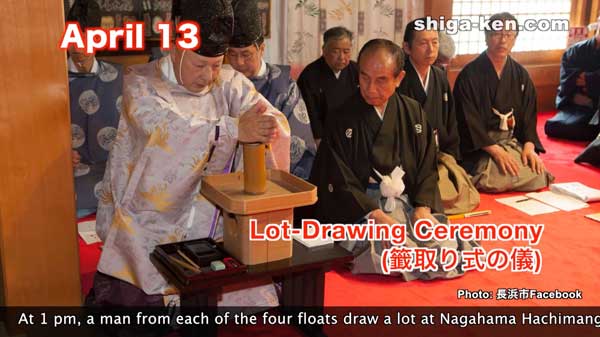
The main events on April 13 are the lot-drawing ceremony and the first kabuki performances in full costume for the public held in the evening.
Taiko Drum Call (起し太鼓)
Before dawn: At all float neighborhoods, a small team walk around and beat a taiko drum as a wakeup call.
Sacred Staff Receiving Ceremony (御幣迎えの儀)
7:00 a.m.: Representatives (including the Sacred Staff Messenger age 5–7) from the four floats go to Nagahama Hachimangu to receive their sacred staff (gohei zigzag paper streamers) to be mounted on their floats.
Lot-Drawing Ceremony (Kujitori-shiki 籤取り式の儀)
1:00 p.m.: This ceremony is held to draw lots to determine the order of the four floats’ kabuki performances. Being Float No. 1 is most desirable since they get to perform first on April 15 (main festival day) and can end early and go home early at the ned of the day. They also have the honor to host the Sanbaso prayer dancer who performs before their kabuki play.
At Nagahama Hachimangu Shrine, four unmarried lads representing the four floats wear a red headband (like they did at the Hadaka-mairi) and sit in front of the shrine priest inside the worship hall. They are the lot drawers (Kujitori-nin).
Four pieces of paper are written with float numbers one to four. Each piece of paper is crumpled into a ball and placed on a tray as a lot to be drawn. There is a tray for each lot, and each lot drawer selects and carries back a tray. While sitting together, they all open their paper lots at the same time to see who is Float No. 1, 2, 3, and 4.
The Lot-drawing ceremony is not for the public since the shrine’s worship hall is too small to allow the public inside to see the ceremony. However, you can see them from outside celebrating (throwing the lot drawer into the air, etc.).
April 13 Kabuki Performance (十三日番)
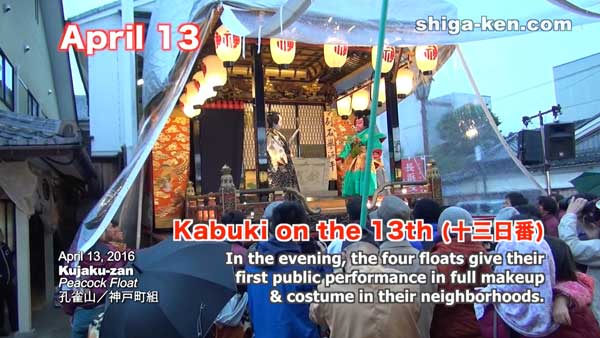


April 13 Kabuki Performance (十三日番)
6:00 p.m. to around 7:30 p.m.: The four floats hold their first public kabuki performances in full makeup and costume in their respective neighborhoods. They will start at 6:00 pm or 7:00 pm, depending on the float. (For exact performance times and locations, see the official festival guide book in Japanese or ask the tourist information desk at Nagahama Station.) Each float will perform kabuki only once or twice this evening.
In case of rain, the float will be covered with a tarp or moved to the shopping arcade for shelter.
About the Sanbaso dancer
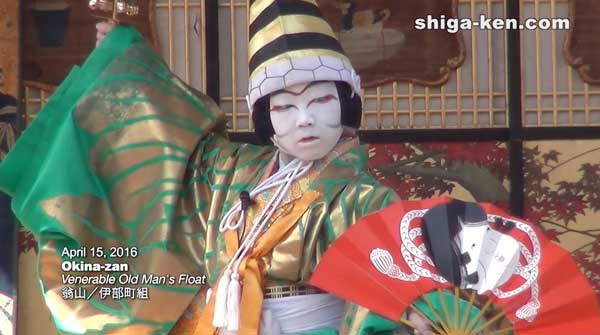
Float No. 1 receives the honor of hosting the Sanbaso dancer. The Sanbaso dances on Float No. 1 before the float’s kabuki play and he is the first performer on April 15 (main festival day) at the shrine. He holds a bell tree shaped like a ripe rice plant and performs prayer dances for a rich harvest.
The Sanbaso performs two short dance segments. The first segment is Momi-no-dan (stomping segment) where he waves his sleeves and stomps on the ground like he is preparing the ground for planting. He also does the “crow jump” (karasu-tobi) by jumping three consecutive times.
The second segment is Suzu-no-dan (bell segment) when the Sanbaso shakes his bell tree and mimes the planting and growing of rice. His costume has a crane design and his high cap has tiger stripes and a red sun on both sides.
The Sanbaso is a well-known dancer in Noh and kabuki. He comes from a Noh prayer dance called Okina (翁) dating from the 14th century as a religious ritual. Okina has three dancers praying for longevity, peace, endless joy, prosperity, and rich harvests. Sanbaso is the third dancer in Okina which is traditionally performed on auspicious and celebratory occasions like New Year’s and at the beginning of the day’s Noh or kabuki program. This is why he always appears first on the main festival day.
The Sanbaso dances each time the float performs during the festival days. The boy playing the Sanbaso is recruited from the public in Nagahama and he is around age 10. He has his own choreographer, tayu narrator, and shamisen player. Ciick here to see the Sanbaso video clip.
April 14 (Morning kabuki)
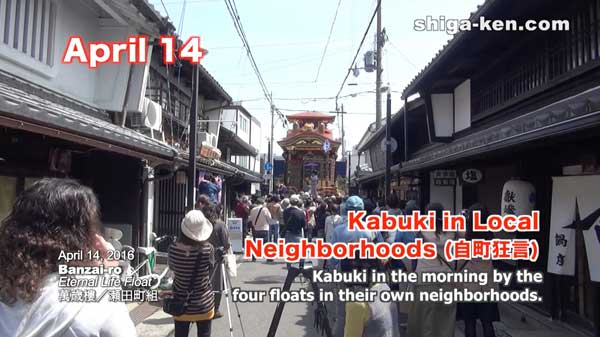


April 14, the day before the main festival day, is also a busy day. Lots to see/photograph.
Kabuki Performance in Local Neighborhoods (自町狂言)
April 14, 9:00 a.m. to 1:00 pm: Morning performances of kabuki plays are held by the four floats in their respective neighborhoods. The floats perform once or twice in the morning. For exact times and locations, see the official festival guide book in Japanese or ask the tourist information desk at Nagahama Station.
Floats Proceeding to Nagahama Hachimangu Shrine (Noboriyama 登り山)
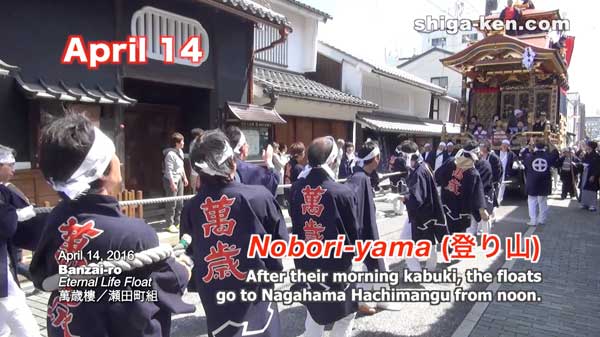
April 14, 1:00 pm to 4:30 pm: After they finish their morning kabuki performances, the four floats proceed from their neighborhoods to Nagahama Hachimangu Shrine. Float No. 4 arrives at the shrine first, followed by the others in reverse numerical order.


All four floats arrive at the shrine by 4:30 p.m. It’s a spectacle to watch them pull the floats through the streets and the shopping arcade as they shout “Yoisa! Yoisa!” It’s a stop-and-go process.


Meanwhile, the Naginata-yama float is pulled from its storehouse across town and arrives at the Otabisho rest place at 3:30 p.m. It is the only float that does not go to the shrine.
About the Naginata-yama “Long Sword Float” (長刀山/小舟町組)
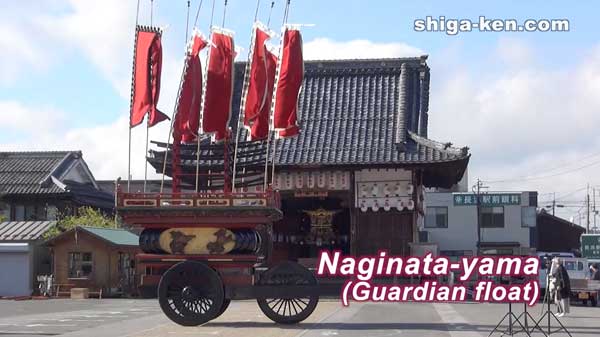


The Naginata-yama float is the only float with no kabuki stage. It’s an Imperial-style carriage with only three wheels. Carries banners and long swords. A ceremonial and “festival guardian” float appearing every year on April 14-15 only at the Otabisho.
On April 15, it will arrive 10:00 am at the Otabisho. It does not go to Nagahama Hachimangu Shrine. Built in 1775 with Chinese lion sculptures on four sides. It’s a nice float, but does not attract the crowds. It’s a quiet float.
After the Sword Procession on April 15, red banners are hoisted on the float. Before Float No. 1 arrives at the Otabisho in the late afternoon, Naginata-yama’s red banners are replaced by white ones bearing the Minamoto Clan’s crest.
The float’s caretaker is the Naginata-gumi association from the lakeside Kobuna-machi neighborhood (小舟町 now in Asahi-cho) where Minamoto Yoshiie landed for his victory march to Nagahama Hachimangu.
Evening Kabuki Procession (Yu-watari 夕渡り)

April 14, 7:00 p.m.: Evening procession of all the child kabuki actors in full costume walking from Nagahama Hachimangu Shrine to Nagahama Hikiyama Museum through Otemon-dori shopping arcade. A real crowd pleaser for locals and tourists alike.


It starts with kabuki actors from Float No. 4, then No. 3, 2, and 1. Occasionally, the actor will stop and pose for photographers.
Each actor is escorted by an adult relative (usually the father) holding a paper lantern and wooden placard indicating the actor’s name, age, and kabuki character. The procession includes festival musicians (no floats).


All the kabuki actors (and stagehands) are treated like royalty during the festival. They receive gifts from relatives and friends and are very much pampered by their parents for undertaking such a difficult and rigorous task of kabuki acting. (A few of them even do it more than once.)
The mothers have to make sure they don’t get sick or catch cold. This childhood experience stays with them for life and many of them come back to Nagahama to help out with the festival.
In recent years, the floats have had difficulty recruiting kabuki actors (and musicians) since there are fewer kids in their neighborhoods.
April 15 (Main festival day)
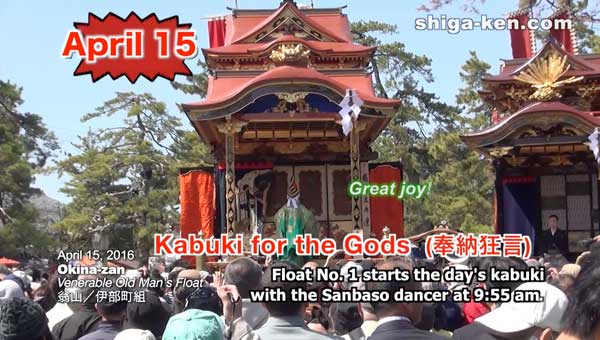
April 15: Main festival day (Honbi 本日)
The festival’s peak day with kabuki performances here and there in central Nagahama from 9:20 am to 7:40 pm. The four floats start at Nagahama Hachimangu Shrine where they perform in succession. This is their most important performance since it is for the gods.
Then they move through the Otemon shopping arcade until they all reach the Otabisho rest place. Each float performs three more times at different locations along the way (see map below).
Note that the floats can be prone to be late (especially in the evening), so the time schedule is only approximate.
If you live in central Nagahama, you might hear the Taiko Drum Call (起し太鼓) before dawn in the floats’ neighborhoods.
April 15 Events at Nagahama Hachimangu Shrine (Times are approximate.)
7:00 a.m.: Spring Festival Ceremony (春季大祭). A religious ceremony, not really for tourists.
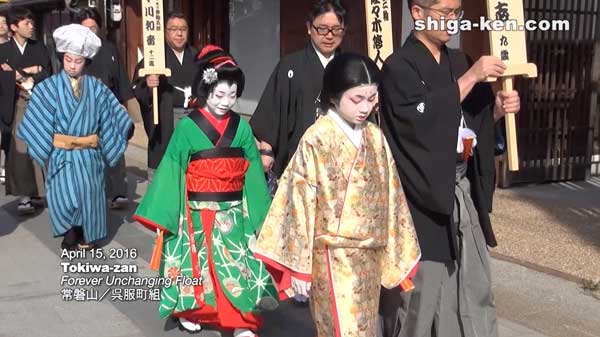
April 15, 8:30 a.m.: Morning Kabuki Procession Arrival (Asa-watari 朝渡り) of child kabuki actors arrive at Nagahama Hachimangu Shrine. If you are near the shrine at around 8:00 am, you may see the colorful processions heading to the shrine.


Sword Procession (Tachi-watari 太刀渡り)

April 15, 8:55 a.m.: Sword Procession (Tachi-watari 太刀渡り) of sword bearers arrives at Nagahama Hachimangu Shrine after going through Otemon-dori arcade. They leave their neighborhoods at 8:00 am.
Led by a golden sacred staff, this procession reenacts the Hikiyama Matsuri’s original samurai procession before floats were added. Young men (wakashu) wear ceremonial aprons (similar to sumo wrestlers) and young boys wear samurai armor and a long naginata sword (2–3 meters long).


They depict Minamoto no Yoshiie’s victory march to the shrine after he won the Gosannen War (1080s) in the Tohoku Region. Minamoto no Yoshiie was a famous samurai who founded Nagahama Hachimangu Shrine in 1069.
By the 16th century, Nagahama Hachimangu was ravaged by civil war, so Nagahama Castle Lord Toyotomi Hideyoshi moved and rebuilt the shrine at its present location further inland. He also used his own samurai retainers to restart the shrine’s annual festival procession dedicated to Minamoto no Yoshie. This was how the festival originated before floats and child kabuki were added.
The Sword Procession is conducted by the Naginata-gumi group which also pulls the Naginata-yama float. It has the Matajirohama beach (又次郎浜) where Minamoto no Yoshie landed for his victory march to the shrine.

After resting at the shrine for a short period, the Sword Procession goes to the Otabisho to mount their long swords on the Naginata-yama float.
Okina Maneki (翁招き) opening ritual

April 15, 9:05 a.m.: Okina Maneki (翁招き) is an opening ritual held in front of Float No. 1 to mark the start of kabuki performances. A long bamboo pole attached with a wooden placard is waved to the shrine and to Float No. 1 as a signal to start the festival and the festival music (flute) begins.
Float No. 1 is then moved into position for the first kabuki performance (opening with the Sanbaso dancer).
Kabuki performances at the shrine

9:20 a.m.–1:35 p.m.: Kabuki at Nagahama Hachimangu Shrine (Hono kyogen 奉納狂言) has the four floats perform kabuki at Nagahama Hachimangu Shrine in succession starting with Float No. 1. These performances are dedicated to the gods. Each kabuki play is about 40 min. long.
Although watching the kabuki is impressive without even understanding it, you would enjoy it more if you knew the kabuki story. Most of the kabuki plays are well known and you may be able to find an English description online. Sometimes the kabuki play includes something about Nagahama or Shiga or Kansai Region. For 2026, you can read my English synopsis of the four kabuki plays above.


After a float finishes a kabuki performance, it leaves the shrine and goes to the next performance location on the way to the Otabisho. The next float is then moved into position in the shrine to give its kabuki performance. So there is a break time between performances.


If you want to see all the kabuki plays on the four floats, one option is to stay at the shrine to see all of them. But it’s standing room only, so you may get tired standing for that long. There is paid seating, but they require advance tickets (costing a few thousand yen) sold in Feb. and usually sell out quickly. If you sit on the ground, you won’t be able to see the float since everyone is standing in front of you.
You can just watch one or two floats at the shrine, take a break, and watch the other floats at other locations and times. For kabuki performance times at the shrine and elsewhere, see the table below. All four floats will also perform at the Otabisho later in the afternoon and evening (also standing room only).
Each float has five or six kabuki actors and one or two stagehands. There used to be more actors like 10 or more per float, but there are fewer kids now. It’s also quite expensive to rent the kabuki costumes. Since each kabuki float performs every three years, that’s how long they have to raise money for the festival.
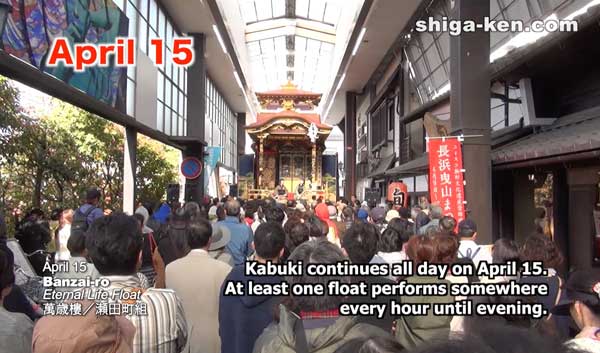
After performing at the shrine, each float will move across town mainly along Otemon-dori road (Kanaya Park, Otemon-dori shopping arcade, Kurokabe Square, etc.) to the Otabisho rest place. Along the way, they will stop and perform kabuki three more times with the last performance at the Otabisho by Float No. 4 ending at 7:40 p.m. Everything is within walking distance.

*The order of the floats’ performances is decided on April 13 by the Kuji-tori ceremony (籤取り式の儀) where they draw lots to see which float is No. 1, 2, 3, or 4.
The map below has a red line indicating the float route on April 15 and the kabuki performance spots along the way. To enlarge the map, click here.
| Float No./Location | 1. Hachimangu | 2. Shrine path | 3. Kanaya Park | 4. Hikiyama Museum | 5. Arcade intersection | 6. Kurokabe Square | 7. Otabisho |
|---|---|---|---|---|---|---|---|
| Float No. 1 | 9:20 am–10:05 am | 11:25 pm–12:10 pm | 1:10 pm–1:55 pm | 3:25 pm–4:10 pm | |||
| Float No. 2 | 10:35 am–11:15 am | 12:35 pm–1:15 pm | 2:15 pm–2:55 pm | 4:40 pm–5:20 pm | |||
| Float No. 3 | 11:45 am–12:25 pm | 1:45 pm–2:45 pm | 3:25 pm–4:05 pm | 5:50 pm–6:30 pm | |||
| Float No. 4 | 12:55 pm–1:35 pm | 2:45 pm–3:25 pm | 4;25 pm–5:05 pm | 7:00 pm–7:40 pm |
April 15 Otabisho Events
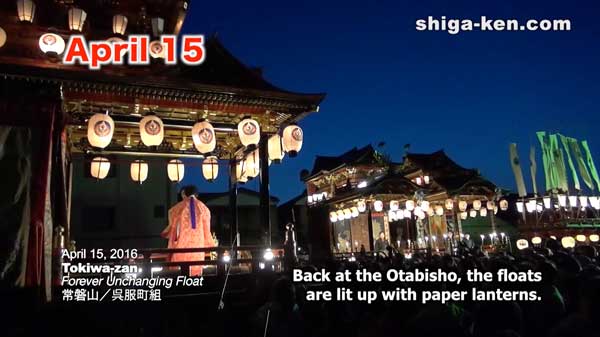
The Otabisho (御旅所) is a small shrine building in a large parking lot near Hokoku Shrine (short walk from JR Nagahama Station). It is where the portable shrine rests during its journey away from Nagahama Hachimangu Shrine. It’s only about 900 meters between Nagahama Hachimangu Shrine and the Otabisho.
The time schedule below is only approximate. Delays may occur. If you are visiting on a day trip and plan to stay until the end, be sure to check the time of your last train home.

April 15, 3:25 p.m.–7:40 p.m.: Successive kabuki performances are held by the four floats as they arrive at the Otabisho one by one. Float No. 1 will arrive first and start performing kabuki at 3:25 p.m. The last float (Float No. 4) is scheduled to finish its kabuki performance at 7:40 p.m.
The kabuki actors are whisked home right after their performance. They don’t stick around for the latter events. They are exhausted and need to sleep and be ready for the next day.
April 15, 8:00 p.m.: Portable Shrine Procession (Mikoshi togyo 神輿渡御)

After all the floats finish performing at the Otabisho, a short Shinto ceremony is held in the Otabisho building with shrine priests.

Then the portable shrine that was brought to the Otabisho on April 12 is taken out and carried around the Otabisho parking lot a few times before it returns to Nagahama Hachimangu Shrine. Note that it can get chilly this late in the evening, so dress warmly.

Returning Floats (戻り山)
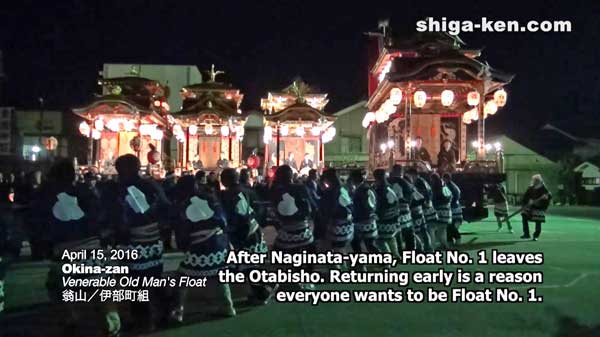
At around 8:30 p.m., the floats start to leave the Otabisho to return to their neighborhoods. Naginata-yama is always the first float to leave, followed by Float No. 1 and the other three floats in order.
The last Float No. 4 might leave pretty late. The floats go back to their neighborhoods. If you came to Nagahama by train and want to stay until the end, be sure to check your train schedule so you don’t miss your last train home.
April 16 (After Festival)
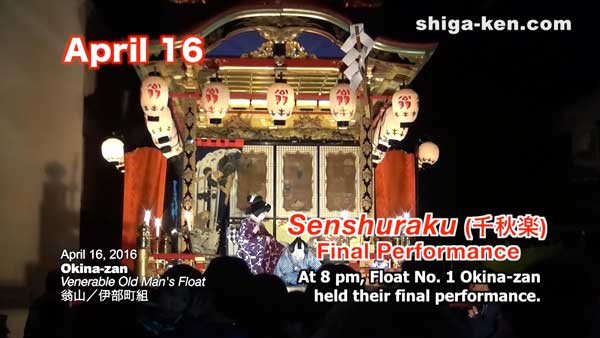
April 16: After-Festival Kabuki (Goen kyogen 後宴狂言)
9:30 am to 8:40 pm: The four floats will perform kabuki three or four times this day in their respective neighborhoods in central Nagahama or at the Nagahama Bunka Geijutsu Kaikan hall for a paying audience from 11:20 a.m. (Floats won’t appear at the Kaikan hall, only the kabuki actors and musicians.)
Between the performances, the floats might move to another location within their neighborhood. This will be the last day to see child kabuki.


Each float’s final performance of the festival is called senshuraku (千秋楽). It starts as early as 6:30 p.m. and as late as 8 p.m. For exact times and locations, see the official festival guidebook in Japanese or ask the tourist information desk at Nagahama Station. Expect to see some tearful kids and relieved parents after the last show is over.
April 17: Sacred-Staff Returning Ceremony (御幣返しの儀)
8:00 am: Representatives (including the Sacred Staff Messenger around age 5–7) from the four floats go to Nagahama Hachimangu to return their sacred staffs (zigzag gohei paper streamers) that were mounted on their floats.
Nagahama Hikiyama Festival Map
The map below shows the float procession route on April 15 and the location of all Nagahama Hikiyama floats. See their neighborhood kabuki performances (on April 13, 14, 16) near their respective float storehouses on the map.
Tips for seeing the Nagahama Hikiyama Festival

- When you arrive at JR Nagahama Station, go to the tourist information center outside the turnstile (go right) and ask for the kabuki performance schedule, locations, and map. There might also be an information desk right outside the turnstile. Hopefully, they can understand foreign languages.
- On April 15, the main day, all four floats will perform kabuki in succession (40 min. each) at Nagahama Hachimangu Shrine from 9:20 am to 1:35 pm. The shrine will also have announcements in English. (Guess who was the English coach.)
- Or if you arrive Nagahama later in the day on April 15, you can see all four floats perform in succession at the Otabisho (large parking lot) near Nagahama Station from 3:25 pm to 7:40 pm when the last performance ends.
- You can also see kabuki between Nagahama Hachimangu Shrine and the Otabisho (see map below) as the floats stop and perform especially at the Otemon-dori shopping arcade and Kurokabe Square. You can see the floats up close (artwork, etc.) while they are parked.
- Each of the four floats will perform kabuki four times on April 15 for a total of 16 kabuki performances. So there will be a kabuki performance once or twice every hour from 9:20 am to 7:00 pm (ending at 7:40 pm). The goal is to see kabuki on all four floats.
- Be aware that it is “standing room only” for all kabuki performances. It can be tiring to watch all four kabuki performances while standing. You could bring a collapsible chair, but people standing in front of you will block your view. Instead of seeing all four kabuki plays in succession, best to take a break in-between and see the next one at a later time and place.
- For food, there are restaurants and eateries in and near Otemon-dori arcade and Kurokabe Square.
- If you plan to see the festival in the evening, the temperature can get much cooler so bringing a jacket is advisable.
- In case of rain, wear a raincoat or poncho. Umbrellas are discouraged because it will block people’s view behind you.
- You can see Nagahama Hikiyama floats year-round at the Hikiyama Museum next to Otemon-dori arcade.
Origin of Nagahama Hikiyama Matsuri Festival

According to popular legend, when Toyotomi Hideyoshi was the lord of Nagahama Castle, his first son Hashiba Hidekatsu was born in the early 1570s. To celebrate his son’s birth, Hideyoshi gave gold dust to the townspeople. The people used the gold to make a wooden float to celebrate the son’s birth. Hideyoshi paraded the float at Nagahama Hachimangu Shrine. This was the start of the Nagahama Hikiyama Matsuri. This legend is often repeated, but it is not true.
Nagahama Hikiyama Festival actually originated from an annual samurai procession held by Nagahama Hachimangu Shrine founded in 1069 by the famed samurai Minamoto no Yoshiie (1039-1106). The shrine worships Hachiman (Emperor Ojin), the divine guardian of samurai. (Not the God of War as popularly called.)
In the late 16th century, daimyo Toyotomi Hideyoshi relocated the shrine to make way for his Nagahama Castle on the shore of Lake Biwa. At the same time, Hideyoshi rebuilt Nagahama Hachimangu that had been ravaged by war. The shrine’s annual samurai procession dedicated to Minamoto no Yoshiie was also resurrected with Hideyoshi’s samurai retainers.
By the 18th century well after Hideyoshi’s death, the samurai procession became more elaborate with wooden floats being added. When kabuki became popular in the 18th century, Nagahama’s townspeople thought about staging kabuki on the floats.
They asked the prominent carpenter and woodcarver family of the late Fujioka Izumi (1617–1705) to design a float having a kabuki stage. The early floats were much simpler than today’s floats. The Fujioka family went on to design and build many of the floats since they were master builders of Buddhist altars. That’s why the floats look like Buddhist altars.
The idea of staging kabuki on festival floats spread from Nagahama to other float festivals such as the Tarui Hikiyama Matsuri in nearby prefectures like Gifu.
More info

For festival details in Japanese, see or download the official festival guide book pdf.
For more information about the Nagahama Hikiyama Festival in English and all the floats, watch my YouTube video (embedded above). It’s the most comprehensive video about the festival in English. Being 91 min. long, it’s a long video, but you’ll learn a lot and enjoy the festival a lot more by knowing more about it and knowing what to expect.
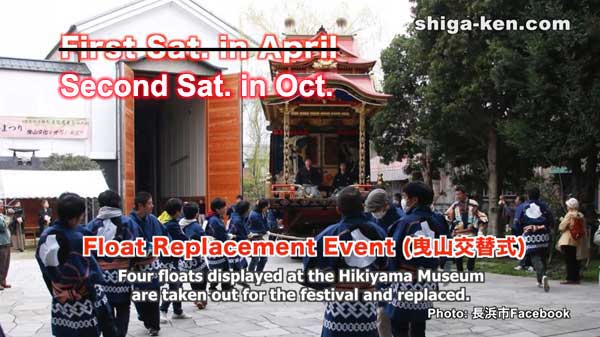
Second Sat. in October (Oct. 10, 2026): Float Replacement Event (曳山交替式)
9:00 a.m. to 4:00 p.m.: The hikiyama floats exhibited in the Nagahama Hikiyama Museum will be pulled out and taken back to their neighborhoods. Then the four floats appearing in next year’s festival will be brought into the museum to be displayed. This event used to be held on the first Sat. in April, but it’s now held on the second Sat. in October since 2019.
For the April 2027 Nagahama Hikiyama Matsuri, the Gekkyuden, Kasuga-zan, Kanko-zan, and Seikai-zan floats will appear.
In April 2028, the Kotobuki-zan, Shojo-maru, Takasago-zan, Ho’o-zan floats will appear. In April 2029, the same floats appearing this year in 2026 will appear again.
Related sights
All the following sights are within walking distance from JR Nagahama Station.
Nagahama Hachimangu Shrine (長浜八幡宮) – Shinto shrine in Nagahama that holds the annual Nagahama Hikiyama Matsuri Festival in April. The shrine is dedicated to Hachiman, the divine guardian and protector of the samurai. It’s also city’s most popular shrine on New Year’s Day. About 150,000 people worship at the beginning of the new year. Map
Nagahama Hikiyama Museum (長浜市曳山博物館) – Located next to Otemon-dori shopping arcade, Hikiyama Museum displays two hikiyama floats and artifacts related to the annual Nagahama Hikiyama Matsuri Festival. Open 9 am–5 pm, closed Dec. 29–Jan. 3. Adult admission ¥600, children ¥300. Map
Otemon-dori shopping arcade (大手門通り) – Otemon arcade is one of Nagahama’s main shopping areas for both residents and tourists. It has a roof so it is convenient even on rainy days. On April 14 evening, the child kabuki evening procession goes through Otemon arcade. And on April 15 in the afternoon, all the hikiyama floats pass through and perform inside Otemon arcade. Map
Kurokabe Square (黒壁スクエア) – Right next to Otemon arcade, Kurokabe Square is one of Shiga’s most popular tourist attractions. It’s a charming shopping area with traditional buildings like the popular glassware shop housed in an old bank building with black walls called “kurokabe” in Japanese. Opened in 1989. Map
Otabisho rest place (御旅所) – The Otabisho is a small shrine building where the god traveling in a portable shrine can take a rest. It is part of the Shinto shrine (Nagahama Hachimangu) and located a short distance away from the main shrine. In the case of Nagahama Hikiyama Festival, the Otabisho is used to keep a portable shrine during the festival and serves as the final gathering place for all four hikiyama floats for their final kabuki performances on April 15. Map
Hokoku Jinja Shrine (豊国神社) – Dedicated to Toyotomi Hideyoshi, the founder of Nagahama when he built Nagahama Castle in the 16th century. During the Nagahama Hikiyama Festival, this shrine is where the Hadaka-mairi water splashing prayers are held on April 9th–12th evenings. This shrine is a 3-min. walk from Nagahama Station and close to the Otabisho. It also holds the Toka Ebisu Festival (十日えびす) on Jan. 9th-11th. Ebisu is one of the seven gods of good fortune. Map
Nagahama Castle and Hokoen Park (長浜城・豊公園) – Nagahama Castle is a lakeside castle within a large park named Hokoen. The original castle was built by Toyotomi Hideyoshi in the 16th century who lived in Nagahama Castle until 1582. The current castle tower was reconstructed in 1983. It serves as a local history museum. Hokoen Park is designated as one of Japan’s 100 Best Cherry Blossom spots in April. Plum blossoms also bloom in March. A short walk from Nagahama Station (west side). Map