Shiga News – by Philbert Ono Rotating Header Image

Lake Biwa Rowing Song

Entries for Lake Biwa Rowing Song (Biwako Shuko no Uta).

In Chunichi Shimbun

Today’s (June 5, 2007) Chunichi Shimbun (Biwako-ban page) ran an article about my photo exhibition in Imazu.

http://photoguide.jp/pix/displayimage.php?album=587&pid=17362

http://www.chunichi.co.jp/article/shiga/20070605/CK2007060502021591.html

Lake Biwa Rowing Song photo exhibition at Yokaichi

I have a Lake Biwa Rowing Song photo exhibition at Yokaichi Public Library (2nd floor gallery) until May 20. 

I will be at the gallery on Sat. the 12th from lunch time until maybe 2 pm or so. If you have time to visit, please come! 

There will be a CD player playing my CD. The gallery is also like a coffee shop where you can sit down and drink coffee and talk.

Int’l event in Okaya, Nagano

Nakamura Naoko singing "Lake Biwa Rowing Song."

The city of Okaya in Nagano-ken held a major int’l event on March 4:
http://www.oiea.jp/jpn/aboutus/other/15thanniversary.htm

I participated by having a small exhibition about Biwako Shuko no Uta. The twin sisters who sang the song in Shiga could not attend, so I was delighted that the Okaya people found someone to sing the song in English in Okaya.

So the English version was sung in public for the first time outside Shiga, and for the first time in public by a Japanese person.

The singer was a college student, and she was chosen by her choir director to sing the song. Even though her pronunciation was not perfect, she sang it quite well. She didn’t know much about the song’s background, so I explained about it before she sang. She had only 2 weeks to practice, and sang three verses (out of six).

The event itself was very successful. Pictures here:
http://photoguide.jp/pix/thumbnails.php?album=515

Japanese speech contest by Shiga foreigners

On Feb. 25, 2007, a Japanese speech contest for foreigners in Shiga was held at the Viva City Hall in Minami-Hikone. Thirteeen non-Japanese from eight countries gave 6-min. speeches in Japanese to a full-house audience.

One of the contestants was Jamie Thompson who is an ALT on the JET Program in Konan, Shiga. She happens to be one of the singers who sang my English version of Biwako Shuko no Uta (Lake Biwa Rowing Song). The title of her speech was “Biwako Shuko no Uta no Boken” 琵琶湖周航の歌の冒険 which can be translated as “Biwako Shuko no Uta Adventures.”

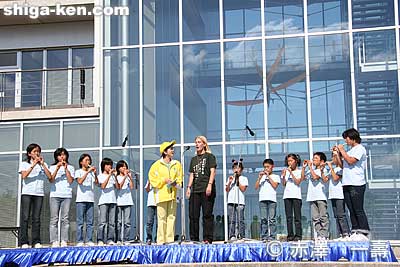
She started off by singing the first line of the song in Japanese (Ware wa umi no ko, sasuraino). Then talked about how she joined the local choir in Shiga and learned about the song and later meeting me online and agreeing to sing my English version of the song. She talked about when we announced the song to the public in June 2006 in Imazu, and how she and her sister Megan got on the NHK Nodo Jiman TV show (broadcast nationally) last Nov. (Details here. )

It was certainly one adventure after another. And now she can add one more adventure to the list because she WON this speech contest. Wow, I was dumbfounded.

Congratulations to Jamie. She received many prizes from sponsors like a case of Kirin beer, 5 boxes of curry mix, cruise tickets to Chikubushima, some money, a certificate, a plaque, and other stuff.

The speech contest was covered by the Feb. 26 morning edition of the Mainichi Shimbun and Kyoto Shimbun newspapers.

http://photoguide.jp/pix/displayimage.php?album=587&pid=17367
http://photoguide.jp/pix/displayimage.php?album=587&pid=17368
http://photoguide.jp/pix/displayimage.php?album=587&pid=17366

Event notice: BNN Japanese speech contest by non-Japanese

To held on Feb. 25, 2007 at Hikone Viva City Hall, this is a Japanese speech contest by non-Japanese in Shiga. One of the contestants is Jamie Thompson, a JET ALT in Konan-shi. She is one of the twin sisters who sang my English version of 琵琶湖周航の歌 (Lake Biwa Rowing Song). 
http://photoguide.jp/txt/Biwako_Shuko_no_Uta 

Her speech will be about the song. I will be attending this event, and there will also be a 交流会 afterward. So if you have time that afternoon, please come and we can have an オフ会 and I’ll introduce you to Jamie. Let me know if you can come so we can meet somewhere. 

The speech contest is organized by the びわこ日本語ネットワーク。 
http://www.biwa.ne.jp/~bnn/

Visit to Okaya, Nagano

In January, I visited Okaya, Nagano and met with a few members of the int’l exchange association and introduced this English song. They were very interested because the song was written by Oguchi Taro 小口太郎 who was from Okaya. He’s famous in Okaya and there’s a statue of him in the city, at Lake Suwa and inside Okaya City Hall. 
http://photoguide.jp/pix/thumbnails.php?album=182 

Oguchi was a student at Kyoto University when he wrote the song during a rowing trip on Lake Biwa in 1917. 

One of the people I met in Okaya knew a friend who lived in the same neighborhood as Oguchi Taro. So the next day, they took me to see his grave and his home in the Minato area where they had a big mudflow last year (but Oguchi’s neighborhood was unaffected). I prayed at his grave (still lots of snow, as you can see in the pictures). It’s a sad story about Oguchi because he committed suicide and died at age 26 in 1924. He was depressed over being drafted into the army and also over a girl. He was a brilliant person with a promising career in science and technology. 

Okaya is actually where I first heard the song in 2004 when I visited Okaya for the first time during the Onbashira Matsuri. I found the song monument and his statue at Lake Suwa by coincidence. Very surprised to see the word “Biwako” at Lake Suwa. 

On March 4, the Okaya int’l exchange association will hold an event and I plan to hold a small photo exhibition to introduce the English song. 
http://www.oiea.jp/jpn/aboutus/other/15thanniversary.htm 
http://www.oiea.jp/jpn/aboutus/lectures/cwnichol.htm

500 people sing “Biwako Shuko no Uta” (Lake Biwa Rowing Song)

The Kyoto University Rowing Club celebrated their 100th anniversary on Dec. 9, 2006.
500 people sang the song “Biwako Shuko no Uta” (Lake Biwa Rowing Song).
See the video here:

Re: NHK Nodo Jiman

My English version of the song, “Biwako Shuko no Uta” (Lake Biwa Rowing Song) was sung on national television for the first time on Nov. 26, 2006 on NHK TV’s “Nodo Jiman” amateur singing contest. This  show is broadcast live on Sundays from a different location each time. This time it was beamed from Mitoyo, Kagawa Prefecture.

The singers were twin sisters Jamie and Megan Thompson whom I met earlier this year and agreed to sing my English song in public on June 3, 2006 when the song was first unveiled.

They applied to appear on the show and lo and behold they were one of the 20 entrants chosen to appear on this show. They sang only the first verse of the song as they had only 1 min. to sing. The next minute was spent chatting with the MC. So they were on stage for about 2 min., which was longer than most other entrants who stood in the spotlight for about 90 sec. or less.

After about 1 min. of singing, a chime is rung once, twice, or three times to rate the singer. Three chimes mean the singer has passed (gokaku) to become a finalist. Two chimes is what most entrants receive. (No one gets a single chime.) Out of the 20 entrants, 5 or 6 of them receive the “gokaku” rating. Out of these finalists, the show’s “Champion” is selected. The Champion of each show later appears in a special “Champion Contest” Nodo Jiman show held later. (Nodo Jiman literally means, “Boastful Throat.”

The show was broadcast for 45 min. from 12:15 to 1 pm. Two guest celebrity singers also appear on the show and this time it was Fuji Ayako and Toba Ichiro. Fuji-san gave the sisters very gracious comments, “Such a beautiful harmony. It was wonderful!” 「とても美しいハーモニーです。素晴らしかったですね!」

I guess I have to run out and buy her CD in appreciation. There was a live audience of 1,500 in Mitoyo gymnasium. At the end of the show, they chose a high school girl from Takamatsu (capital city of Kagawa) to receive the Champion Award.

“Biwako Shuko no Uta” is Shiga’s most famous song and famous nationally. It is about a rowing trip around Lake Biwa where they visit lake’s famous spots. More details about the song is here:
http://photoguide.jp/txt/Biwako_Shuko_no_Uta
http://photoguide.jp/txt/Lake_Biwa_Rowing_Song

Thanks to everyone who watched the show!

NHK “Nodo Jiman” 出場します!

–速報– 

明日の26日にNHK総合テレビ「のど自慢」の番組に出場します! 

歌は「琵琶湖周航の歌」の英語版です。私が作成した英語版がアメリカ人の姉妹、Jamie & Megan Thompsonが出場して歌います。

11月26日 12:15〜13:00 NHK総合テレビ 
http://www.nhk.or.jp/nodojiman/

今日、その予選会が開催されて姉妹が通過しました!! 

明日の「のど自慢」は、Meganさん在住の香川県三豊市から生中継。僕は東京にいますが、テレビで見ます。

My English version of “Biwako Shuko no Uta” will be performed on NHK TV’s famous “Nodo Jiman” amateur singing contest tomorrow on Nov. 26 at 12:15 pm to 1 pm.

The song will be sung by  Jamie & Megan Thompson who passed the preliminary screening today. The show will be broadcast live from Mitoyo, Kagawa Prefecture.

NHK Radio Asaichi-ban

A radio program named “Radio Asaichi-ban” will start at 5:18 am. Later at 5:45 am, they will have a segment called “Furusato Asaichi Report” for 5 min. They will introduce my English version of 「琵琶湖周航の歌」(Lake Biwa Rowing Song). A reporter in Takashima-shi will introduce the song and play it. I won’t appear on the show though. If you are awake that early, please tune in. 

http://www.nhk.or.jp/radiodir/shou/asa/asa.html 

周波数案内 

http://www.nhk.or.jp/res/tvres5/h50302.htm 

2006年9月25日にNHKラジオ第一放送の「ラジオあさいちばん」という早朝の番組の「ふるさとあさいちリポート」のコーナーで午前5:45に「琵琶 湖周航の歌」の英語版が5分間ほど紹介されます。私が作った英語版です。レポーターは高島市の方です。私は番組に出演しません。全国放送。

Biwako Shuko no Uta videos

I found a few videos at YouTube for this song in Japanese.
My favorite is one of John Denver singing the song with Minami Kosetsu and Kato Tokiko in Shiga in 1984 (after Country Roads):

This nice video (2 parts) was made by Kyoto Univ. Rowing Club’s OB in Dec. 2006. It is a mixture of still photos and movies. Many of the photos were taken by me. You can see my name in the credits in the end:

This is Baisho Chieko singing the song. Looks like during the 1970s. (Probably illegal uploading.)
http://www.youtube.com/watch?v=ALIuou3mE48

This is a video I took at Okaya, Nagano where the Oguchi Taro song monument is. There’s a sound box which plays the song when you press a button:

「琵琶湖周航の歌」が外国人弁論大会に優勝

2007年2月25日に滋賀県彦根市で開催された「外国人による日本語スピーチ大会」にJamie Thompsonが優勝(最優秀賞)しました。Jamieは、私が作成したこの歌の英語版を歌ってくれた人です。

この大会は、滋賀県内に日本語を勉強している外国人のための日本語弁論大会。今年で3回目。滋賀県知事の代理や、彦根市長、滋賀議員などの来賓も来ました。審査員に國松前知事もいました。残念ながら嘉田知事が来れませんでした。

Jamieのスピーチは、「琵琶湖周航の歌の冒険」でした。歌の英語版に関わった出来事と発表経緯が紹介された。昨年に今津での発表会、CDレコーディング、NHKのど自慢の出場などの話。スピーチは6分しかできないので全部話したかったことができなかったけど、13名のうちになんと優勝!!

表書状、男性用の電子カミソリ、1ケースのビール、カレー、竹生島のクルーズ券、と沢山もろた。

そして総合の評価をした審査員が突然に「一度、例の英語版の歌を歌ってくれないか」と頼まれてちょっとびっくりしたJamieが見事に2番まで歌いました!!僕も泣きそうだった。来場者300人。ホールがいっぱい。

今日の毎日新聞の朝刊の滋賀版にこの弁論大会を大きく報道された。中日新聞も記事が載りました。

http://photoguide.jp/pix/displayimage.php?album=587&pid=17367
http://photoguide.jp/pix/displayimage.php?album=587&pid=17368
http://photoguide.jp/pix/displayimage.php?album=587&pid=17366

そして来週の日曜日(3月4日)に長野県岡谷市の国際交流協会が国際集いを開催します。そこにも現地の一人の女性がこの英語版を歌います。私も出席して歌を紹介します。歌の写真展もやります。

http://www.oiea.jp/jpn/aboutus/other/15thanniversary.htm

*岡谷市は、歌を作詞した小口太郎の故郷です。

Lake Biwa photo exhibition in Otsu, Shiga

I will hold a small photo exhibition in Otsu, Shiga Prefecture to show pictures of Lake Biwa based on the well-known song, “Biwako Shuko no Uta” or Lake Biwa Boating Song. (琵琶湖周航の歌)

Made famous by singer Tokiko Kato in 1971, the song is about a bunch of Kyoto University college students in the college boating club in 1917 who rowed in a sleek, wooden racing boat around Lake Biwa starting at Otsu and stopping overnight at Omi-MaikoImazu, and Hikonebefore returning to Otsu. It was the boat club’s tradition to row around the entire lake every summer.

The song mentions famous places in Lake Biwa and also symbolizes life itself. The song was written by Taro Oguchi (1897-1924), a member of the boating club and native of Okaya, Nagano Prefecture. The melody was based on a song called Water Lilies (Hitsuji-kusa) by Chiaki Yoshida (1895-1919) from Niigata Pref. who never knew that his melody was used for the song.

It was during the second night of their boating trip in June 1917 in Imazu, in the northwest corner of Lake Biwa, when Oguchi first showed his lyrics to his boatmates. One boatmate suggested that the Water Lilies melody went well with the lyrics, so it stuck and they sang the song together for the first time, even while rowing on the lake.

It’s sad that both Oguchi and Yoshida died in their early 20s. Both were extremely talented and would’ve accomplished much if they had lived longer. The song has a very intriguing mystique. Some of the words are incomprehensible, doesn’t make sense, or just plain wrong. It was not a seriously written song.

It nonetheless went on to become very popular in Japan and many famous singers like Peggy Hayama, Miyako Harumi, Frank Nagai, and Kobayashi Akira have covered it. Nini Rosso even played a trumpet version.

The town of Imazu even has a nice museum dedicated to the song. It points out all the mistakes and mysteries of the song, but does not shed much light on all the questions. There’s a listening corner where you can don headphones and listen to all the cover versions of the song (it can take at least an hour). The town also holds an annual choir singing contest in June for that song. Choir groups from around the country enter the contest just to sing that song.

Also, Shiga Prefecture has six monuments dedicated to this song. Each one is dedicated to one of the six verses of the song covering the following six places: Otsu (Mihogasaki), Omi-Maiko, Imazu, Chikubushima, Hikone, and Chomeiji. The song monument in Hikone (for verse No. 5) was recently unveiled in Oct. 2005. And the city of Okaya in Nagano Prefecture also has a monument for the song and its composer, Taro Oguchi, a native of Okaya.

The mysterious meaning of the lyrics, the way it was created, the story behind the people who created it, the nostalgic reflection of a certain time and place in the past, and its national fame all combine to make it a very interesting song to study.

I had never even heard of it (it was before my time) until last year in April 2004 when I was in Suwa, Nagano to see the Onbashira Festival. I stayed in Okaya city on the shores of Lake Suwa. I walked around the lake and came across a statue of Taro Oguchi. It even had a sound box where you could hear the song. The lyrics were also displayed and I immediately found it intriguing.

For this exhibition, I have created my own photographic rendition of the places and scenes mentioned in the song and the six monuments dedicated to the song. I used Photoshop to composite images and to alter the colors into a dreamy condition as the song suggests. I also translated the lyrics into English. Call it “Lake Biwa Boating Song in Pictures and in English.”

Place: Shiga Kaikan Bunka Salon Gallery (滋賀会館文化サロンギャラリー)
5-min. walk from JR Otsu Station.
Map: http://www.shiga-bunshin.or.jp/shigakaikan/map.html
Address: Kyomachi 3-4-22, Otsu, Shiga Pref.
Phone: 077-525-9995
〒520-0044 大津市京町三丁目 4-22
Web site: http://www.shiga-bunshin.or.jp/shigakaikan/

Date & Time: Nov. 21 to Dec. 4, 2005, 9:30 am to 5:00 pm, closed Mon.

The gallery is actually inside a salon-type coffee shop. It’s a nice space (see image below).

Update: I now have an online version of the exhibition:
http://photoguide.jp/pix/thumbnails.php?album=155

And video here:
Lake Biwa Rowing Song music video